



Deepam ruling in a nutshell: Why it’s a rebuke of DMK govt’s ‘meaningless’ stance
Devotees, right-wingers celebrate “victory for tradition”; dargah representatives disappointed, fear encroachments; TN govt announces intention to appeal in SC

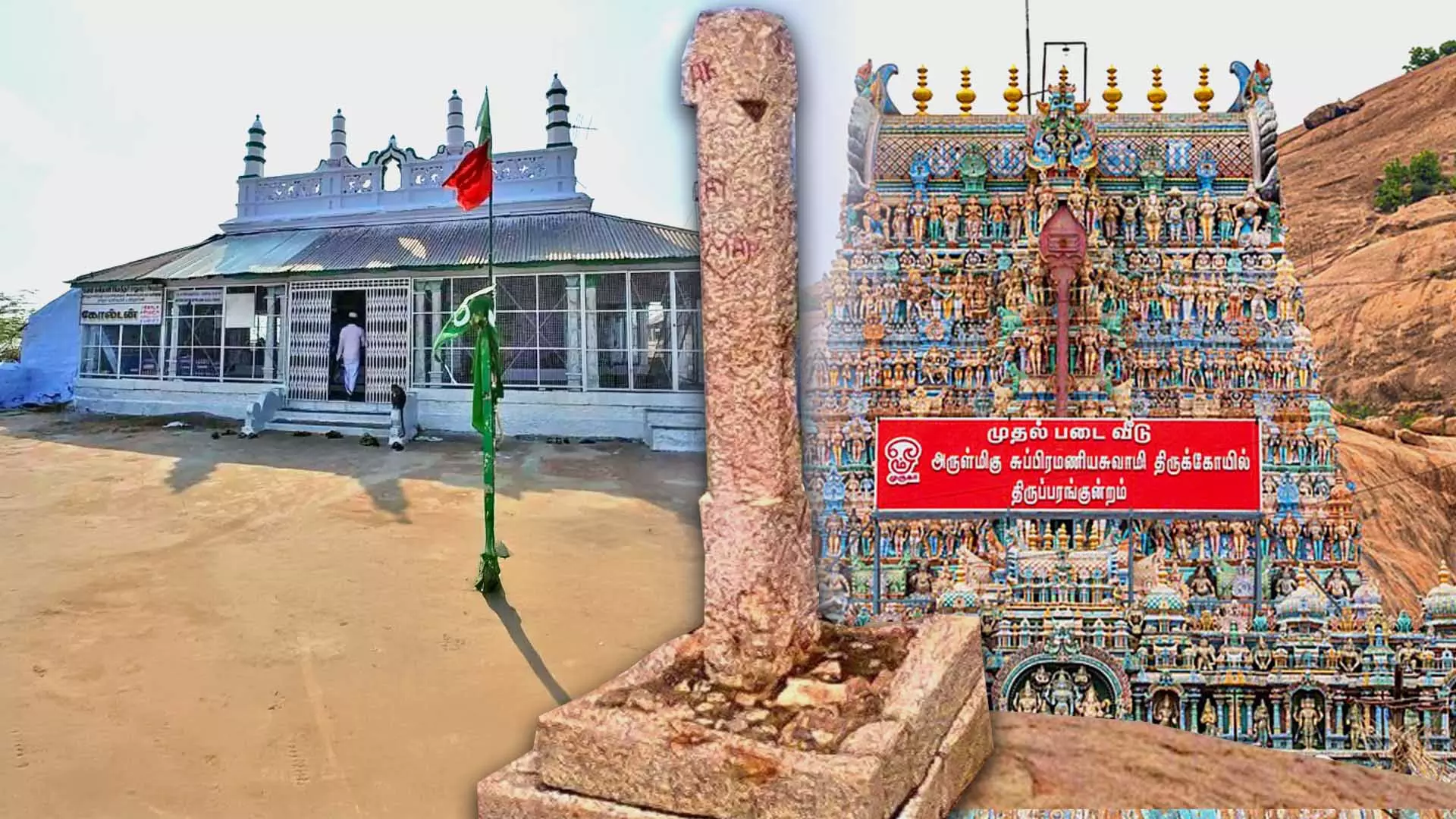
In a landmark ruling that underscores the interplay of religious customs, property rights, and communal harmony, the Madurai Bench of the Madras High Court on Tuesday (January 6) dismissed a batch of writ appeals, affirming a single judge’s order to light the Karthigai Deepam (festival lamp) at the historic “Deepathoon”, a stone pillar on Thiruparankundram hill, in addition to traditional sites.
The verdict, delivered by Justices G Jayachandran and KK Ramakrishnan, has reignited debates on temple administration, interfaith relations, and the role of the State in preserving ancient practices amid modern sensitivities.
The judgment comes amid heightened tensions between Hindu devotees and Muslim representatives over the shared sacred hill, home to the ancient Arulmigu Subramania Swamy Temple at its base and the Hazarath Sultan Sikkandar Badhusha Avuliya Dargah at the summit.
Also read: Madras HC upholds lighting of deepam at Thiruparankundram hilltop with curbs; Stalin to move SC
Critics, including human rights advocate Sridhar Subramaniam, have hailed the ruling as a rebuke of the Tamil Nadu government’s “meaningless” stance, while urging constructive engagement to foster unity rather than division.
What history says
Thiruparankundram hill, rising about 1,050 feet in Madurai district, is steeped in millennia-old history. Revered as one of the six abodes of Lord Murugan (Subramania Swamy), the hill features a cave temple at its foothills, dating back to the Pandya era (6th-9th centuries CE).
Ancient Tamil literature, including the Sangam-era epic Paripadal, describes it as a site of divine worship, with natural features like springs, Jain rock beds, and Brahmi inscriptions from the 2nd century BCE attesting to its multi-faith past, including Jain monastic activity before Hindu dominance.
The dargah, dedicated to Sultan Sikandar Badusha (a 13th-century Sufi saint), crowns the hilltop, symbolizing centuries of syncretic traditions. However, ownership disputes have simmered since colonial times. In 1920, the temple authorities sued the dargah trustees in O.S. No. 4 of 1920, claiming the entire hill as temple property.
Also read: Deepam row: Union Minister Murugan accuses DMK of 'disrespecting' Constitution
The Privy Council in 1931 (AIR 1931 PC 212) upheld the temple’s ownership of most of the hill, including shrines, paths, and unoccupied lands, while granting the dargah limited rights to its mosque and flagstaff area. This decree emphasized the hill’s integral role in temple rituals, such as the Giri Pradakshina (circumambulation), viewing the hill itself as a sacred lingam.
What petitioners and opponents argued
Coming to the present case, the petitioners argued that:
- The pillar is temple property, meant for lamps, and lighting it asserts ownership amid alleged encroachments.
- It’s an ancient custom, not violating Agama Shastras (Shaivite rituals), and aligns with constitutional rights to worship (Articles 25-26).
- Prior court orders (1996) were ignored, allowing the custom to fade.
Opponents, including the temple EO, state government, Dargah Jamath, Waqf Board, and Archaeological Survey of India (suo motu impleaded), countered with the following:
- No historical evidence of Deepathoon use; it’s possibly a Jain relic or survey marker.
- Lighting a lamp near the dargah risks law-and-order issues, stampedes, and communal discord.
- Res judicata from prior dismissals; violates Agamas by inventing customs.
Temple trustees and priests (Sthanikars) opposed, citing safety and tradition.
On December 1, 2025, a single judge allowed the petitions, directing lighting at the Deepathoon to “protect temple property” and promote visibility. This sparked appeals, with police imposing Section 144 CrPC (now 163 BNSS) curbs.
Also read: Amid deepam row, Thiruparankundram goes the extra mile to celebrate unity
What court said
In today’s 170-page judgment, the Division Bench dismissed all 20 appeals, upholding the directive. The temple authorities must light the Karthigai Deepam at the Deepathoon annually, alongside traditional spots.
The court decoded the issue through historical, legal, and constitutional lenses:
Property rights and historical precedent: Relying on the 1931 Privy Council ruling, the bench affirmed the Deepathoon as temple property, not dargah land. It’s a purpose-built lamp post (with niches for wicks), dating to the temple’s antiquity, not a Jain or British artefact as claimed. The practice of curtaining it with a piece of cloth by temple staff proves control.
Custom and Agama compliance: Lighting a lamp at the hilltop is an “ancient custom”, not a new invention. The current Uchipillaiyar site is a “recent alternative” post-19th-century disruption. Agama Shastras (from Paniru Thirumurai) permit hilltop flames for visibility; no prohibition against multiple sites. The court dismissed Sthanikars’ opinions as non-binding, emphasizing judicial oversight in public interest.
Res Judicata rejected: Prior cases (e.g., 2014 dismissals) didn’t specifically address Deepathoon lighting; they left it to temple discretion or focused on different spots (e.g., Kuthirai Sunai). The 1996 order was “superficial and temporary”, not final.
Also read: Thiruparankundram row: Why the urgency? Former justice D Hariparanthaman flags haste
Fundamental rights: Restrictions on worship must be proportionate; speculative law and order fears don’t suffice. The bench invoked Articles 19(1)(a), 25, and 26, mandating strict scrutiny of executive curbs.
Public interest and harmony: The court emphasized the hill’s syncretic legacy, urging the event to bridge communities rather than divide.
Criticism of state
The court strongly criticized the DMK-led Tamil Nadu government for failing to protect temple properties and uphold constitutional rights. Key observations include:
- The government has “no inclination to restore or resume the old tradition” of lighting the Karthigai Deepam at the hilltop, instead taking sides and pre-closing options, leading to a loss of credibility as custodians of temple affairs.
- It invents reasons to “divide” people and prevent harmonious religious practices, projecting untenable pleas of public order disturbances to curtail worshippers’ rights under Articles 19(1)(a) and 25 of the Constitution.
- The government’s silence and inaction on previous court directions (e.g., from 1994 and 2014 peace meetings) demonstrates a consistent failure to act neutrally, effectively allowing encroachments and ignoring requests for change.
- There is “diffidence” (reluctance) in permitting the Archaeological Survey of India (ASI) to conduct a joint survey of the hill despite repeated requests in 2025, with revenue officials not cooperating to demarcate protected monument boundaries covering 172 acres.
- The state expects temple devotees to “surrender for existence” and has not honoured cultural practices prevalent elsewhere in Tamil Nadu, such as lighting lamps at hilltops visible to surrounding villagers.
Overall, the government was seen as unwilling to enforce customs or protect culture, prompting judicial intervention as it has “failed to uphold the Constitution”.
Also read: Why was my order ignored? Justice slams TN officials on Thiruparankundram row
Court slams HR&CE Department
The court was highly critical of the HR&CE Department, viewing it as biased and ineffective in its role as custodian of temple customs and properties. Specific points include:
- The department pre-determines issues and closes options without neutral consideration, losing credibility as “true custodians” by taking sides against worshippers’ requests.
- It fails to exercise powers under Sections 28 and 63(e) of the Tamil Nadu Hindu Religious and Charitable Endowments Act, 1959, ignoring mandates from prior judgments (e.g., 1994 order to consider lighting lamps at alternative hill spots).
- Officials, including the Commissioner and Joint Commissioner, negate requests in counters and lack inclination to restore traditions, effectively colluding with opposing parties.
- Resorting to the department under Section 63(e) is deemed futile and not an efficacious remedy, likened to going from “Caesar to Caesar’s wife” due to its predetermined stance.
- The department’s theories on the stone pillar (e.g., claiming it was for Jain monks, not Hindu rituals) contradict evidence and fail to substantiate prohibitions under Agama Shastra.
- It is controlled by the state and shares responsibility for not resuming old customs, leading to judicial intervention via certiorarified mandamus for non-exercise of statutory duties.
Madurai Collector criticised
The court also criticized the Collector of Madurai, as the head of the district administration, for inaction and apprehending unfounded law-and-order issues. Notable remarks:
- The administration projects “tenacious pleas” of public disturbances to block religious practices, but these are seen as invented and not based on real threats.
- It failed to cooperate with ASI for joint surveys to demarcate protected monuments, despite communications in January and February 2025, showing reluctance to resolve boundary issues.
- Peace meetings under the Collector (e.g., 2014) resolved to form committees for hilltop lighting but led to no action even after a decade, widening mistrust.
- In the final directions, the Collector is tasked with coordinating and supervising the lamp-lighting event at the Deepathoon, in consultation with ASI and the police, indicating a supervisory role but implying past failures necessitated court oversight.
Madurai police chief panned too
The court also came down heavily on the Madurai Commissioner of Police for over-relying on law-and-order concerns to restrict rights, with specific criticisms:
- Issuance of prohibitory orders under Section 144 CrPC (now Section 163 BNSS) to prevent lamp-lighting is viewed as unjustified, especially when used to defy court directions (e.g., blocking 20 persons in 2025 contempt proceedings).
- Refusals of permissions (e.g., in 2014) cite unlit precedents and potential disturbances, but the court finds these subjective and not sufficient to curtail constitutional rights without strict review.
- Prior disturbances are recorded, but the court notes the hilltop’s sensitivity is exaggerated; police must ensure compliance with court orders rather than hinder them.
- In directions, police are to consult on team size for the event and provide security, but the judgment implies past actions prioritized prevention over facilitation, contributing to the government’s broader failure to protect worship practices.
‘Government’s stance backfired’
Writer-cum-senior advocate Sridhar Subramaniam said the court dismissed the government’s “meaningless” stance that the Deepathoon belongs to the dargah, ignoring historical evidence.
He also pointed out that fears of disruption were deemed unfounded; the court noted the state could have used the lighting to “foster goodwill” between Hindus and Muslims, potentially earning national acclaim for interfaith unity.
Also read: Deepam row: INDIA bloc MPs move impeachment motion against Madras HC judge Swaminathan
The government also failed to implement the 1996 directive to identify a hilltop spot, allowing customs to erode due to “appeasement politics” and hesitation in asserting temple rights.
Apprehensions of stampedes or disharmony reveal either “incapacity to maintain order” or “unwillingness to promote harmony”. The bench suggested collaborative implementation with dargah trustees could have countered “Hindutva narratives”.
Subramaniam, in a social media post, lamented that the government’s stance had backfired, denying Muslims credit or participation in the festival. He urged DMK supporters to focus on constructive solutions rather than probing judges’ backgrounds, warning of escalating tensions.
Who said what
Temple devotees and right-wing leaders celebrated the verdict as a “victory for tradition”, planning grand Deepam events. Dargah representatives expressed disappointment, fearing encroachments, while HR&CE Minister PK Sekar Babu defended the government’s “neutral” position but promised compliance.
The DMK-led Tamil Nadu government has announced its intention to appeal to the Supreme Court against the Madras High Court’s Madurai Bench order upholding the lighting of the Karthigai Deepam at the ancient stone lamp pillar (Deepathoon) atop Thiruparankundram Hill.
Law Minister S Regupathy confirmed the move, asserting no historical precedent for the practice and accusing some of politicizing the issue to undermine public sentiments, while emphasizing the government’s commitment to protecting rights amid ongoing disputes over the site’s religious significance.
BJP leaders, including Piyush Goyal and Tamilisai Soundararajan, welcomed the High Court verdict as a victory for Hindu devotees, accusing the DMK of attacking Sanatan Dharma, even as the state prepares to challenge the ruling in the apex court.
