How voting patterns undid LDF dominance in Mattathur; BJP gained at Congress' expense
With a singular objective of defeating the Left, the Congress has often conceded political space, sometimes deliberately and sometimes by default, to the BJP

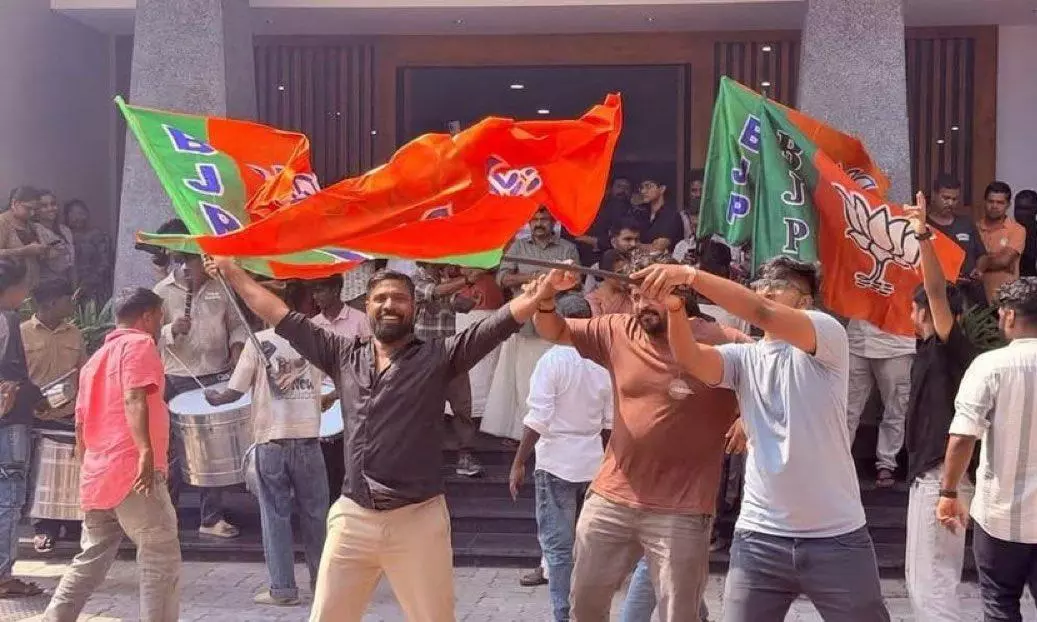
The Mattathur gram panchayat in Kerala’s Thrissur district stole national headlines for a brief period after the results of the Kerala Local Self-Government (LSG) elections came out earlier in December, thanks to the Bharatiya Janata Party (BJP) orchestrating a political coup to seize control of the local body.
However, a closer look in hindsight shows that the churn did not begin the day the rebel members of the Congress resigned, enabling a BJP takeover, but much earlier at the polling booth. Ward-level voting patterns reveal a deep structural erosion of the Grand Old Party’s base and a steady consolidation of the BJP, largely at the expense of the Congress-led United Democratic Front (UDF) than the Communist Party of India (Marxist)-led Left Democratic Front (LDF).
Mattathur results ominous for Congress
An examination of the recent local body election results shows a consistent trend across Mattathur’s 24 wards: Wherever the LDF emerged victorious, the UDF was pushed decisively to the third position. In contrast, in wards where the LDF lost, it slipped to third place in only two instances.
Also read: Congress left red-faced in Kerala as internal feud helps rival BJP in local bodies
The unmistakable beneficiary of this swirl has been the BJP, which either won or finished second in a growing number of wards, marking a significant shift in the panchayat’s political landscape.
Also, out of the 24 wards in Mattathur, the UDF finished third in as many as 14 wards. This is not merely a statistical detail but a political signal that the Congress is no longer the default alternative to the LDF in large parts of the panchayat. Instead, the saffron party has emerged as the principal challenger in multiple wards, relegating the Congress to the margins.
This decline is starkly visible in wards where BJP candidates either won or secured the second spot. In these wards, the Congress’s vote tallies were not just low, but abysmally low, often failing to cross even 100.
In Nooluvally ward, where the BJP registered a decisive victory by 768 votes, the LDF finished second with 629 votes. The Congress candidate, however, managed a paltry 44 votes, effectively disappearing from contention. A similar pattern was seen in Korechal ward, where BJP candidate Athul Krishna won the seat, and the Congress candidate there received just 58 votes.
Also read: Congress revolt in Mattathur as leaders back BJP; KPCC cracks down with suspensions
The numbers are equally stark for the party in Chembuchira (63 votes), Nadippara (64 votes), and Moolamkudam (71 votes). In ward after ward, the Congress’s vote share collapsed to levels that suggest not tactical defeat but organisational disintegration.
Vellikulangara reflects Congress’s erosion of vote share
The result at Vellikulangara ward particularly helps in understanding the dynamics at play. There, independent candidate Ouseph emerged victorious with 453 votes. The BJP finished second and the LDF third, both polling over 300 votes each. The Congress’s official candidate, PR Sunikumar, finished fourth among as many contenders with just 108 ballots.
This outcome points to a decisive transfer of votes away from the Congress. Ouseph’s winning tally of 453 votes is widely understood to have been drawn from both traditional UDF and LDF vote banks, indicating a consolidation of the anti-Congress sentiment rather than a mere three-cornered split.
The Congress, far from being a central player, was effectively sidelined.
It is against this backdrop of electoral marginalisation that the subsequent political developments in Mattathur need to be understood. After failing to influence outcomes through voting, the Congress found itself with limited leverage inside the panchayat council. The resignation of elected Congress members and their alignment with the BJP did not occur in a vacuum. It followed a clear electoral verdict that had already weakened the party’s bargaining power.
Also read: BJP's 2024 LS poll show in Kerala under lens as SIR exposes shocking ASD entries
The BJP-led front eventually took control of the Mattathur panchayat, not through a sweeping electoral mandate but post-poll realignments enabled by Congress defections. However, the voting data suggest that the groundwork for this outcome was laid earlier, when the Congress failed to retain its core support base and allowed the saffron party to emerge as the principal challenger to the Left.
A broad pattern in pockets across Kerala
What has unfolded in Mattathur reflects a broader pattern increasingly visible in pockets across Kerala, which will go to the Assembly polls in 2026.
With the singular objective of defeating the Left, the Congress has often found itself conceding political space, sometimes deliberately and sometimes by default, to the BJP. Panchayat-level results across districts exhibit similar trends where the BJP gains ground not by directly dislodging the LDF, but by replacing the Congress as the primary Opposition force.
The Mattathur controversy has thus reopened uncomfortable questions within the UDF. Was the Congress’s organisational machinery active on the ground?
Were candidates imposed without local acceptance?
Did tacit understandings with the BJP during the campaign further alienate core voters?
And most crucially, can the Congress afford to continue with a strategy that prioritises weakening the Left even if it strengthens the BJP?
For LDF, it's assuring and warning
For the LDF, the results offer both reassurance and warning. While it remains electorally resilient in Mattathur, the rise of the BJP as a competitive force alters the arithmetic of local politics. For the BJP, Mattathur represents not just a panchayat captured but a model of incremental expansion built on the Congress’s decline.
Also read: After LSG debacle, Left front to launch mass protests against Centre's new Bills
Ultimately, the Mattathur panchayat controversy is less about individual resignations and more about a deeper political realignment. The ballot numbers tell a clear story — the BJP votes are on the rise, and the Congress was already sidelined by voters before it lost power in the council chamber.
What followed was a political denouement, not an aberration.
When similar voting patterns are repeated across panchayats, Mattathur may no longer be seen as an exception. In the neighbouring panchayats of Thrissur district, especially within the Thrissur Lok Sabha constituency where Suresh Gopi defeated both the LDF and the UDF opponents in the 2024 general polls, the trend appears strikingly similar.
In Vallachira and Paralam, panchayats where the Left declined, and the BJP gained ground, the UDF’s position looks equally bleak. In Vallachira, all six seats were won by the NDA, with the LDF finishing second and the Congress lagging at third place. This mirrors the Lok Sabha election outcome, where Gopi defeated the LDF’s VS Sunilkumar, while veteran Congress leader K Muraleedharan slipped to the third position despite a strong UDF wave across much of the state.
Also read: Despite Thiruvananthapuram magic, Kerala LSG results expose chink in BJP's armour
According to the LDF leaders in Thrissur, the BJP had attempted to influence the outcome in four panchayats in the district with fractured majority — Mattathur, Paralam, Avinissery and Vallachira — by persuading UDF ward members, especially those from the Congress, to take their support. However, they claim that this effort succeeded only in Mattathur.
BJP speaks with confidence
BJP sources, however, present a different version. They say the immediate outcome was not their primary concern, and that even if a by-election is necessitated due to the disqualification or resignation of defecting members, the party could return with greater strength. According to these sources, the moves were part of a calculated, long-term strategy rather than an ad hoc intervention.
Also read: Kerala LSG elections: What numbers say about UDF, LDF, NDA performance
This trend is not confined to Thrissur alone. In areas where the BJP concentrated its campaign to wrest power, a similar pattern has emerged. For instance, in Thiruvananthapuram, where the BJP went on to win the corporation, several wards captured by the party also saw an exceptionally weak performance by the Congress, underlining the same erosion of the UDF base seen elsewhere.
An independently compiled set of figures, now being cited by Left leaders, presents an interesting picture of the BJP’s rise and the nature of the contest against it across Kerala.
According to this data, the BJP-led National Democratic Alliance (NDA) front won a total of 1,917 seats statewide.
Of these, 1,445 seats were secured in gram panchayats. In 815 of those seats, the LDF emerged as the runner-up, indicating that in 56.4 per cent of the contests, it was the principal challenger to the BJP.
At the block panchayat level, the BJP-led NDA won 54 seats, with the LDF finishing second in 34 of them. This translates to the LDF directly contesting the BJP in 62.9 per cent of these seats.
In municipalities, the NDA won 324 seats. The LDF came second in 148 of these, accounting for 45.6 per cent of the contests where it was the main opponent to the BJP. Notably, the Congress managed to finish second in only 33.3 per cent of these seats.
A similar pattern is seen in corporations, where the NDA won 93 seats. In 63 of these, the LDF was the runner-up, meaning that in 67.7 per cent of the seats, it was the primary force taking on the BJP.