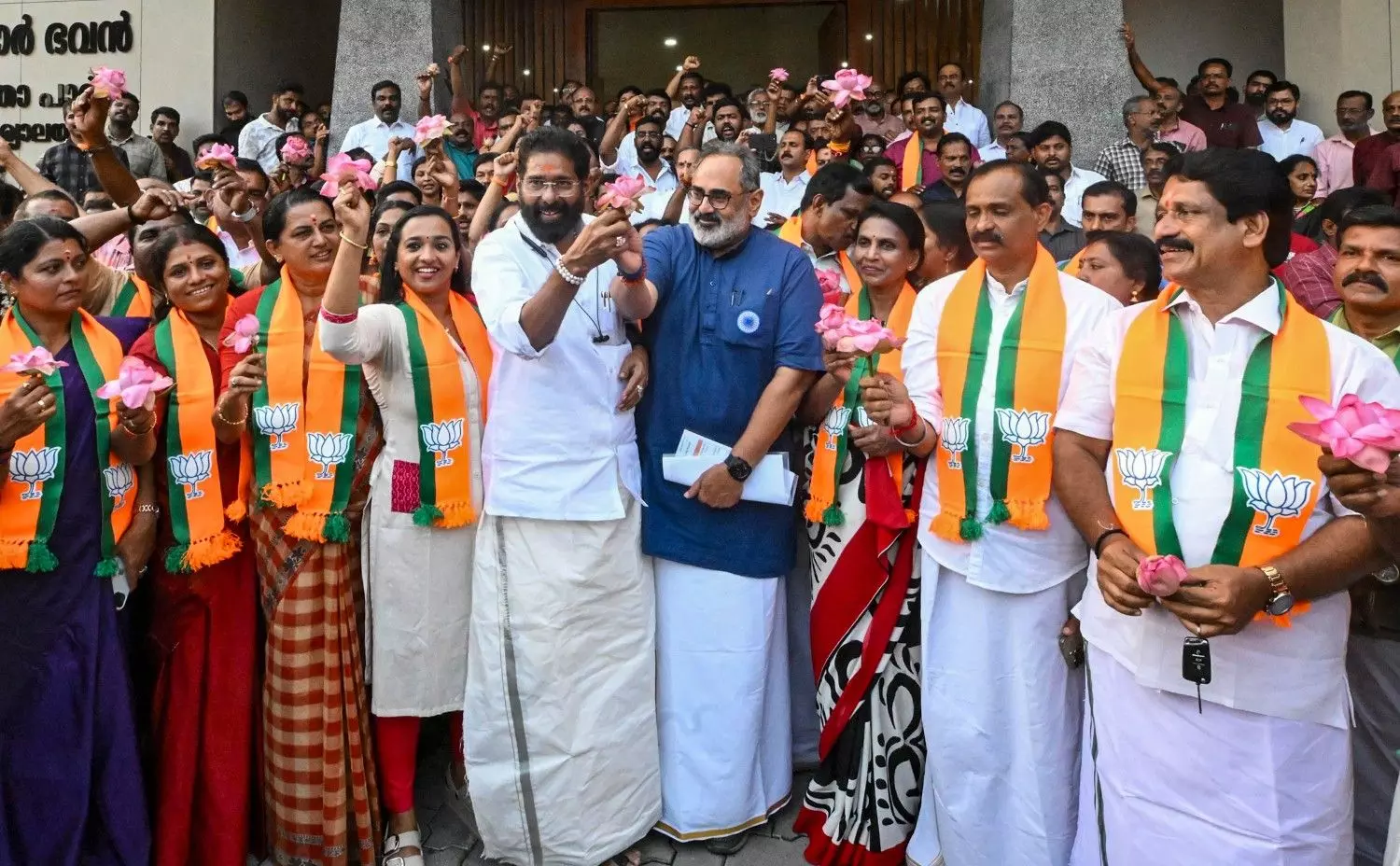
Kerala BJP president Rajeev Chandrasekhar (in blue) with the National Democratic Alliance’s winning candidates of Kerala’s recent local body elections at the party headquarters in Thiruvananthapuram on December 14, 2025. Photo: PTI Photo
Despite Thiruvananthapuram magic, Kerala LSG results expose chink in BJP's armour
The saffron party's NDA alliance saw its vote-share in the 2025 polls declining by 3.4 per cent compared to the 2024 Lok Sabha results, which was its best ever

The Bharatiya Janata Party’s (BJP) unprecedented feat of breaching the Leftist citadel of Thiruvananthapuram Corporation in the recently held local self-government (LSG) elections in Kerala has grabbed national headlines. Although the saffron party has fallen short of clinching the majority in the civic body by a single ward, the decision of the state’s arch-rivals — the Left Democratic Front (LDF) and the United Democratic Front (UDF) — against joining hands effectively clears the BJP’s path to pick the mayor of the state capital, again something which has never happened before.
If this pattern holds, the BJP could end up ruling 26 panchayats, two municipalities and one corporation, where it has emerged as the single-largest party in the recent polls.
Reality check for NDA
However, there is another side to the story. While the BJP has made a historic administrative entry in a major urban civic establishment in the southern state, both the party and its National Democratic Alliance (NDA) has also received a reality check.
Also read: Kerala LSG elections: What numbers say about UDF, LDF, NDA performance
Despite improving its presence in city wards and village panchayats, the alliance has seen its vote-share sliding to 15.73 per cent, compared to the 2024 Lok Sabha elections, when it mustered a vote-share of 19.14 per cent and one seat (Thrissur), its best ever show in a state where it has traditionally not been a major player.
The local body election results suggest that the party’s electoral expansion at the grassroots level has stalled, even as its organisational spread widened.
National gains not equal to local surge
The outcome also underscores a familiar pattern in Kerala politics where gains made in national elections do not automatically translate into local electoral consolidation. While the BJP has succeeded in establishing itself as a visible third force in the state of late, the 2025 outcome indicates that its voter base has not expanded beyond a certain threshold in the civic contests.
Also read: After local poll gains, UDF allies split over bringing Kerala Congress (M) back
To understand the implications of the dip, it is important to trace the BJP’s electoral trajectory in Kerala over the last decade.
In the 2014 Lok Sabha elections, the party remained firmly on the fringes of the state’s political system. Its vote-share stood in the low double digits, and it failed to win a single seat, even as the NDA swept much of the country. Kerala continued to be shaped by the alternating dominance of the LDF and UDF, with the BJP lacking both social depth and organisational reach.
NDA's roller-coaster side in Kerala polls
The NDA’s vote-share in Kerala over the past decade shows a pattern of gradual growth, punctuated by clear peaks during Lok Sabha elections and relative dips in the state and local polls. Starting at 10.82 percent in the 2014 Lok Sabha elections, the NDA improved its performance to 13.3 percent in the 2015 LSG polls, indicating early consolidation at the grassroots level.
The share fell back to 11.3 percent in the 2016 Assembly elections, before rising sharply to 15.64 per cent in the 2019 Lok Sabha polls. This momentum was largely held in the 2020 local elections with a 15.01 per cent share, but declined again to 12.4 percent in the 2021 Assembly elections. The high point came in the 2024 Lok Sabha polls with more than 19 percent, but it slumped by more than three points in the 2025 local elections.
Also read: Kerala’s LSG Polls: What is behind Congress' stunning comeback?
Over the decade spanning 2014-2025, the saffron party invested steadily in building its cadre base, expanding booth-level committees and increasing its visibility through high-profile campaigns. This effort began to reflect in vote-share gains in successive elections. By the 2019 Lok Sabha polls, the BJP had significantly improved its numbers, emerging as a consistent third force, albeit without parliamentary representation.
The turning point came in the 2024 Lok Sabha elections.
The NDA’s vote-share in Kerala rose sharply to over 19 per cent, and the BJP won its first-ever Lok Sabha seat. The victory carried a strong symbolic value, breaking a long-standing perception that the BJP was structurally incapable of winning in Kerala. The result also fuelled expectations that the party was on the verge of a broader political breakthrough in the state.
The party’s national leadership had given them a target to attain 25 per cent vote-share in the latest LSG elections, which the state unit could not achieve.
Also read: Kerala local body polls: BJP ends LDF's 45-year rule in Thiruvananthapuram; Modi reacts
With the NDA’s vote-share settling at 15.73 percent, the BJP has fallen back to a level closer to its earlier local election performance. While this does not represent a collapse, it does indicate that the surge seen in the last Lok Sabha polls did not sustain itself in elections driven by local issues and governance records.
NDA has won more wards in 2025 than 2020
In terms of winning seats, the BJP can still point to modest gains. The NDA won 1,919 wards in the 2025 local elections, compared to 1,597 in the 2020 elections. It also secured majorities in 26 village panchayats, up from 19 last time.
These numbers suggest an incremental organisational consolidation, particularly in urban and semi-urban areas where the party has focused much of its effort.
However, the improved ward count did not translate into a higher vote-share.
In contrast, the UDF emerged as the clear leader in the local polls with 40.7 per cent of the vote-share, while the LDF followed with 35.7 percent. Together, the two traditional fronts continued to command over three-quarters of the electorate, reaffirming their dominance at grassroots institutions.
BJP's overwhelming participation in 2025 polls
One of the defining features of the 2025 local elections has been the scale of the BJP’s participation. The party fielded 19,262 candidates, the highest among all political formations in the state. The Congress fielded 17,497 candidates and the Communist Party of India (Marxist) or CPI(M) 14,802. The BJP’s extensive presence reflected both organisational confidence and a strategy of contesting as widely as possible.
Also read: Kerala actress assault case: Pulsar Suni, 5 others get 20-year prison sentence
Yet, in many areas, this saturation approach produced limited returns. BJP candidates often finished third, consolidating a loyal voter base but failing to break into winning positions. This pattern diluted the impact of the party’s efforts on the overall vote-share and highlighted the limits of expansion without deeper social penetration.
The urban-rural divide
The results also exposed a clear urban-rural divide in the BJP’s support. The party performed relatively better in cities and large towns, where its appeal among middle-class voters and sections of youth remains stronger. Its show in urban corporations reinforced the perception that the BJP’s growth in Kerala is largely city-centric.
In rural areas and village panchayats, however, resistance to the BJP remained strong. The CPI(M)’s organisational strength and the Congress’s traditional vote banks continued to dominate these regions. The BJP’s inability to substantially dent these networks remains a major obstacle to expanding its statewide vote-share.
Also read: Kerala local body polls: Northern districts vote amid shifts in minority alignments
Another factor shaping the outcome was the nature of local elections themselves. LSG polls in Kerala are heavily influenced by assessments of local governance, welfare delivery and personal familiarity with candidates. National narratives and leadership factors that benefit the BJP in the Lok Sabha elections carry far less weight in these contests.
As a result, the Thrissur parliamentary victory and the BJP’s improved performance in 2024 appear more as constituency-specific successes than evidence of a statewide political realignment. The 2025 results suggest that the party has yet to embed itself firmly within Kerala’s decentralised governance structures, which play a central role in electoral mobilisation.
Vote-share dip a pause, not reversal
The dip in vote-share, therefore, signals not a reversal, but a pause. The BJP has moved well beyond its pre-2014 marginal status and now commands a stable voter base of around 15 to 16 per cent in local elections. What remains uncertain is whether the party can push beyond this ceiling without reshaping its social coalitions and rural outreach.
Also read: Over 25L voters found untraceable during SIR of electoral rolls in Kerala
As Kerala heads towards future Assembly and parliamentary contests, the BJP faces the challenge of converting national momentum into durable local support in a state where grassroots politics continues to decide electoral outcomes. Its next test will be due in a few months, when the state holds its Assembly elections.