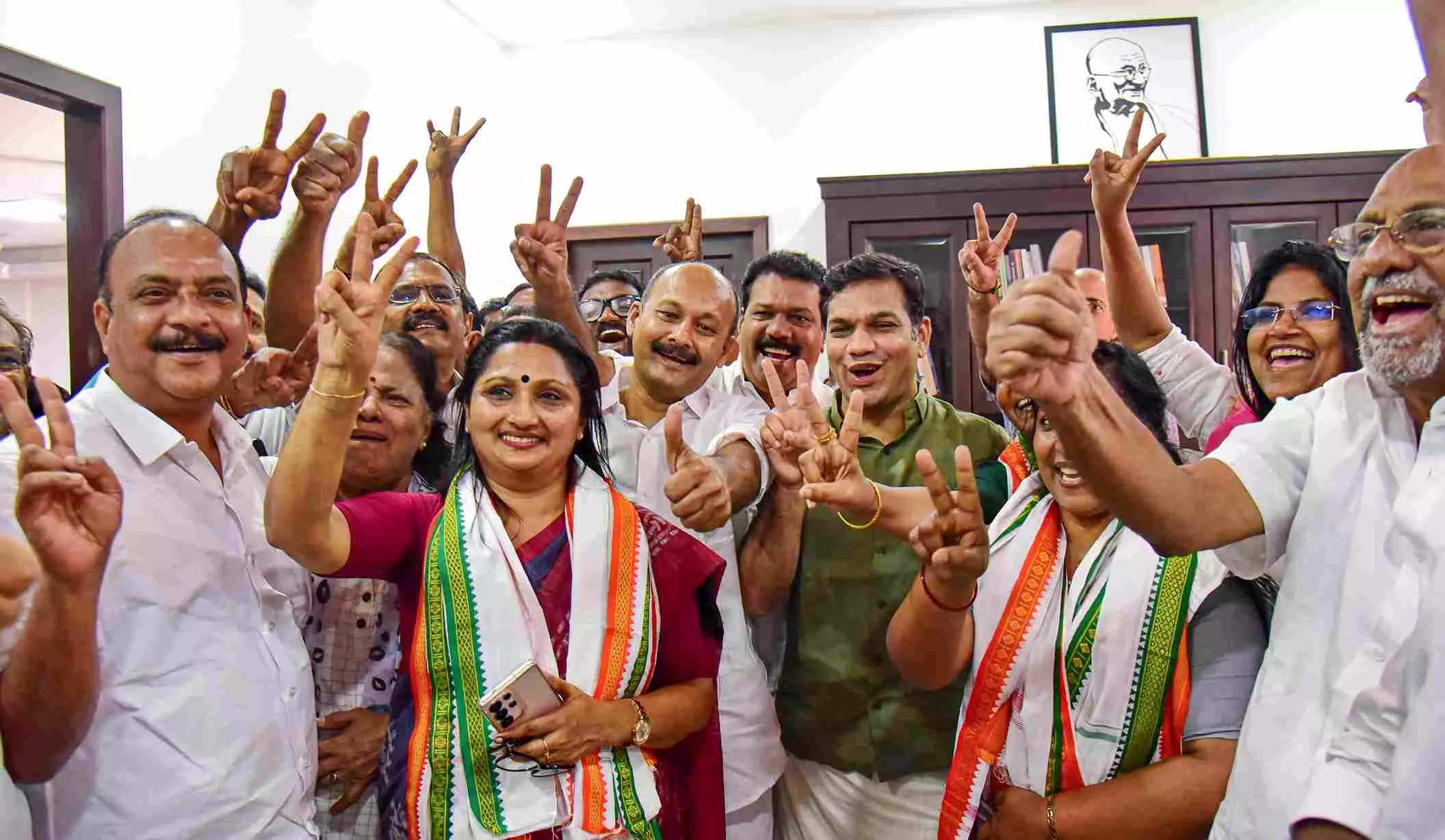
UDF candidate Deepthi Mary Varghese, front second left, and others celebrate after the alliance's victory in Kerala's local body elections, in Kochi. PTI photo
Kerala LSG elections: What numbers say about UDF, LDF, NDA performance
LDF's invincible aura punctured, as it's reduced to 340 panchayat seats, losing Thiruvananthapuram corporation; BJP didn't register huge surge, contrary to fanfare

The 2025 Local Self-Government election results in Kerala mark a decisive departure from the political script written five years ago.
Compared to the sweeping mandate secured by the Left Democratic Front (LDF) in 2020, the latest verdict signals a clear resurgence of the United Democratic Front (UDF), a visible erosion of the Left’s urban dominance, and a far more nuanced picture of the Bharatiya Janata Party’s (BJP) growth than suggested by celebratory national-level claims.
A comparison of the two election cycles underlines the scale of this shift.
The reversal
In the 2020 Local Self-Government (LSG) elections, the LDF had delivered one of its most emphatic performances in Kerala’s local governance history.
It won 581 of the 941 grama panchayats, compared to the UDF’s 334, along with 113 of 152 block panchayats, 11 of 14 district panchayats, 44 municipalities, and five of the six corporations. The BJP-led NDA secured 17 gram panchayats and two municipalities. That result was widely read as a popular endorsement of the LDF government’s welfare-centric governance, crisis management during floods, and early handling of the COVID-19 pandemic.
The 2025 results present a striking contrast.
Also read: Cong-led UDF sweeps Kerala LSG polls; BJP captures Thiruvananthapuram
According to the official status, the UDF now leads in 505 grama panchayats (absolute majority in 382), while the LDF is down to 340 (absolute majority in 239). The UDF has also secured 79 (majority in 75) block panchayats, compared to the LDF’s 63 (majority in 53), while district panchayats are evenly split at seven each (absolute majority in 6 each).
In urban local bodies, the shift is sharper, the UDF leads in 54 (majority in 40) of 87 municipalities and four of six corporations (clear majority in 3), whereas the LDF is reduced to 28 (majority in 16) municipalities and just one corporation.
This reversal is not merely numerical; it reflects a broad change in voter sentiment across both rural and urban Kerala. BJP’s tally has been 26 gram panchayats, two municipalities and Thiruvananthapuram corporation, even though they have no clear majority in any of these three urban bodies.
Thiruvananthapuram shock
The most symbolic moment of the 2025 verdict is the LDF’s loss of the Thiruvananthapuram Corporation, aLeft bastion for over four decades.
In 2020, the LDF controlled five of the state’s six corporations; in 2025, it holds just one. Urban Kerala, once seen as a reliable pillar of the Left’s governance narrative, has emerged as the most volatile political space.
Municipalities tell a similar story. While the LDF had edged past the UDF in municipalities in 2020 (44 to 41), it has now fallen far behind. This shift suggests that urban and semi-urban voters, more exposed to everyday governance challenges, infrastructure stress, and administrative fatigue, have turned decisively towards change.
BJP breakthrough
The BJP-led NDA’s performance, however, demands careful reading. Contrary to the perception triggered by Prime Minister Narendra Modi’s public remarks on Twitter, the BJP has not registered a huge surge as it is projected.
Also read: Shashi Tharoor calls BJP’s Thiruvananthapuram win ‘beauty of democracy’
In 2025, the NDA leads in 26 grama panchayats, up from 17 in 2020, retains two municipalities, and leads one corporation. In seat-share terms, the BJP has emerged victorious in only about 8 per cent of the total seats contested. This remains a marginal presence in Kerala’s local governance landscape.
Moreover, the party has suffered notable setbacks even amid these gains. Its dominance in Palakkad municipality has weakened, it has lost Pandalam municipality, adjacent to Sabarimala, and its lead in Thrippunithura municipality could be neutralised if the UDF and LDF tactically align. These losses complicate the narrative of a linear saffron rise in the state.
Shibu Baby John, leader of RSP, a constituent of the UDF, told The Federal, “No victory is being dismissed. However, given the media narratives since yesterday and the claims being made by the BJP, it is necessary to place one fact on record. The BJP has won only 1,919 seats across the state, accounting for roughly eight per cent of the total. These figures are being highlighted solely because there are attempts to underplay the significance of the UDF’s historic advance, despite this being the factual position."
Assembly seat projections
Several media analysis, based on the combined performance in panchayats and municipalities, suggest that if Assembly elections were held today with the same voting pattern, the UDF would be ahead in around 80 Assembly segments, the LDF in 58, and the NDA in two.
Such extrapolations, while politically significant, must be treated with caution, pointed out the analysis.
In 2020, when the LDF dominated the LSG polls, it was projected to be leading in nearly 120 Assembly constituencies. In the 2021 Assembly elections that followed, it won 99 seats — a historic mandate, but still well below the LSG-based projection. Similarly, in 2010, the UDF’s landslide in local body elections suggested a lead in 103 constituencies, but the front managed to win only 72 seats in the 2011 Assembly polls, even amid intense factionalism within the CPI(M).
Also read: KC(M) can decide about their return to UDF: KPCC chief
The lesson from Kerala’s electoral history is clear: LSG results indicate direction, not destination.
Anti-incumbency, minority votes
The 2025 verdict also reflects layered anti-incumbency. The LDF has now governed the state for a decade and many local bodies for nearly fifteen years. While welfare schemes and pension hikes remain politically relevant, their electoral payoff appears to have plateaued.
Equally significant is the consolidation of minority votes in favour of the UDF, particularly in central and northern Kerala. The CPI(M)’s strained relationship with sections of Muslim organisations and the Jamaat-e-Islami’s campaign critical of the Left, appear to have influenced tight contests at the ward and panchayat levels, amplifying the UDF’s advantage.
The Christian Church has visibly tilted towards the UDF, effectively puncturing the BJP’s attempts to build influence through sustained outreach to Church leadership. The Sabarimala gold theft controversy, too, appears to have worked in the UDF’s favour rather than the BJP’s, as reflected in the results from Pathanamthitta district.
The BJP’s gains, in contrast, remained largely confined to the Thiruvananthapuram Corporation, where the party had relied almost exclusively on temple-centric issues.
“There was never an expectation of repeating 2020, as it represented an exceptional peak. At the same time, there was no anticipation of a slide back to a situation comparable to 2010,” reflected Dr T M Thomas Issac, CPI(M) central committee member and former finance minister.
Issac added that even in 2010, when the performance was weaker than it is now, the subsequent Assembly election resulted in a narrow defeat, coming close to victory. "This time, however, anything short of a win is unacceptable. In the current national political climate, the country needs at least one state government led by the Left to remain in power. To secure such a victory, the party has already made it clear that this setback must be subjected to a rigorous and honest evaluation, and that necessary course corrections must be undertaken without delay."
Tactical politics
An emerging feature of the post-poll scenario is tactical coordination between the UDF and LDF to prevent the BJP from gaining control of key urban bodies. In municipalities where the NDA has emerged as the single largest bloc, mutual support between the two traditional fronts could keep the BJP out of power.
Even in the Thiruvananthapuram Corporation, there is a long-shot possibility of an independent mayor being installed with backing from both the UDF and LDF, a move that would underline Kerala’s distinctive political culture, where ideological rivals often close ranks to contain the BJP.
However, the Left leadership believes that the LDF’s performance is not a collapse. It has fared better than the UDF did in both the 2015 and 2020 local elections, and continues to command a strong rural base. Districts such as Thiruvananthapuram, Kollam, Thrissur, Kannur, Alappuzha, and Palakkad showed that the Left’s organisational machinery remains resilient.
However, the aura of invincibility that surrounded the LDF since 2020 has clearly been punctured. The 2025 LSG elections do not predict the outcome of the next Assembly polls with certainty, but they redraw the political map.