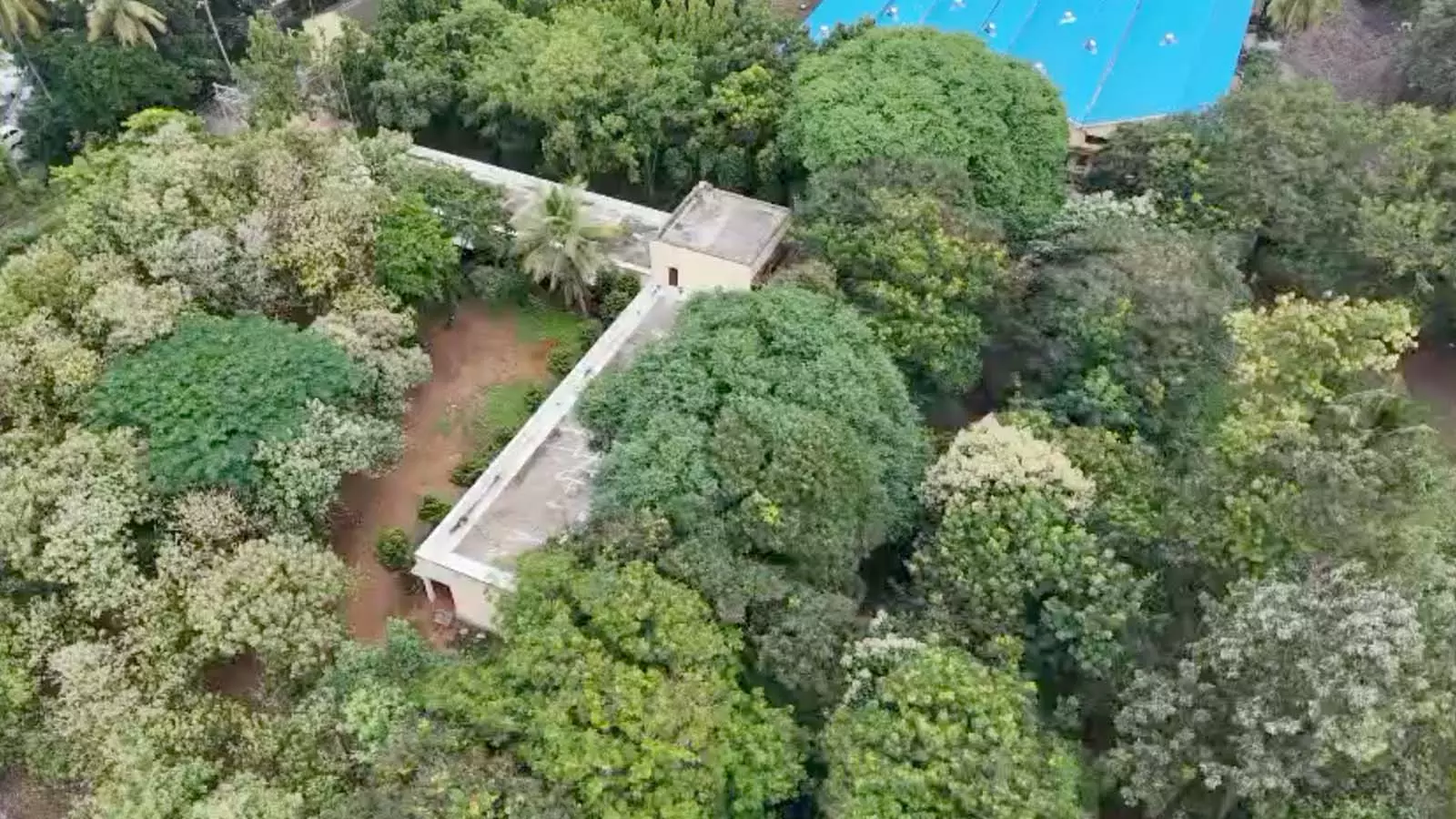
The Mysore Silk industry unit of Karnataka Silk Industries Corporation in T. Narsipura in Mysuru district, surrounded by dense greenery.
How an upcoming stadium threatens the future of Karnataka's Mysore Silk brand
Loss of green cover at the T. Narasipura filature could expose workers to toxic cinder ash, compromise the GI-tagged quality of Karnataka’s iconic yarn and threaten loss of jobs

The production of Mysore Silk, one of Karnataka’s cultural landmarks and a pride of the nation, has faced a challenge with the silk-filature premises of the Karnataka Silk Industries Corporation (KSIC) in the state’s Mysuru district, which supplies yarns for sarees made of the silk, caught in a battle between development and environmental concerns. The matter has also spilled into the political arena with Karnataka's Opposition party taking a stand against the state's Congress government.
On Friday (February 27), R Ashoka of the Bharatiya Janata Party (BJP), who is the Leader of Opposition in Karnataka Assembly, went to the filature unit in Mysuru to join the protesting workers and criticise the government's decision to cede land from the factory premises for a taluk-level stadium. He also expressed concerns over loss of livelihoods and Karnataka's pride and urged the government to make the stadium on an alternative site.
Mysore MP Yaduveer Wodeyar, the current titular king of Mysuru and a BJP leader, also met Chief Minister Siddaramaiah on Wednesday (February 25) and requested him on behalf of the KSIC employees to reconsider the decision to build a stadium on the land of the century-old factory set up by one of his predecessors.
Stadium planned on silk factory land
What has hogged the limelight is the state government’s plan to set up the stadium and the land earmarked for it on five out of 13.5 acres under the KSIC unit (also called mother unit) in T. Narsipura, which is not just another industrial establishment but also speaks about a legacy. Those against the idea of setting up a stadium there allege that environmental mayhem would not be far if the project becomes a reality.
Also read: Why a Karnataka farmer’s campaign for road access to his land has made him a local ‘Gandhian’ hero
Speculation is rife that more than 500 trees, including teak and sandalwood, would be destroyed to make way for the stadium worth Rs 6 crore. If that is realised, the workers of the unit and even those who play in the new sports venue would face health hazards since the loss of green cover would mean a reduced buffer against heat and foul smell caused by the filature.
Also, a reduced vegetation would expose the silk workers to the cinder ash produced by the coal, which is used for boilers at the unit’s yarn-reeling centre.
A colourful array of fauna found in the forest areas surrounding the Mysore Silk unit of the KSIC in T. Narsipura in Mysuru district of Karnataka, which will be threatened if trees are destroyed for a new sports stadium.
The problem
Environment, history and economy have come under threat once the idea to build a stadium on the premises of the KSIC was conceived. The Mysore Silk Sarees, renowned for their high quality, pure mulberry silk and gold zari, have a prestigious Geographical Indication (GI) tag that guarantees their authenticity. The unit in T Narsipura, on the other hand, is a piece of history as it was established in 1912 by Nalvadi Krishnaraja Wodeyar (1884-1940), the 24th king of Mysuru. The silk yarn from the unit is sent to Mysore and Channapatna, where silk sarees are woven.
Also read: Why Karnataka’s planned discontinuation of 'Nali-Kali' education programme has some concerned
With such a historic industry in place and the KSIC planning to cater to the ever-growing demand for the Mysore Silk sarees, the initiative to make a stadium in its vicinity has alarmed the environmentalists for not only the loss of green but also the increased threat to the workers’ health. Keeping these in view, the workers have resorted to protest, which, if continues indefinitely, could pose economic challenges to the thriving industry and result in loss of jobs. More than 200 workers are currently employed in the T. Narsipura unit.
How workers’ health is threatened
Hot water used in the boilers of the filature unit here is used to extract silk from the silkworm cocoons. For this, coal is used and it produces cinder ash, which contains very fine particles. The ash spreads with the wind and enters the lungs through breathing, raising the dangers of asthma and bronchitis. When ash particles go into the eyes, it can cause irritation and redness. It can also cause itching of the skin and allergies.
Thus, in the interest of the health of the workers in the yarn unwinding unit, there is a rule that trees should be grown in 33 percent of the area of the premises. More than 900 trees have been grown on the land to mitigate the effects of these potential threats, besides heat, smell and noise. But, if more than 500 of these trees are cut down at one go, what is the protection of the health of the workers?
Also read: Why Karnataka’s Lakkundi village has become the state’s latest history hotspot
The destruction of the trees would also mean more than 40 bird species and over 30 species of butterflies would become homeless, a survey has found.
Craft quality could suffer
The loss of green cover would not only hurt human health but also the silk craft. If dust produced by the industrial processes settles on the silk yarn, the quality of the silk for which the sarees are known will also suffer. Such an eventually would have a major financial consequence for the silk producers and the organisation as a whole. Zehera Naseem, managing director of KSIC, has written to the state government pointing out these concerns.
What officials say
The protesters’ mood has simmered ever since T G Sureshachar, tehsildar, T Narasipur, officially handed over the title deed of the land to the state youth empowerment and sports department recently for the construction of the stadium.
What has shocked the protesters is that the government has taken such a decision that would affect the KSIC, which it itself had awarded in the past with the prestigious Karnataka Ratna Award in the past for excellence in marketing and promotion of Mysore Silk products. If the stadium sees the light of day, the unit could face a major existential threat, according to many of the protesters.
Also read: Vulture chick hatches at Ramadevara Betta Vulture Sanctuary for fifth consecutive year
The matter has also taken a political angle, with N Mahesh, a former MLA of T. Narsipura’s neighbouring Kollegal constituency, having also launched a protest against the stadium.
But what are the officials saying? According to them, the multi-sports structure will be “eco-friendly”, and no trees will be cut for it. However, the protesters have doubted whether it is possible to build a stadium at all without cutting down trees.
'Tree audit for Mysuru'
Speaking to The Federal, Parashuramegowda, state general secretary of Karnataka’s ‘Naavu Parisarakke’ (We are for the environment), a green organisation, told The Federal, “The silk spinning unit built by the Maharaja is being destroyed in the name of development. By building a stadium on five acres of land here, more than 500 trees will be destroyed. The axe is ready to destroy this biodiversity completely. If the industry goes bankrupt, the livelihood of hundreds of families will be affected. Where will the bird species that rely on these trees go?”
“Development does not mean destruction. If the government is concerned about sports, let it use barren land. Cutting down living trees to build a stadium is a betrayal of the environment. A tree audit should be conducted across Mysuru city, and old trees should be declared heritage trees,” he added. His organisation has also submitted a memorandum to Siddaramaiah urging for action.
(The article was originally published in The Federal Karnataka.)