- Home
- India
- World
- Premium
- THE FEDERAL SPECIAL
- Analysis
- States
- Perspective
- Videos
- Sports
- Education
- Entertainment
- Elections
- Features
- Health
- Business
- Series
- In memoriam: Sheikh Mujibur Rahman
- Bishnoi's Men
- NEET TANGLE
- Economy Series
- Earth Day
- Kashmir’s Frozen Turbulence
- India@75
- The legend of Ramjanmabhoomi
- Liberalisation@30
- How to tame a dragon
- Celebrating biodiversity
- Farm Matters
- 50 days of solitude
- Bringing Migrants Home
- Budget 2020
- Jharkhand Votes
- The Federal Investigates
- The Federal Impact
- Vanishing Sand
- Gandhi @ 150
- Andhra Today
- Field report
- Operation Gulmarg
- Pandemic @1 Mn in India
- The Federal Year-End
- The Zero Year
- Science
- Brand studio
- Newsletter
- Events

Why a Karnataka farmer’s campaign for road access to his land has made him a local ‘Gandhian’ hero
For two years, Prasanna Kumar claims he ran from pillar to post for road connectivity to his farm. Faced with alleged demands for bribe, he offered officials radishes grown by him. The road got built, though official version of the case is different. Now, other farmers are citing his 'Gandhian' protest to demand accountability.

It all started two years back. Prasanna Kumar, a 64-year-old farmer in Karnataka’s Jakkenahalli village, in Madhugiri taluk of Tumkur district, found road access to his farmland cut off after differences with his brother.“My brother’s land is adjacent to the road. My land is behind his. I would have to pass through his land to access the road. Two years back, however, we had...
It all started two years back. Prasanna Kumar, a 64-year-old farmer in Karnataka’s Jakkenahalli village, in Madhugiri taluk of Tumkur district, found road access to his farmland cut off after differences with his brother.
“My brother’s land is adjacent to the road. My land is behind his. I would have to pass through his land to access the road. Two years back, however, we had some differences and without the means to use his farm to connect to the road, I was left with no road access to my farm,” recalls Kumar.
Which meant carrying out the farm produce or bringing in things like fertilisers, for example, became a nightmare because no vehicle could reach the 2.068 acres (approximately) farm.
Still, he wasn’t too perturbed. A study of his land records convinced him that there should be a connecting road to his farm and armed with it he landed up at the Madhugiri tehsildar’s office to request that the government build a road to his farm.
And was greeted with alleged inaction and greed.
Also read: Why, in coastal Karnataka, toddy tapping, once part of legends and ballads, has few takers today
What makes his story stand out, however, is not the conundrum of a farmer finding himself with no road access to his land, or even the alleged callousness of government officials, but how the farmer chose to respond to the situation.
“When I requested for a connecting road to my farm, the tahsildar instructed junior officials [to help me out], but nothing was done,” alleges Kumar, who grows vegetables on his farm. He adds: “Two months ago, the Lokayukta visited the area and directed that the road be provided within a month. When I asked local officials, they gave a different excuse every day.”
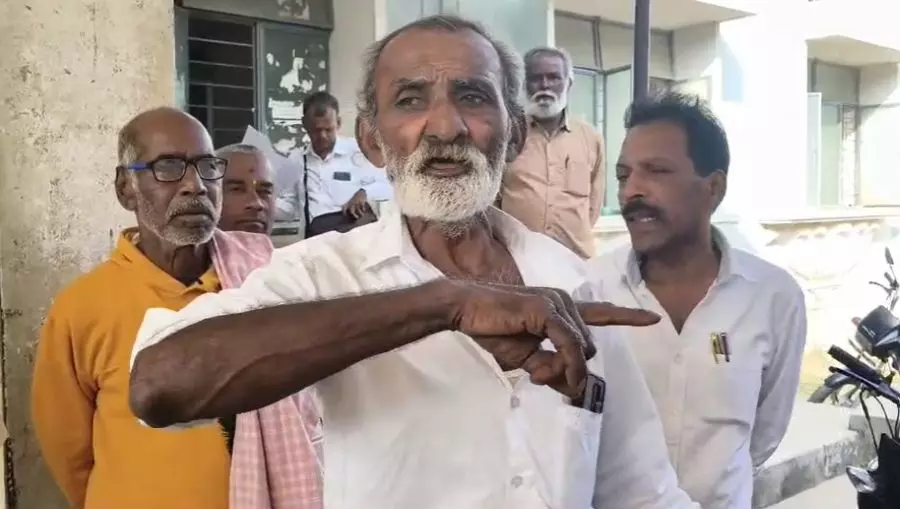
Prasanna Kumar protests outside teh tahsildar's office. Photo: By special arrangement
Then came the alleged demand for bribes to get the work done. What followed can only be described as a modern-day version of Gandhi’s ‘Non-Cooperation Movement’.
Kumar refused to pay for what he believed was his due and started a ‘non-violent protest’ outside the tehsildar’s office. Earlier this month, he reached there with a basket of radishes grown on his farm, and using a microphone, addressed the officers with these bold words — “I don’t have money. I have grown radish on my farm; eat that if you like.”
And just like that, he claims, the road got built the very next day.
Madhugiri tahsildar H. Srinivas claims, however, that there was no road connectivity to Kumar’s land mentioned in the land records. “Prasanna Kumar’s land lay beyond the recorded road and his relatives [brother] had not made provisions for a path to connect Prasanna’s farm to the road. Kumar claimed there was an eight-foot road shown in the records, but in reality, no such road existed in the land records. If the officers had checked, they could have clarified this before. Even the Lokayukta police, when they inspected the site found no recorded road to his land,” Srinivas told The Federal.
He added: “Eventually, officials negotiated with some farmers, including Prasanna Kumar's brother, to build a makeshift path on one side of the farm, connecting it to the village road. We helped build the connecting path after the other farmers agreed [to have the connecting lane be built through their land]. The department only intervened to provide Prasanna with road access to his farm; it did not build an additional road.”
The tahsildar dismissed Kumar’s allegations of bribe being demanded as “baseless”. “However, it is true that the officials delayed the work. If they had visited the place and inspected the issue when Prasanna Kumar submitted the application [to build a road], this problem would not have arisen,” said Srinivas.
Also read: How a groundnut festival to appease a bull became a part of Bengaluru's cultural calendar
The tahsildar’s claims are in direct contradiction to the local narrative, which has made Kumar a local hero based on the success of his “Gandhian protest”. For them, it has been the victory of a common man’s desperation over alleged organisational inaction.
“For the success of any struggle, Gandhigiri is the foundation. There is a situation today where officials openly demand bribes. Officials fear neither the government nor ministers. Corruption has become rampant and daylight robbery is taking place. The Madhugiri farmer’s struggle has once again created the need to revive the farmers’ movement of the 1980s in the state. A statewide discussion on this is underway,” says Muttappa Komar, vice president, State Farmers’ Association.
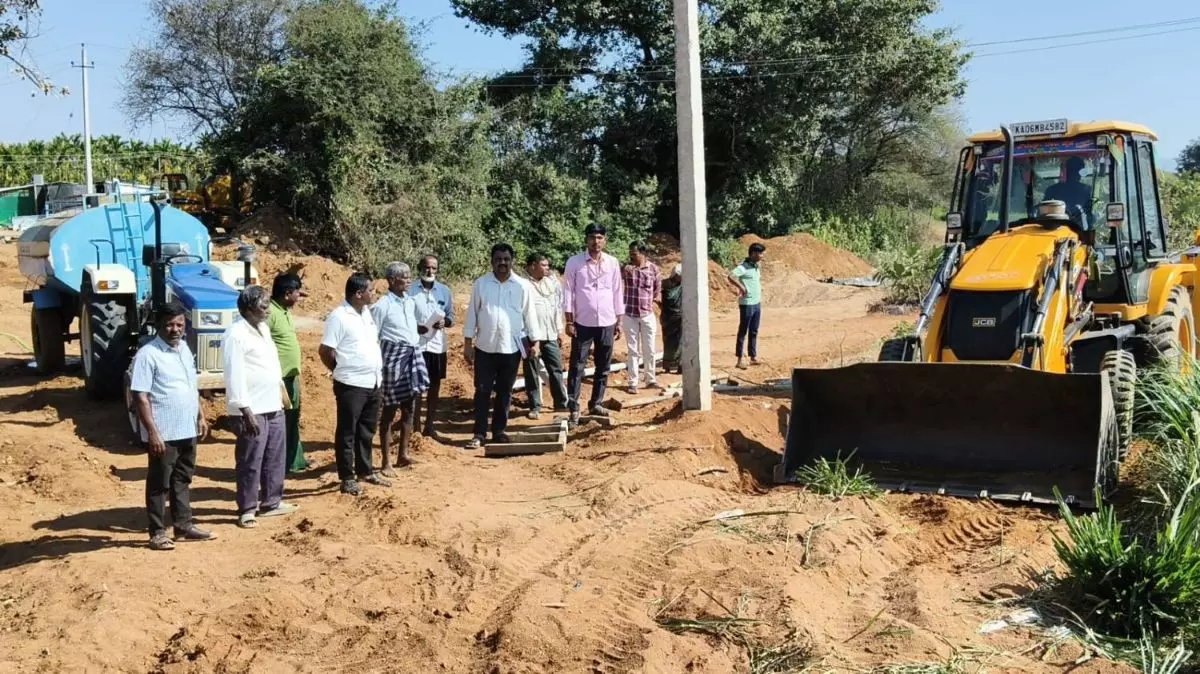
The makeshift road conencting Prasanna Kumar's farm to the village road being built. Photo: By special arrangement
Interestingly, Prasanna’s persistent campaign for road access to his farm unfolded alongside a protest by sugarcane farmers in Karnataka for ‘fair price’ for their produce, which reportedly turned violent in November 2025. And earlier this month, a sandalwood grower in the state was reported to have cut off branches from a sandalwood tree near the state legislature in protest against National Highways Authority of India (NHAI) acquisition of over four acres of his land for road work. According to reports, the sandalwood grower alleged that he had not received fair compensation for it.
Farmers’ associations and movements are not new to Karnataka.
In 1980, M.D. Nanjundaswamy, a Gandhian who tirelessly fought for farmers’ rights and led anti-globalisation campaigns, formed the Karnataka Rajya Raitha Sangha (or Karnataka State Farmers’ Association).
However, Kumar is a unique example of a common man hero, born of desperation. The farmer has emerged as the local face of farmers’ travails in Karnataka and his community is turning to him for leadership in seeking accountability from the government — whether with respect to promised welfare measures or state acquisition of farmland for industries and infra projects.
“The way a farmer expressed his anger has inspired many others. Such effective struggles are the need of the hour, and it is a matter of pride that farmers have found the courage to question the system,” P Pramod, a young farmer from Devanahalli in Bengaluru Rural District, told The Federal.
Not everyone, however, approves of Prasanna’s method.
“Officials who demand bribes have no sense of shame; offering them crops as bribes is not what they deserve. Officials must be taught a lesson through revolutionary struggles. At present, corruption has spread at every level. Officials have turned farmers and agriculture-related activities into business ventures. To confront this, farmers must first become aware and, with commitment, teach the corrupt a lesson,” says Kuruburu Shanthakumar, president of the Karnataka State Sugarcane Growers’ Association.
Meanwhile, Kumar’s fame has spread beyond the state borders.
Responding to the way in which Kumar responded to alleged demands of bribe, Bhajanlal Meena, farmer leader from Rajasthan, said, “Your [Kumar’s] decision to offer the crop you grew to those who demanded a bribe was truly remarkable. The reply you gave to the official who asked for a bribe in exchange for providing access to your land has become an example for the entire farming community.
Also read: How Makhana cultivation in Bihar leaves farmers struggling for survival
Kumar, on his part, has risen to accept the mantle of leadership that has been thrust on him by local farmers.
“Officials must resolve legitimate farmers’ issues. Instead, farmers are made to run around for years. Farmers should form a non-partisan organisation rather than align with political leaders. Many farmers have already discussed launching Gandhian-style protests like mine [against issues faced by them]. We have decided to come together and form an organisation,” he says.
He adds: “I had warned [the officials] that if a road was not provided within a week, I would commit suicide in front of the tahsildar’s office. Alarmed by this, officials provided the road to my land within a single day.”
He admits, however, that when he made the offering of the radishes, or throughout his determined demand for road access to his farm, philosophy, even Gandhi's, was not really something that he was thinking about.
“I did not have the capacity to bribe the officials. So, I offered them the vegetables I had grown. It was the other farmers who termed my protest Gandhian,” he says.