- Home
- India
- World
- Premium
- THE FEDERAL SPECIAL
- Analysis
- States
- Perspective
- Videos
- Sports
- Education
- Entertainment
- Elections
- Features
- Health
- Business
- Series
- In memoriam: Sheikh Mujibur Rahman
- Bishnoi's Men
- NEET TANGLE
- Economy Series
- Earth Day
- Kashmir’s Frozen Turbulence
- India@75
- The legend of Ramjanmabhoomi
- Liberalisation@30
- How to tame a dragon
- Celebrating biodiversity
- Farm Matters
- 50 days of solitude
- Bringing Migrants Home
- Budget 2020
- Jharkhand Votes
- The Federal Investigates
- The Federal Impact
- Vanishing Sand
- Gandhi @ 150
- Andhra Today
- Field report
- Operation Gulmarg
- Pandemic @1 Mn in India
- The Federal Year-End
- The Zero Year
- Science
- Brand studio
- Newsletter
- Events

Why Karnataka’s Lakkundi village has become the state’s latest history hotspot
Residents of Lakkundi have always shared space with the past. The village is believed to have been an important hub of the Kalyana Chalukya empire. While efforts are on to secure a UNESCO World Heritage Site tag, rumours of residents being rehabilitated are doing the rounds, and the hopes of a 'heritage town' have pushed up real estate rates.

Picture this. An epigraphist — someone who specialises in the study of words that are etched on a stone or clay surface — slowly descends into a trench, somewhere in a village in Karnataka, to find an 8-foot-long stone tablet. After the tablet is lifted out, the epigraphist sets to work to decipher the inscription on its surface. It appears to be in Halegannada, an old Kannada script...
Picture this. An epigraphist — someone who specialises in the study of words that are etched on a stone or clay surface — slowly descends into a trench, somewhere in a village in Karnataka, to find an 8-foot-long stone tablet. After the tablet is lifted out, the epigraphist sets to work to decipher the inscription on its surface. It appears to be in Halegannada, an old Kannada script dating back centuries. A crowd of residents have gathered to witness the proceedings, and they all listen as the epigraphist reads aloud the words on the tablet — “Preserve me or face the wrath”.
For decades, residents of Lakkundi, a village in Gadag district of Karnataka, have shared space with history. Scattered across the village are medieval-era temples and ruins of old monuments, relics and stepwells. It’s a heritage the locals take immense pride in.
“Many villagers built walls and constructed houses attached to centuries-old temples, without knowing their archaeological importance. Some people converted the medieval-era temples into houses. One can find such houses in Chowkimuth and Kumbara Oni (lane). Some artefacts have become steps and backyard pillars because people didn’t understand their historical value,” says 50-year-old Sharanu Mallappa, a Lakkundi resident who runs a grocery shop in the area. “Following the excavations, we now know of its importance. We are elated and happy to hand them over to the tourism department to create an open-air museum. Villagers are even prepared to transfer their property to the government [for excavation and preservation of history]. All they want is a decent place to live, with land for cultivation, for a living.”
Now, with efforts on to secure a UNESCO World Heritage Site tag for Lakkundi, there are rumours of the authorities shifting residents to an alternate site. Meanwhile, the hopes of a future 'heritage town' have pushed up real estate rates in Lakkundi.
Located at a distance of about 400 kilometres from state capital Bengaluru, Lakkundi, or Lokki Gundi as it is said to have been known in the past, is believed to have been an important commercial hub of the Kalyana Chalukya (also known as the Western Chalukyas) empire of the 10th to 12th century. According to historical documents, there was a Tankasaale (mint) where gold coins were produced. Referred to as Lokki and Gadyana, these coins were known for their weight and size. The accounts of the mint are one of the reasons that have fuelled talks of buried treasure in town.
And a recent incident seemed proof that the legend could be true. In January, workers at an under-construction house in the village unearthed a buried copper pot while digging up land for foundation laying. Inside were gold jewellery, coins and other items. While the owner of the plot, Prajwal Ritti, handed over the find to the state government, archaeologists estimate the articles to be between 300 and 1000 years old and jewellery of everyday use, rather than a royal treasure. With the find likely to facilitate further research at the location, the state has reportedly offered the family an alternate plot for their house.
Also read: What Telangana’s Mudumal Menhirs say about India’s past astronomical prowess
“Whenever I visited Lakkundi, I found more inscriptions. I found Veeragallu (Hero Stone or Warrior Stone) that belongs to the Rashtrakoota period (between 8th and 10th centuries),” says historian Hanumakshi Gogi, author of Lakkundi Inscriptions.
Indeed, over the years, Lakhundi seems to have become a custodian of legacies from across eras.
While the village’s connection with the Kalyana Chalukya period has been well documented, during an excavation in January, researchers of the Archaeological Survey of India (ASI) reportedly found tools which they think could date back to the Stone Ages, a prehistoric period spanning from roughly 500,000 BCE to 1000 BCE. The find includes an oval-shaped stone tool with one sharp edge, which archaeologists believe might have been used by early humans for hunting or self-protection.
The built remains that dot the area also indicate an amalgamation of different cultural influences.
The Indian National Trust for Art and Cultural Heritage (INTACH) has in the past pointed out that the temples built in northern Karnataka during the Kalyana Chalukya period are in the Vesara, or hybrid, style that combine elements of Nagara (popular in Northern, Central, Western and Eastern India), Dravida (architectural style of the South) and Bhumija (a variant of the Bhumija style) styles, but create a distinct temple form.
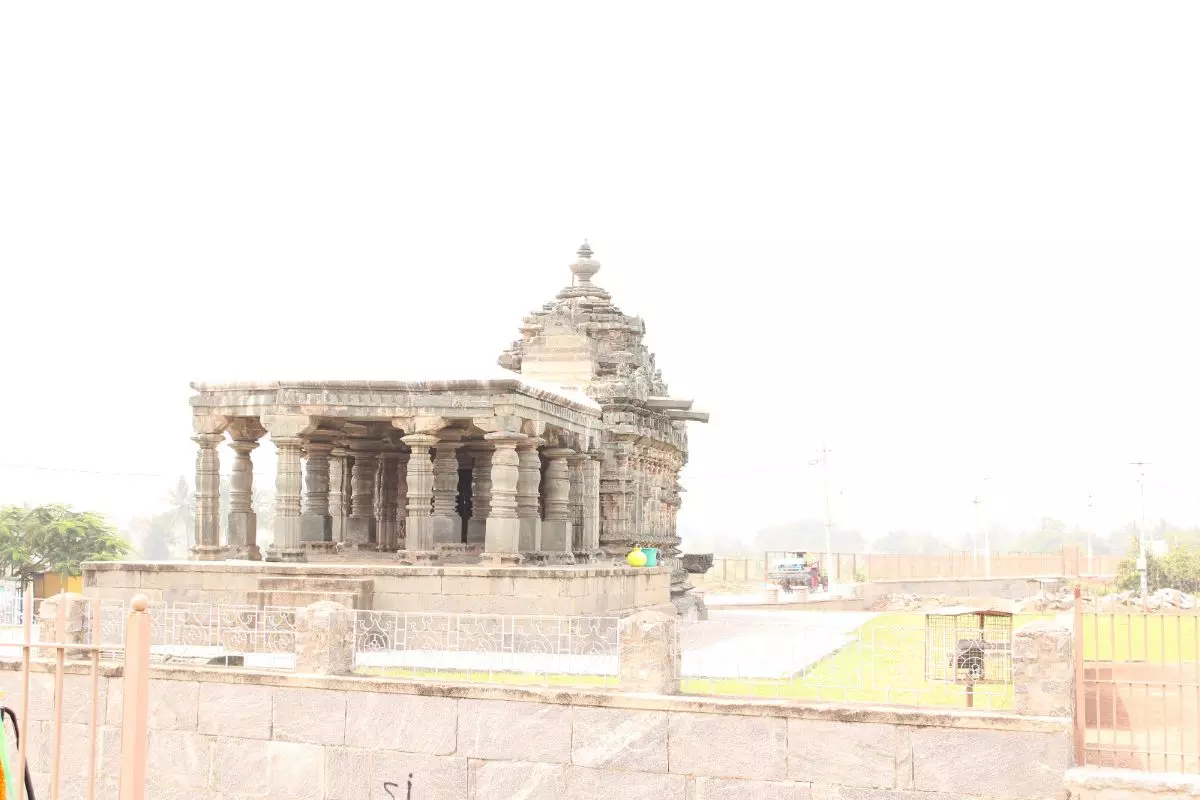
One of the historical temples in Lakkundi. Photo: By special arrangement
“The Deccan plateau, by virtue of its geographical location between the North and South, was a melting pot of architectural ideas from both regions. Deccani artisans, being aware of the northern Nagara tradition, tended to experiment with novel ways of tweaking and putting together architectural components within mounds of the Dravidian tradition,” says Srikumar M Menon, associate professor at the National Institute of Advanced Studies, Bengaluru.
According to historians, Lakkundi saw a confluence of Vaishnava, Shaiva and Jain traditions.
“Lakkundi was once known as the land of 101 temples and wells. While many of these temples are buried under present-day settlements, about 70 are still visible. They need to be excavated and preserved,” says Sharanu Gogeri, commissioner, Lakkundi Heritage Area Development Authority (LHADA).
The LHADA was envisaged in 2017-18, following a budget declaration by the Karnataka government to conserve, manage and develop the historic town of Lakkundi. It was formed as an institution in 2020. The aim was for it to oversee the preservation of over 50 Chalukyan-era temples and 101 step wells, as well as the various inscriptions scattered around the village and to promote heritage tourism.
The first excavation in Lakkundi, according to chief minister Siddaramaiah, was in 2004-05, which had unearthed a wealth of inscriptions dating back to the Kalyana Chalukya period. The CM was speaking at the inauguration of a makeshift, open-air museum to display artefacts collected in Lakkundi. Excavations in Lakkundi were carried out last year too, in November, and then again last month.
In a novel initiative by the ASI on November 24 last year, 1050 antiquities, including rare sculptures, coins, pearls and gems, were collected, all donated by the local community. The day saw the streets of Lakkundi filled with palanquins bearing ancient coins and gold, silver, brass and copper artefacts, carved stone inscriptions and palm leaf manuscripts; all testament to the town’s historical wealth.
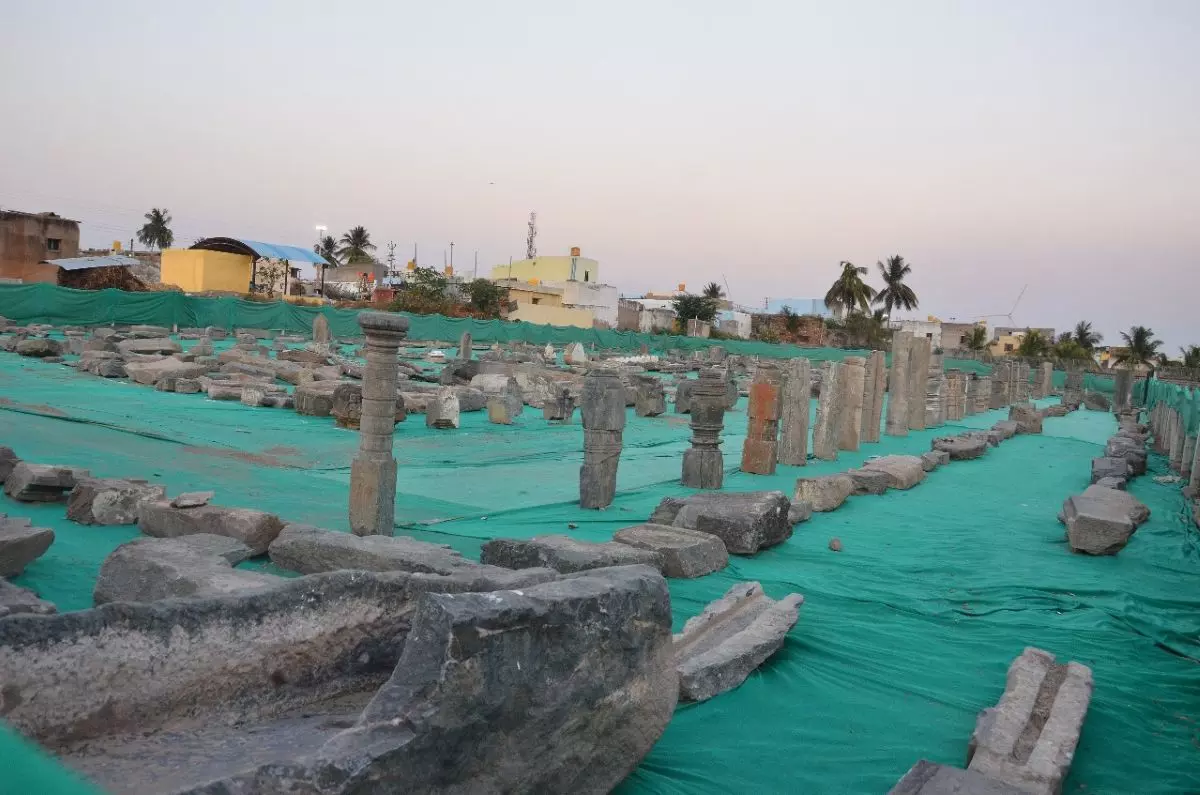
A makeshift, one-air museum displays artefacts collected from Lakkundi. Photo: By special arrangement
The Deccan Heritage Foundation (DHF), a non-profit working to “preserve, restore and promote the architectural heritage of the Deccan region” has shown interest in conserving these artefacts.
While Lakkundi already has a museum at the Brahma Jinalaya (Jain praying place), managed by the ASI, a new museum has been proposed, an initiative of the State Department of Archaeology, Museums and Heritage, which will be under the ambit of LHADA, where the artefacts currently being displayed in the open museum will be conserved.
All these developments have coincided with the Karnataka government’s ongoing efforts to secure a UNESCO World Heritage Site tag for Lakkundi. A final proposal to this effect was sent by the state to the Centre in December and a team from UNESCO visited Lakkundi this month to assess the 10th-century Kalyana Chalukyan monuments. The tag is likely to bring prominence to the village and draw tourists.
Also read: How Hyderabad’s iconic palaces and monuments narrate a story of past architectural glory
However, Lakkundi’s prominence as a heritage town may result in displacement for its current residents.
“Elders in our family are proud of being a part of the great historical and archaeological treasure of this historic place,” says resident Siddu Patil.
However, purported government notices received by some of them to vacate their ancestral houses have come as a blow.
Sharanayya Chowkimutt, 60, claims to be among those who have received a notice to vacate. His house forms an extension of the Lakkundi’s Mahanteshwara temple, one of the historical monuments. “For the past five generations, my family has lived in this house. Now, we have received a notice to vacate. We will not oppose the government and are willing to move out if alternate land and housing are provided.”
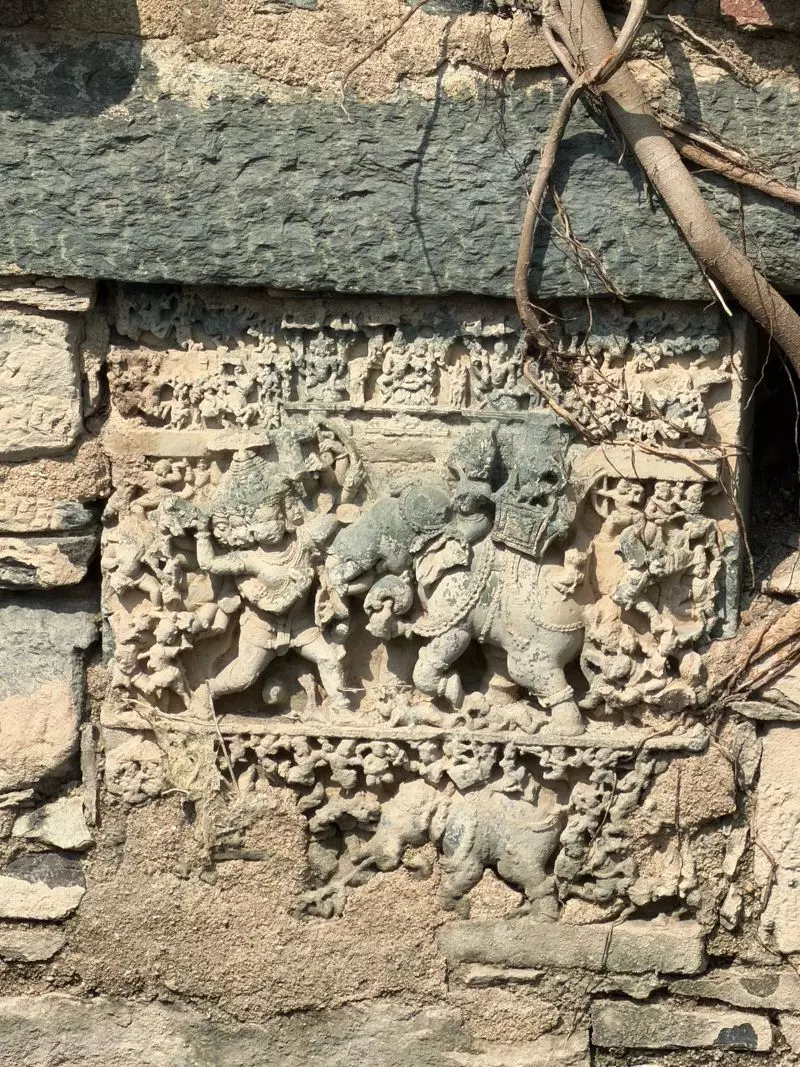
A piece of old stone carving. Photo: By special arrangement
While movement fill only happen once a final notice to that effect is received, LAHDA has been completely silent about rehabilitation and compensation plans, which will need to be sorted out at the government level. According to sources, there are plans to shift those who will be moved out of their homes to alternate housing in Maruthi Nagar.
Meanwhile, there are rumours that the entire village may be shifted to an alternate site, to preserve the history that lies buried under Lakkundi. According to sources in the state tourism department, the decision will be taken after the findings of last month’s excavation have been fully evaluated. According to the sources, there are plans to launch a more extensive excavation on the premises of the 12th-century Kote Veerbhadreshwara Temple (dedicated to the Hindu deity Shiva) and the project will be jointly undertaken by Karnataka’s Department of Archaeology, Museums and Heritage and LHADA.
A Devaraj, commissioner, department of archaeology, museums and heritage, says, “they identify locations [for excavations] based on importance and potential findings”.
As of now, however, CN Sridhar, deputy commissioner, Gadag district, informs that “the decision on shifting the entire village depends on the findings and the possibility of finding more monuments under the mounds that are visible to the bare eyes.”
Also read: Why in Bihar’s Biswak, a Kashmiri sultan’s grave remains forgotten and neglected
Ironically, while residents live under the threat of possible eviction, real estate rates in Lakkundi have been seeing a surge.
Barely two years ago, in 2023, agricultural land near Lakkundi, and along the national highway, was priced around Rs. 50 lakh per acre. Within two years, rates have nearly doubled, touching an all-time high for the region. Real estate agents attribute the hike in land price for the recent excavation at Lakkundi. “With the hope of Lakkundi emerging as a major heritage destination, realtors stepped up efforts to attract investors,” says a real estate agent speaking on condition of anonymity.
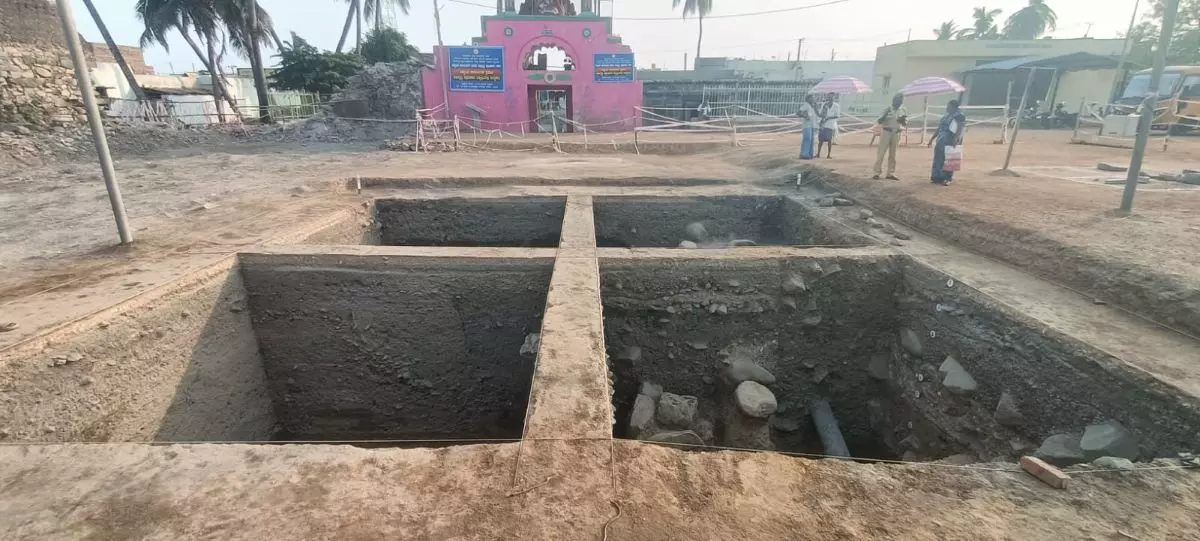
One of the excavation sites at Lakkundi. Photo: By special arrangement
According to a senior official of the tourism department, “At best, the UNESCO heritage site tag would put another ring of protection around the monuments and offer greater visibility for Karnataka’s artistic heritage. Karnataka can reap the benefit only if the authorities concerned take adequate measures to make these monuments tourist-friendly and meet all world standards in conservation.” Rajendra KV, director tourism, asserts that, “the government is dedicated to providing tourist-friendly facilities at all the monuments of significance. It is determined to implement master plans and recommendations made by the UNESCO committee in the coming days”.
But as the recently-found inscription reminds, ‘preservation’ is key; visibility and tourism will follow.