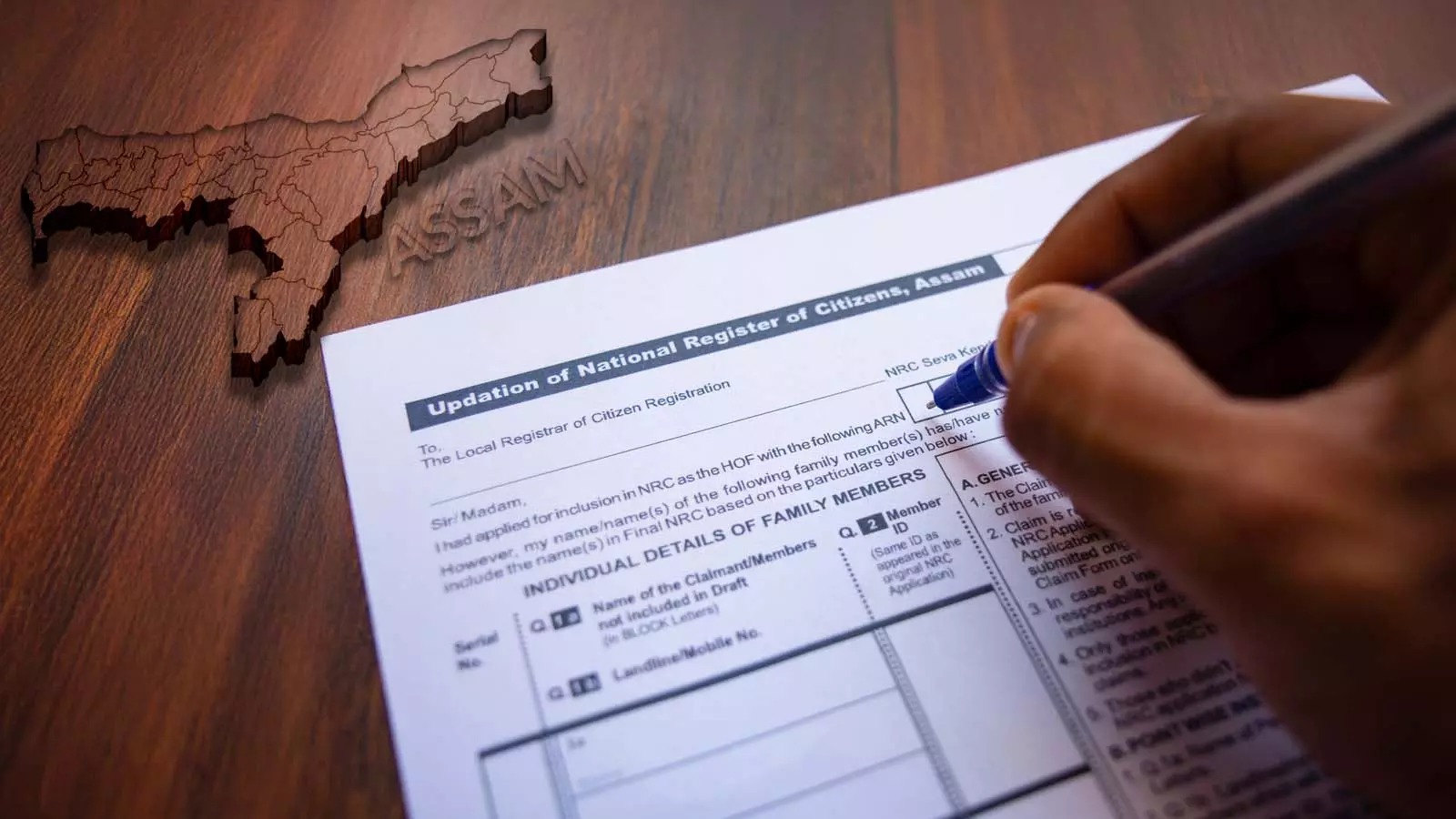
The question of establishing Indian citizenship by a petitioner in Assam faced a major legal hurdle recently, bringing to the fore the NRC issue once again.
Assam citizenship verdict shows one missing link can cost you your nationality
Dismissing a Goalpara resident’s petition, the Gauhati High Court reinforces that identity cards and oral testimony cannot substitute for an unbroken genealogical record

In Assam, citizenship disputes before Foreigners Tribunals (FTs) are rarely decided by identity alone. A person’s place of birth, language or even generations of residence in the state carry little weight unless backed by an unbroken chain of documentary evidence linking them to an ancestor whose name appears in records predating March 24, 1971.
Also read: Citizenship proof burden can’t be on people: Legal expert Faizan Mustafa
The significance of that documentary trail has once again come into focus after the Gauhati High Court upheld an FT’s decision declaring a resident of Goalpara a foreigner. The 21-page order, while confined to the facts of one case, illustrates the evidentiary standards that continue to govern thousands of citizenship proceedings in the north-eastern state.
Why HC dismissed a writ petition
A Division Bench of the high court comprising Justice Kalyan Rai Surana and Justice Shamima Jahan dismissed a writ petition filed by Aminul Hoque, a resident of Hashdoba village in Assam's Goalpara district and affirmed the February 2019 opinion of FT No. 4 in Kamrup (Metro), holding that he had failed to establish a continuous documentary link with the ancestors through whom he claimed Indian citizenship.
The court made it clear that the case did not turn on minor spelling differences in names, as is often assumed in such disputes. Variations in names are common in official records, the court observed. What proved decisive was Hoque’s inability to establish an uninterrupted chain of admissible documents connecting successive generations of his family despite claiming that they had moved across several villages over the decades.
Courts have also consistently held that more recent identity documents such as Aadhaar, PAN cards and EPIC have limited evidentiary value in citizenship proceedings. While they may establish identity or residence, they do not by themselves prove Indian citizenship.
According to court records, Hoque claimed that his family originally lived in Charai Khasara village under Lakhipur Police Station in Goalpara district and that the names of his father, grandparents and other relatives figured in the 1951 National Register of Citizens (NRC). He said recurring erosion caused by the Brahmaputra River forced the family to move to Dhobakura village in the same district around five decades ago, where his grandparents appeared in the 1966 and 1970 state electoral rolls.
He further stated that after the family got separated and his parents shifted to Ghugudoba, also in Goalpara district, before finally settling in Hashdoba, where he was born in 1988. His own name first appeared on the electoral roll only in 2015.
Also read: 'Modern Assam result of centuries of social, economic, political changes'
To support his claim, Hoque produced 15 documents before the tribunal, including extracts from the 1951 NRC, certified copies of electoral rolls from 1966 to 2017, a land sale deed executed in 1973, a school certificate, his PAN card, and his Electors Photo Identity Card (EPIC). He also examined himself and a person identified as his father as witnesses.
Tribunal, HC find evidence inadequate
Neither the tribunal nor the high court found the evidence sufficient. The two extracts from the 1951 NRC were held to be inadmissible because they were computer-generated copies produced through legacy data software without the certification required under Section 65B of the Evidence Act for electronic records.
The court bench also reiterated that the 1951 NRC had been prepared under the Census Act, 1948, which bars the use of census records as evidence in judicial proceedings, a legal position settled in earlier judgments.
The 1973 land sale deed produced by Hoque was similarly found inadequate. While it established that his “projected grandfather” had purchased land in Ghugudoba, it did not prove Hoque’s relationship with the purchaser.
If the family had subsequently partitioned or inherited the property, corresponding land mutation or revenue records ought to have been produced, the court said.
Why PAN, EPIC didn't establish citizenship?
The bench also rejected the evidentiary value of the PAN card and EPIC, reiterating that neither document establishes citizenship. A PAN card is issued primarily for taxation purposes, and an EPIC only recognises a person as an elector; neither is proof of citizenship by itself. The court also noted that both documents had been issued after proceedings against Hoque had already begun.
The school certificate fared no better. Since the headmaster who issued it was not examined before the FT and the school’s admission register was not proved, the certificate could not be relied upon. The court referred to a settled law that such documents must be proved through the issuing authority.
Also read: Is India heading towards nationwide citizenship register? | AI With Sanket
Nor could oral testimony bridge the gaps in the documentary record. Although the person identified as Hoque’s father appeared before the tribunal and affirmed their relationship, the high court reiterated that citizenship proceedings under the Foreigners Act are decided primarily on documentary evidence rather than oral assertions.
A close examination of electoral rolls spanning more than five decades also failed to establish continuity. The bench found that the family did not appear consistently in the electoral records of Dhobakura, Ghugudoba and Hashdoba. Every shift in residence (as the family had lost land due to river erosion) was accompanied by a different combination of names, ages or family members, but the documentary links needed to establish lineage remained missing.
Mother's age inconsistency
One inconsistency involved Hoque’s mother. In the 1979 electoral roll of Dhobakura, Faziron Nessa was shown as 25 years old. In the 1997 electoral roll of Hashdoba, a person bearing the same name was recorded as 39. Yet in the 2005 electoral roll, her age was again shown as 25. The court treated this not as a routine clerical mistake but a significant discrepancy.
It also noted unexplained gaps involving other “projected family” members, including an uncle whose name disappeared from subsequent electoral rolls and two persons listed in the 1979 roll whose relationship with the family was never established.
The judgment reflects a broader legal principle that has shaped citizenship adjudication in Assam for decades. Under the framework that evolved after the Assam Accord (1985), a person claiming Indian citizenship through the pre-1971 route must first produce a recognised legacy document issued before the midnight of March 24, 1971.
That document alone, however, is rarely enough. The claimant must also establish, through admissible records, an unbroken genealogical link with the person named in the legacy document.
Recognised legacy documents include the 1951 NRC, electoral rolls published before the cut-off date, land and tenancy records, permanent residence certificates, refugee registration certificates and citizenship certificates.
Depending on the facts of a case, passports, LIC (Ife Insurance Corporation of India) policies and school certificates issued before the cut-off may also be considered. Where citizenship is claimed through a parent or grandparent, additional linkage documents—such as birth certificates, school records or other contemporaneous public records—become critical in establishing continuity.
Also read: Passport as citizenship proof: Trial balloon for a larger agenda?
It is this requirement of proving lineage, rather than merely producing an old electoral roll or legacy document, that often determines the outcome of proceedings before the FTs.
What Hoque's case showed
While the Hoque case turned on gaps in documentary evidence, it also reflects the broader framework governing citizenship proceedings in Assam. The law requires more than the presence of an ancestor’s name in a pre-1971 record. A claimant must establish an uninterrupted documentary link with that ancestor through admissible records such as birth certificates, school records or other public documents.
Missing records, changes in village names, spelling variations and inconsistencies in age often become the focus of scrutiny before the FTs.
Courts have also consistently held that more recent identity documents such as Aadhaar, PAN cards and EPIC have limited evidentiary value in citizenship proceedings. While they may establish identity or residence, they do not by themselves prove Indian citizenship. The emphasis remains on legacy documents and the continuity of records linking successive generations.
The documentary requirements are well settled in law, but their implementation continues to generate political debate. The Assam government has maintained that the process is religion-neutral and aimed solely at implementing the March 24, 1971, cut-off date as per the Assam Accord.
It has argued that the same legal standards apply to everyone referred to an FT, irrespective of religion or language, and has cited cases in which individuals initially marked as doubtful voters were later declared Indian citizens after producing the required evidence.
Poorer, marginalised bearing brunt: Advocate
A senior advocate of the Gauhati High Court, Abdur Rejjak Bhuyan, however, argued that the burden of producing decades-old documents falls disproportionately on poorer and marginalised communities. They point to the state’s history of floods, river erosion and repeated displacement, which have destroyed land records and other official documents. Clerical errors in electoral rolls, variations in spellings and changes in administrative boundaries have further complicated the task of proving lineage, particularly for families that have moved frequently or for women whose names changed after marriage.
Also read: MEA says passport is not citizenship proof; so how do you prove you are Indian citizen?
The debate has widened beyond Assam. The Centre’s Immigration and Foreigners Order, 2025, allows for the establishment of FTs outside the state, while recent electoral roll revision exercises in other parts of the country have revived discussions around documentation and citizenship. Rights groups have also questioned whether communities with historically weaker access to official records are more vulnerable to exclusion, even when the legal standards remain uniform.
Bhuyan said the burden of proof remains the defining feature of proceedings before the FTs. Under Section 9 of the Foreigners Act, 1946, the responsibility of proving citizenship rests on the person facing the reference, unlike in most legal proceedings, where the burden lies on the state administration.
Missing paper trails a huge challenge
Bhuyan further said the courts have repeatedly held that minor discrepancies in names or ages cannot, by themselves, defeat a citizenship claim. But where the documentary chain is broken or key records are missing, tribunals are unlikely to accept oral testimony alone.
The high court’s order in Hoque’s case reinforces that position. It makes clear that while minor clerical variations may be overlooked, citizenship claims ultimately stand or fall on the strength of a credible and continuous documentary trail linking an individual to a recognised pre-1971 ancestor. For thousands of families in Assam, that paper trail remains both the legal requirement and the greatest challenge.
“Moreover, the court bench also referred to as a ‘projected father’, ‘projected grandparents’ or ‘projected family’, which indicated that the court is not accepting those relationships as established facts. Instead, it is signalling that those persons are merely being presented or claimed to have that status, pending proof,” Bhuyan added.