Is India heading towards nationwide citizenship register? | AI With Sanket
Former Chief Election Commissioner SY Quraishi questions the intent behind the government's passport clarification and warns against an Assam-like NRC fiasco

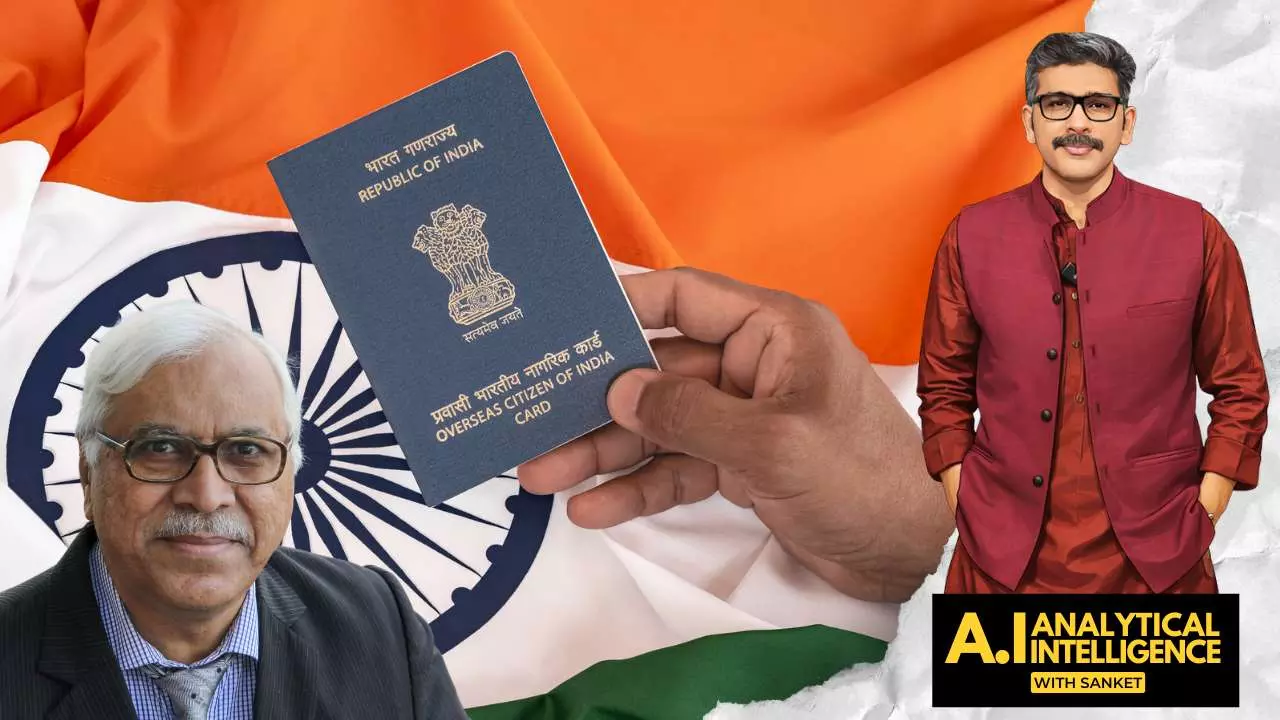
Is an Indian passport proof of citizenship or merely a travel document? The Centre's recent clarification has triggered a nationwide debate, raising fresh questions about citizenship, documentation, the NRC, voter ID, Aadhaar, birth certificates, and what legally establishes Indian citizenship. On AI with Sanket, former Chief Election Commissioner SY Quraishi speaks to The Federal to examine the legal position, the political implications of the government's clarification, and whether India is moving towards a nationwide citizenship register.
Quraishi explains why passports are legally travel documents, discusses the lessons from the Assam NRC, questions the government's intent, and proposes an alternative roadmap that that he says would minimise harassment while creating a credible citizenship documentation system.
Also read | Passport, citizenship, and the SIR debate: Why the govt’s stand faces scrutiny
In a country where common identifiers like ration cards, voter IDs, and other identity certificates are increasingly questioned as definitive proofs of nationality, the question of how an individual establishes their citizenship has taken centre stage. Quraishi unpacks the implications of recent administrative clarifications, the logistical challenges of implementing a nationwide citizen registry, and potential, less disruptive paths forward.
How do you view the Ministry of External Affairs' reiteration that a passport has nothing to do with proving your citizenship?
Although the clarification by the Ministry of External Affairs (MEA) is legally correct—because by law, a passport is strictly a travel document—I am surprised by the provocation behind issuing this statement. Who had asked for it? What was the occasion? We really don't know, so surely there is more than meets the eye. Be that as it may, the statement makes it clear that the passport, which most of us took as final proof of citizenship, cannot be legally regarded as such anymore.
Conventional wisdom suggests that you only get a passport after excessive background checks and police verification to satisfy the state that you are a bona fide citizen. In light of this, how is an average individual supposed to prove their citizenship if every common document is deemed insufficient?
The point you raised is absolutely correct. Until now, most of us believed that holding a passport was foolproof evidence of citizenship because it is primarily issued to citizens. However, if you look deeper, it is not only citizens who can obtain one. In special circumstances, non-citizens can also be granted a passport. For instance, Tibetans in India, though not declared Indian citizens, are given Indian passports. Therefore, a non-Indian can get a passport under specific conditions.
But you are right that for the general population, a passport is issued only after proving citizenship. The same went for the voter ID card, which was given exclusively to Indian citizens—a foreigner, even from a neighboring country like Nepal, could not get one. Most of the people have that voter card in their pocket, making it a very convenient arrangement.
While the passport is now declared unfit as proof of citizenship, it doesn't create too much of a practical problem or unsettle the situation for the masses because only about 6.5% of the country's population holds a passport. Most of India does not depend on it. Declaring the voter card insufficient, however, was a far more serious step.
The government frequently clarifies what does not constitute proof of citizenship, but there is no major awareness campaign explaining what does. Legally, a birth certificate and a domicile certificate are solid proofs, but for older generations, births often happened at home without any official registration. Are we seeing the groundwork being laid for a nationwide National Register of Citizens (NRC) and a unique citizenship card?
You are absolutely right. That is the exact question coming to most people’s minds. Perhaps a movement like the NRC is the underlying provocation, but the government should be quite upfront about it instead of approaching it through devious ways. If we need a citizenship document, we ought to have one, and I am actually all for it. It is strange that we haven’t had one all these years.
The Registration of Births and Deaths Act was passed in 1969, making the birth certificate the foundation for all subsequent identity documents. While states took their time to implement it, the act has been actively operational for the last 40 years. In 2003, the NDA government amended it to make birth registration explicitly compulsory and proposed a population register. Why it hasn't been fully realised after more than two decades remains a question.
However, we must look at the Assam NRC experience of 2019, which turned out to be a fiasco. After five years of effort, solid administrative backing, and Supreme Court supervision, it concluded with 19 lakh people being excluded, 14 lakh of whom were Bengali-speaking Hindus. Both the factions demanding the NRC and those against it declared the outcome highly defective, which is why it remains in limbo. We spent ₹1,500 crore just to count 3.3 crore people. If you scale that up to a population of 145 crore Indians, you can imagine how monumental and difficult the task would be.
Also read | ‘Passport should prove citizenship’: Tharoor calls for legal change
While a citizenship registry is inevitable and should be done, pushing it down the throats of the nation without adequate preparation or a clear roadmap would be silly. All six of our neighboring countries—Pakistan, Bangladesh, Bhutan, Nepal, Sri Lanka, and the Maldives—have a national document of this nature. On the flip side, countries like the US, UK, and Canada do not have a specific citizenship document and rely on various other papers.
I have a solution to offer: since birth certificates are currently available to roughly 60% to 65% of our population, about 80 to 85 crore people can easily be granted a citizenship certificate within six months without any issues. If we split the problem into two segments, we can address the younger demographic first. For elders who cannot be expected to dig up documents belonging to their fathers or grandfathers, we should wait. If the country has lived without a citizenship certificate for 75 years, heavens will not fall if we wait another 10 to 15 years. We should give certificates to those who have birth records and let the system phase in naturally for the rest over time, ensuring there is absolutely no administrative harassment.
Given that existing documents like Aadhaar, voter IDs, and passports have faced vulnerabilities regarding fraudulent procurement, what guarantee is there that a new citizenship ID card won't face the same loopholes? Are we just forcing people to stand in lines again without solving the core issue?
Fraud can be committed against any document; forgeries can be created at any time, and that remains a matter of criminal law and enforcement. Throwing the validity of existing documents into the dustbin simply because some forged variants were discovered is a mischievous and foolish policy decision. Millions of genuine individuals who were deleted or left out in previous exercises faced severe consequences and harassment.
When Aadhaar was being rolled out intensively between 2009 and 2016, it represented a massive missed opportunity. Aadhaar was in an ideal position to become a citizenship certificate. Government machinery went door-to-door collecting biometrics, fingerprints, and iris scans—the exact same data an NRC would require. Why did the government stop short and declare it strictly a proof of identity and residence? The argument provided was that it was meant solely to streamline welfare schemes and eliminate duplicate beneficiaries.
With better scrutiny and administration, that exercise could have established citizenship. Instead, it was pushed aside, and now we are looking at repeating an identical, intensive exercise that adds to public harassment. The administrative system has become highly insensitive to the struggles of citizens.
Why do we fundamentally need a citizenship card right now if the country has functioned well without one for over seven decades?
The 2003 amendment to the Citizenship Act introduced the explicit term "illegal immigrant." The drive toward a citizenship card is largely driven by the intent to identify these individuals. However, there are far better, localised ways to identify illegal immigrants instead of harassing 99.9% of the population to find a few thousand people.
For instance, Booth Level Officers (BLOs) routinely conduct door-to-door verifications for electoral rolls. Neighbours are always the first to notice and report a new, unfamiliar resident in the locality, and they historically account for the maximum applications for electoral roll deletions. The Election Commission has successfully utilised these summary revisions for decades to maintain the rolls.
Why can't the voter ID card itself simply function as the definitive citizenship card, given that citizenship is a mandatory prerequisite to vote?
Exactly, that is the most logical path forward. Since the voter card is legally restricted to Indian citizens, cleaning up the electoral rolls via smart, regular administrative measures is the best way to address the problem.
Also read | Passport row: If a passport isn't proof of citizenship, what is? Experts explain
To check fraud, you do not penalise or harass 99% of the population; you target the specific loopholes through better enforcement. The electoral rolls used by the current election commission have successfully brought governments into power, meaning they are substantially accurate. Of course, there are administrative discrepancies, such as deceased individuals remaining on the rolls because no one formally reports the death, or duplicate entries due to people relocating for work without canceling their previous registration.
During our tenure at the Election Commission, our philosophy was to make the process inclusive. Instead of forcing a migrant worker to travel back to their hometown to get a cancellation certificate, we allowed them to fill out Form 6 at their new residence, list their previous address at the bottom, and we handled the internal deletion ourselves. Cleaning up the rolls forcefully but with dignity, using the voter ID as a foundation, remains the most efficient, hassle-free path toward a verifiable citizen count.
The content above has been transcribed from video using a fine-tuned AI model. To ensure accuracy, quality, and editorial integrity, we employ a Human-In-The-Loop (HITL) process. While AI assists in creating the initial draft, our experienced editorial team carefully reviews, edits, and refines the content before publication. At The Federal, we combine the efficiency of AI with the expertise of human editors to deliver reliable and insightful journalism.