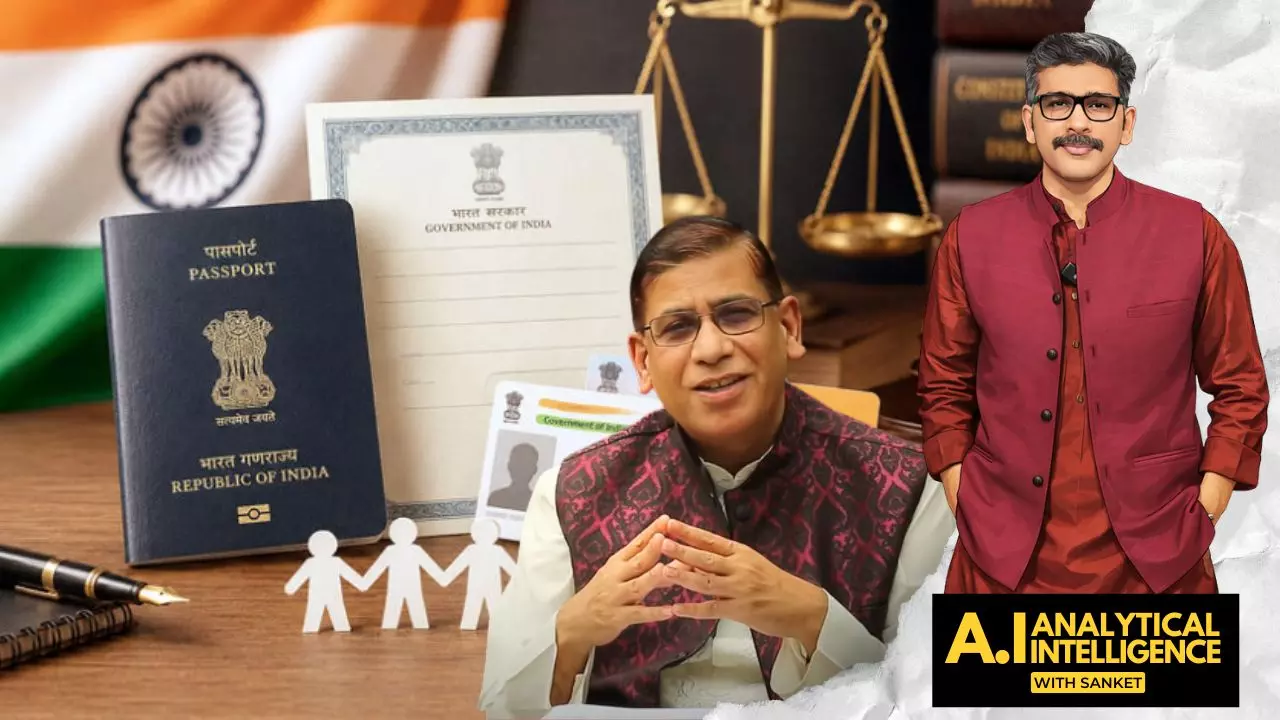
Citizenship proof burden can’t be on people: Legal expert Faizan Mustafa | AI With Sanket
Constitutional law expert Faizan Mustafa says citizens should be presumed to be Indian unless proven otherwise, and passports must be accepted as a proof

The burden of proving citizenship should not be placed on ordinary citizens, especially in a country where millions lack complete documentation, said Professor Faizan Mustafa, constitutional law expert, in this episode of AI With Sanket.
He argued that anyone born in India should be presumed to be an Indian citizen unless the government or any challenger produces evidence to prove otherwise. He also contended that a passport and voter ID, once issued by the government after due verification, should be treated as conclusive proof of citizenship.
The debate follows the Centre's clarification that a passport is legally only a travel document and not proof of citizenship. In this context, The Federal spoke to Professor Mustafa about the legal position, the Passport Act, the Supreme Court's observations, and why he believes shifting the burden of proof onto the citizens could create enormous hardship. Edited excerpts:
The government says a passport is only a travel document and not proof of citizenship. How do you view this debate?
Technically speaking, the government's clarification is legally correct because a passport is primarily a travel document. But the issue is much larger than that.
Also read: Passport row: If a passport isn't proof of citizenship, what is? Experts explain
Even a birth certificate is not, by itself, proof of nationality. Children of foreign diplomats born in India do not automatically become Indian citizens. In countries like the United States, birth right citizenship makes the birth certificate sufficient, but India's citizenship law is different.
My concern arises from the Passport Act itself. Section 6(2)(a) clearly says that a person who is not an Indian citizen cannot apply for a passport, except in extremely rare circumstances provided under Section 20. Anyone applying for a passport must declare that they are an Indian citizen, and if that declaration is false, it is a punishable offence carrying imprisonment from one to five years.
My first passport even carried a seal stating "Citizen of India". That wording may no longer appear, but the legal position remains the same.
Just before the Supreme Court closed for its summer break, it delivered a detailed judgment in the Bihar Special Intensive Revision case, where it observed that a passport is a major document for proving citizenship, whereas Aadhaar is not.
Technically, yes, a passport is a travel document. But this clarification has unnecessarily created anxiety among millions of Indians. That is why the issue has dominated newspapers, television debates and social media discussions over the past few days.
If passports, Aadhaar, voter IDs and other documents are not considered proof of citizenship, what exactly is?
That is precisely the concern.
For decades, India consciously chose not to issue a citizenship card. Although the Citizenship Rules framed after the 2003 amendment provided for such a mechanism, no government has implemented it for over two decades.
Also read: Passport, citizenship, and the SIR debate: Why the govt’s stand faces scrutiny
Perhaps that has been wise because any nationwide exercise to determine citizenship would become enormously complicated.
Look at the Special Intensive Revision exercise in Bihar. If a similar exercise were undertaken nationally, I estimate that perhaps 25 to 35 crore people may struggle to produce documents proving not only their own citizenship but also that of their parents, wherever the law requires it.
That is why I have suggested a completely different legal approach.
You have argued for a "presumption of citizenship". What exactly does that mean?
The law frequently works on presumptions.
Courts take judicial notice of certain facts without requiring proof. For example, nobody needs to prove that the sun rises in the east.
Similarly, the law creates presumptions in criminal cases. In rape cases, once sexual intercourse is established, the law presumes absence of consent in certain circumstances unless the accused proves otherwise. If stolen property is found in someone's possession, the law initially presumes involvement in theft unless the person offers a satisfactory explanation. Dowry death provisions similarly create legal presumptions.
My proposal is very simple. Every person born in India should be presumed to be an Indian citizen. If anyone questions that person's citizenship, the burden should lie on the challenger—not on the citizen. If someone claims that I am not an Indian citizen, let that person produce evidence. For example, let them produce records showing I was born abroad or that my parents were foreign nationals.
Instead, we are asking poor, illiterate people—many of whom have no formal records—to prove their citizenship. That is fundamentally unfair.
Also read: Is India heading towards nationwide citizenship register? | AI With Sanket
India's record-keeping is nowhere close to that of developed countries. Large numbers of migrant workers, labourers and economically weaker citizens simply do not possess complete documentation.
Does the Assam NRC offer any lessons for the rest of the country?
Absolutely.
Assam has debated citizenship for nearly four decades, making people much more conscious about preserving documents. Even then, despite extraordinary efforts, only 3.11 crore people managed to establish their citizenship.
Seven years after the NRC process, however, not a single person included in the final NRC has been issued a citizenship certificate.
The 19 lakh people left out have not even received notices from Foreigners Tribunals in many cases.
We spent over Rs 1,100 crore on this exercise, yet the matter remains unresolved.
Women suffered disproportionately because many were married at a young age and shifted to different villages without proper records linking them to their parental homes.
If this level of difficulty exists in Assam, imagine the challenge across India.
Insisting excessively on documentation could wrongly exclude genuine Indian citizens.
Do you believe this debate has become more political than objective?
I would not immediately attribute political motives.
Perhaps the clarification was issued by an official simply interpreting the law in a technical manner.
But regardless of the intention, it has undoubtedly created anxiety among the public.
These issues deserve discussion with complete objectivity rather than political rhetoric.
Why do you believe the government focuses more on what is not proof of citizenship rather than explaining what is?
That is a very important question.
One possibility is that eventually the government may introduce a citizenship card and then ask people to produce documents to obtain it.
Ironically, those very documents that are currently described as insufficient may then become necessary for obtaining the citizenship card.
Also read: ‘Passport should prove citizenship’: Tharoor calls for legal change
We need two basic legal principles.
First, everyone born in India should be presumed to be an Indian citizen unless the government proves otherwise.
Second, once the government has issued a passport after police verification, that passport should be treated as conclusive proof of citizenship.
Similarly, a voter ID should also be treated as conclusive proof because only Indian citizens are eligible to be registered as voters.
Evidence law recognises the concept of conclusive proof, meaning no further evidence is necessary unless fraud or misrepresentation is established.
There is also the legal doctrine of estoppel [a legal principle that prevents a person from going back on their word, or arguing something that contradicts what they previously stated or agreed to].
If the government has itself accepted me as an Indian citizen while issuing my passport or voter ID, it cannot later casually deny that very status.
Of course, if fresh evidence emerges that someone voluntarily acquired foreign citizenship, the government can act accordingly. Citizenship can change over time.
But the government's own documents cannot simply be dismissed as meaningless.
The Passport Act itself begins by saying that it is enacted to enable citizens of India to travel abroad. Even the Act's territorial application refers to citizens of India living abroad.
How then can officials ignore the very opening words of the law?
Should passports and voter IDs continue to carry legal weight unless the government proves otherwise?
Exactly. If the government later discovers that someone became a citizen of another country and failed to surrender Indian citizenship, it has every right to cancel that passport.
But unless such evidence exists, the government should accept the validity of documents it has itself issued. Otherwise, the position becomes absurd.
Also read: MEA says passport is not citizenship proof; so how do you prove you are Indian citizen?
The government issues passports only to Indian citizens. It cancels passports once someone voluntarily acquires foreign citizenship. Yet it now says that its own passport cannot establish citizenship. That logic simply does not hold.
Some argue that many neighbouring countries maintain citizenship registers or NRC-like exercises. Why should India be different?
India is simply too large. Had we introduced such a system immediately after Independence, matters might have been different. If we undertake such an exercise today, it should be designed to include citizens rather than exclude them.
Suppose 30 crore people fail to establish their citizenship. Where exactly will they go?
Which country will accept them?
Article 14 of the Constitution requires every state action to have a rational objective.
If genuine foreigners are caught entering India with foreign passports, certainly the burden of proof can rest upon them.
But if people are born in India, have lived here throughout their lives and possess government-issued documents, the law should begin with a presumption that they are Indian citizens.
Laws exist to make people's lives easier, not more difficult.
(The content above has been transcribed from video using a fine-tuned AI model. To ensure accuracy, quality, and editorial integrity, we employ a Human-In-The-Loop (HITL) process. While AI assists in creating the initial draft, our experienced editorial team carefully reviews, edits, and refines the content before publication. At The Federal, we combine the efficiency of AI with the expertise of human editors to deliver reliable and insightful journalism.)