From Siraj's surprise call to Modi's direct coronation, India's decision-makers increasingly treat procedure as optional and that should worry us all
Now that the T20 Cricket World Cup is over, the Indian team has walked away as victors and, most importantly, IPL is around the corner, this can be told.
If written before, or while the tournament was underway, this writer may well have been accused of anti-nationalism.
Liberties taken by the Indian team management with “convention” on the eve of the tournament unfortunately mirrored what has been happening nationally, at the highest echelons of government and political parties.
Rana out, Siraj in. But who made the call?
Barely a couple of days prior to the tournament kicking off, pacer Harshit Rana sustained a serious right-knee ligament strain during a warm-up match against South Africa and was advised immediate surgery.
This created a vacancy and the replacement was not just to be “selected” immediately, but his name needed clearance from the Event Technical Committee of the International Cricket Council too.
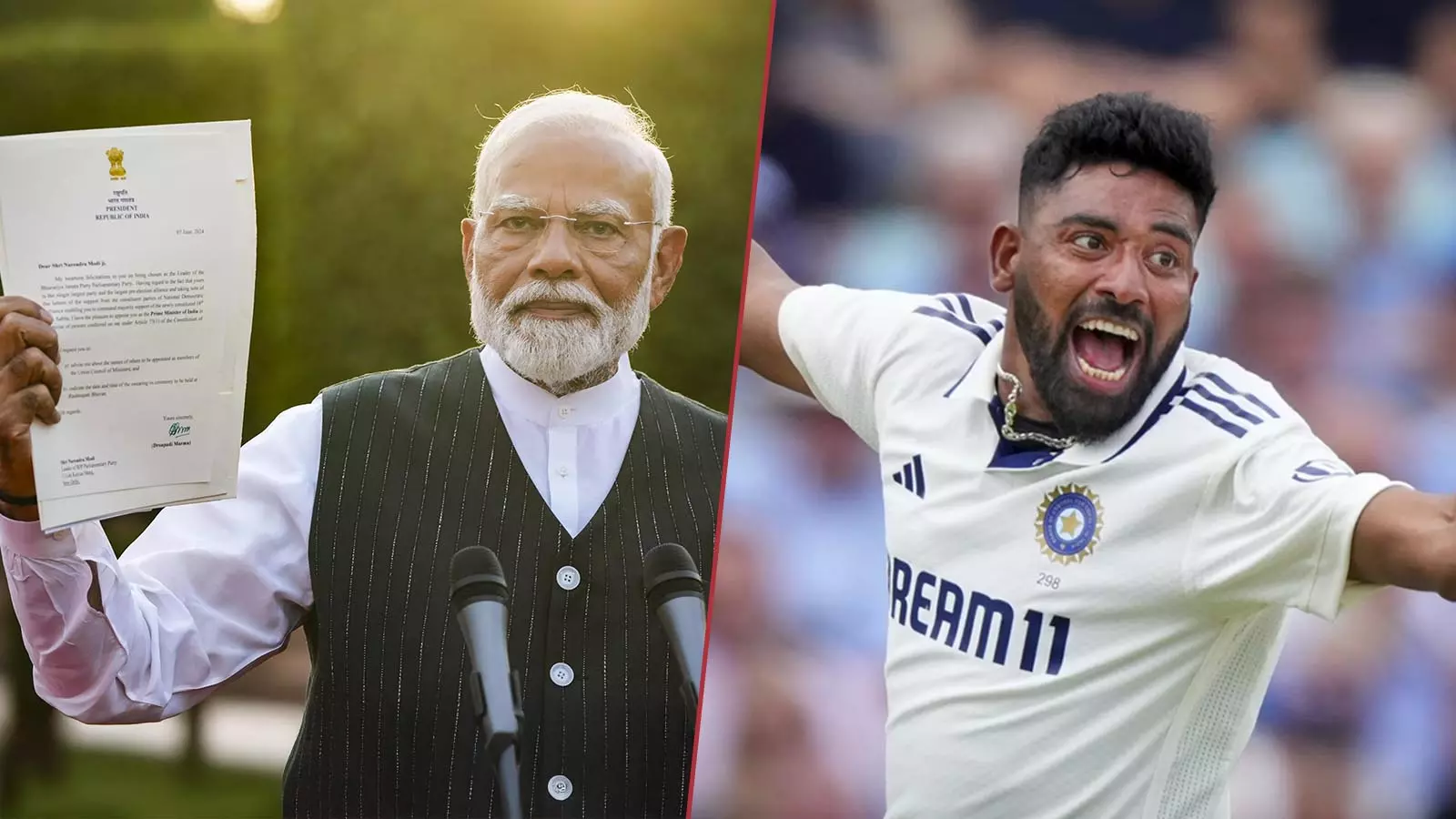
But, there is no record of the selection committee meeting, identifying, and intimating the substitute. Instead, records available of statements made by skipper Suryakumar Yadav and Rana’s replacement, Mohammed Siraj, establishes that the first call was made by the captain.
Also Read: ‘Colour discrimination’: L Sivaramakrishnan quits commentary; who said what
The Hyderabad pacer was quoted in the media as believing that Yadav was pulling his leg when he called and informed him about being drafted into the Indian squad as Rana's replacement.
Yadav evidently told Siraj, “Miya, get ready, pack your bags and come.” Siraj said on hearing this, he replied, “Surya bhai, don't joke right now. You joke a lot, but not about something like this.”
Yadav, however, explained to Siraj that he was serious. “Pack your bags and come.” It was only later, the pacer mentioned, that Pragyan Ojha, a former India cricketer and currently one of the national selectors, called him and officially informed him about his selection. Eventually, Siraj joined the team in Mumbai barely 36 hours before their first match.
Right choice, wrong process
Few would disagree with Siraj’s selection as Rana’s replacement. Even before he settled down, Siraj was tasked to stand in for pace spearhead, Jaspreet Bumrah, who was unwell. Siraj turned out against USA and performed admirably. He did not get another chance to play in the tournament. But one match was enough to underline that Siraj’s induction for Rana was correct.
However, I have a bone to pick with the manner in which Siraj was identified and informed by Yadav. This process practically underscored the redundancy of the selection committee. The episode also established that officially-accepted “processes” are not followed in the BCCI.
The selection committee had ample time to meet, online at least, if not in-person.
Also Read: Gavaskar slams Sunrisers for buying Pakistan's Abrar in Hundred
True, the coach and captain are invited to selection meetings to provide input, share team requirements, and assist in team selection. But, they do not have voting rights. Additionally, the BCCI secretary serves as the convener for the senior selection committee meetings.
There are instances of disagreement between the team management and selectors in the past. This does not however, mean that team selection should be left in the hands of the coach and captain duo.
In this instance, it is difficult to believe that the selectors passed the role of informing Siraj of his selection. Clearly, Yadav jumped the gun, possibly with or without Gautam Gambhir’s clearance, and wanted to appear as having personally favoured Siraj.
The BCCI is unlikely to caution Yadav, and not just because winning captains are seldom reprimanded, but also because the BCCI itself is not following due processes.
Jay Shah called first, the selectors later
In another media Q&A featuring Yadav after the T20 crown was bagged, the skipper, after waxing eloquent on how the hard work over two years (as captain and player) paid off.
He was asked if he remembered when the call came regarding his appointment as T20 captain.
“I can never forget that day,” Yadav started. “One week before going to Sri Lanka, I got a call from Jay Sir (Jay Shah) saying we are making you the T20 captain. After that, Ajit Bhai (Agarkar, chief of the selection committee) called, and I also spoke to Gauti Bhai (Gautam Gambhir) because I knew he was going to be the coach. Jay Sir said, ‘Speak to all the senior players, prepare a roadmap.’ The vision was to win the World Cup…” Yadav concluded.
Also read: Nitin Nabin as BJP president: Do party chiefs wield power in Modi-Shah era?
The Sri Lankan tour Yadav referred to was in July 2024, a month after India won the ICC T20 Championship in the USA, dramatically defeating South Africa in the last over. Rohit Sharma and Virat Kohli retired from white-ball cricket immediately after this.
In this instance too, Yadav was informed of the decision, of being picked to lead the Indian T20 team till at least the next world cup, by Jay Shah, the Honorary Secretary of the BCCI and not the chief of the selection committee.
When process is bypassed, trust erodes
Every institution, department, organization or similar entities have well-laid procedures regarding functioning and decision-making. Organisations function seamlessly if these processes are followed. If not, ad hocism becomes the norm.
Following the right procedure has the capacity to blunt anger and dismay at a decision that’s not to the liking of people.
But if right procedures are not followed, functional methods come in for scrutiny and public trust erodes. For instance, if India and even Mohammed Siraj performed poorly, the manner in which the pacer was chosen, with seemingly little role of the selection committee, would have been squarely criticized by cricket followers and Team India fans.
From the pitch to Parliament: A national pattern
In India, especially in recent years, we have come across numerous instances when procedures are either bypassed or are nominally followed. Worse, this is not solely limited to government departments, but the malaise the eaten into political parties too.
Also read: Nitin Nabin’s appointment: BJP borrowing the Congress playbook
Take, for instance, the process of selecting the new Bharatiya Janata Party president. JP Nadda had overstayed in the office despite his term ending in January 2023. His innings at the party’s helm was first extended till June 2024, after which he continued without any specific time-bound extension.
On December 14, 2025, it was dramatically announced that the party’s Parliamentary Board had “appointed” Nitin Nabin as the party’s “National Working President”. A month later, in a sham election in which he was the only leader to file his nomination for the post, he was formally “elected”.
It was no secret that the procedure, as laid down in the party’s constitution, was not followed either in letter or spirit. When Nabin was named in December as Working President, no information was disclosed regarding when and where the Parliamentary Board met to make the all-important decision.
Effectively, Nabin was “selected”, first in December last and thereafter a month later.
Previously, after the Lok Sabha results in June 2024, Prime Minister Narendra Modi was not formally selected by the party’s Parliamentary Board. He was also not elected as the leader of the BJP’s Parliamentary Party. Instead, he was directly “chosen” by the NDA Parliamentary Party.
Although it is difficult to imagine any other BJP leader becoming prime minister, it is difficult to fathom why procedures were not followed.
A decade of procedural shortcuts
One of the first instances of the government not following correct procedures, or using deceit, was in March 2016, during the passage of the Aadhaar Act (2016), when it was legislated as a Money Bill to bypass the necessity of securing the approval of Rajya Sabha too. This was done because the BJP or NDA then did not have majority in the Upper House.
Over the years, the Comptroller and Auditor General also pointed to several procedural lapses in flagship programmes like Bharatmala Pariyojana and PM Kaushal Vikas Yojana.
Also Read: ‘Gambhir vs Kohli, Rohit’: Head coach admits ‘mistakes’
Questions were also asked in 2019 on privatization and tendering process in domestic airports, which eventually overruled objections from the Department of Economic Affairs and NITI Aayog to allow a single private entity to win bids for six airports simultaneously.
Even on decisions which had a spiralling effect on national economy, as well as individual finances, demonetization, and lockdown, the decisions were autocratically taken without going through the proper channel.
More often than not, the Union Cabinet (also most state Cabinets) mostly uses a rubber stamp to clear decision taken by a handful at the highest echelon of the government – the Prime Minister’s (or Chief Minister’s) Office.
The law says: Do it right, or not at all
In Indian jurisprudence, several judges have based their judgement on an oft-repeated principle: “If a power is given to do a certain thing in a certain way, the thing must be done in that way or not at all.” But, this is not followed universally.
Procedures in decision-making being bypassed are a norm for most populist leaders and their cronies. It is also a working-style that is common to autocrats and authoritarians across the world.
This style in contagious and seeps downward – mostly from the super-autocrat(s), the hierarchy seeps down to junior or minor ones cast in the same mould.
Within India, from governance to selection for the Indian cricket team, decisions are not being taken by following the specified procedures. It may not lead to problems for the powers that be at the moment. But there is no knowing when awareness among people spreads and violations of procedures start stinging.
(The Federal seeks to present views and opinions from all sides of the spectrum. The information, ideas or opinions in the articles are of the author and do not necessarily reflect the views of The Federal.)