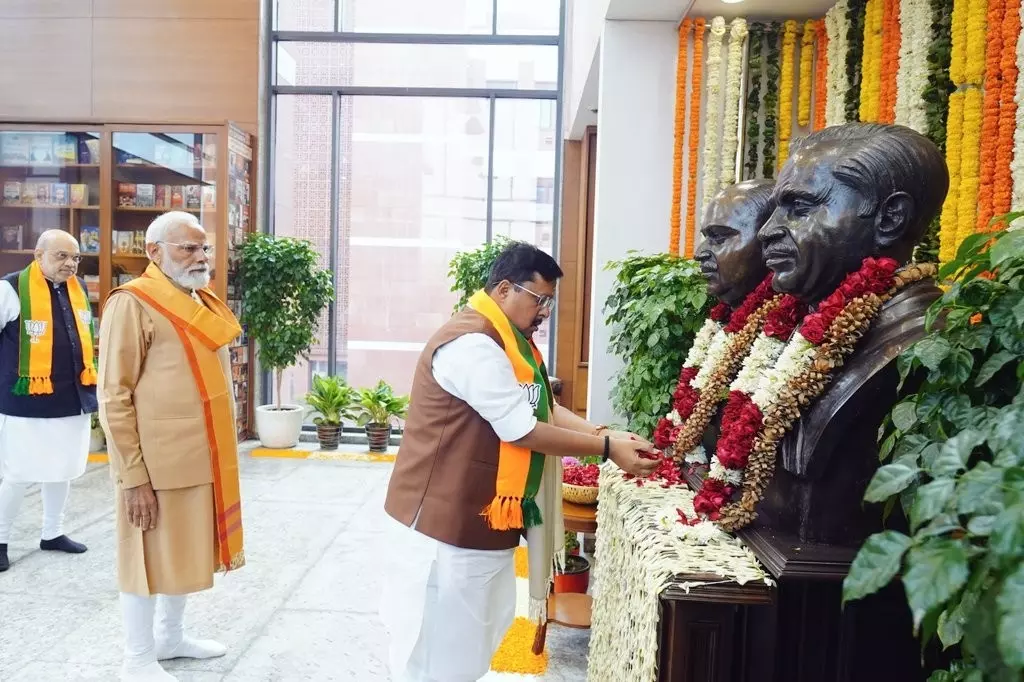
BJP's new president Nitin Nabin pays floral tributes to the statues of Bharatiya Jana Sangh leaders Dr. Shyama Prasad Mukherjee and Pandit Deendayal Upadhyay in the presence of Prime Minister Narendra Modi and Union Home Minister Amit Shah. Photo: X/@NitinNabin
Nitin Nabin as BJP president: Do party chiefs wield power in Modi-Shah era?
The Federal’s Editor-in-Chief S Srinivasan discusses Nitin Nabin's elevation as BJP's national president in detail on the programme 'Srini se Samvad'

Nitin Nabin assumed office as the 12th national president of the Bharatiya Janata Party (BJP) on January 20. The appointment of the 45-year-old leader has triggered intense discussion in political circles. His selection is seen as part of a strategy devised by Prime Minister Narendra Modi and the party’s top leadership.
Also read: Why Nitin Nabin’s leadership will be tested in Uttar Pradesh
Against this backdrop, The Federal’s Editor-in-Chief S Srinivasan discussed the issue in detail on the programme Srini se Samvad. He believes the move is aimed at promoting younger leadership while keeping decision-making power tightly centralised within the party.
Nabin hails from Bihar but has limited national visibility. His contribution during the Chhattisgarh Assembly elections is considered significant. Known as a loyal party worker and a relatively young leader, his elevation does not alter the real power structure within the BJP. Srinivasan argues that actual authority will continue to rest with Prime Minister Modi and Union Home Minister Amit Shah.
Also read: Nitin Nabin takes over as BJP national president in presence of Modi-Shah
According to him, Nabin’s position is largely a formal, rubber-stamp role — a post filled to meet constitutional requirements, while real decision-making remains firmly with the top leadership.
Questions over internal democracy in BJP
The BJP often accuses other parties of lacking internal democracy. Yet, under the party constitution, the election of a president is mandatory. Historically, leaders such as Atal Bihari Vajpayee, LK Advani, Bangaru Laxman, Venkaiah Naidu, Nitin Gadkari and JP Nadda all became party presidents, but none faced a direct contest. The selection has always been through consensus and consultations among senior leaders. At times, RSS functionaries have also taken charge of the party presidency for brief periods. Srinivasan points out that while there have been no direct elections, leadership choices have consistently been made through discussion and agreement, which has remained the BJP’s established practice.
Modi’s 'boss' symbolic message
The choice of Nabin signals an effort to project younger leadership and give the party a fresh direction. It also sends a message to senior leaders that the post of party president is no longer the central axis of political power. Since 2014, authority and decision-making within the BJP have become fully concentrated in the hands of Modi and Shah. Srinivasan notes that Nabin’s tenure could still play a role in shaping strategies for the 2024 and 2029 Assembly and Lok Sabha elections.
Prime Minister Modi, while addressing Nabin, remarked, “You are my boss; I am only a worker.” Srinivasan describes this as symbolic messaging, underlining that real power will continue to lie with Modi and Shah. Constitutionally, the BJP president is the highest authority, but in practice, decisive control rests with the top leadership.
Historically, too, the post has never been filled through a direct election, relying instead on consensus among senior leaders. Nabin’s elevation, Srinivasan argues, is part of internal signalling — reinforcing to other senior leaders that the presidency will function in alignment with decisions taken by the party’s central command.
Congress’s electoral history: a comparison
In 2022, the Congress party held a presidential election in which Mallikarjun Kharge defeated Shashi Tharoor. Both before and after Independence, the Congress has seen several direct contests for the post. After 1942, leaders like Sardar Patel, Acharya Kripalani and Jawaharlal Nehru contested for the presidency.
Even during the eras of Indira Gandhi, Rajiv Gandhi and Sonia Gandhi, the party witnessed visible democratic processes and internal contradictions around leadership selection. Srinivasan notes that while power structures in both the BJP and Congress have been dominated by top leadership, this centralisation has become far more pronounced in the BJP after 2014.
Nabin’s role and challenges
Nabin has been appointed at the behest of Modi and Shah. His challenge is not to wield power, but to manage the party organisation and coordinate with NDA allies. Senior leaders such as Shivraj Singh Chouhan, Bhupender Yadav, Dharmendra Pradhan, Manohar Lal Khattar, Devendra Fadnavis and Yogi Adityanath will work alongside him, but key decisions will continue to be guided by Modi and Shah.
Srinivasan believes that Nabin’s appointment sends a clear message to younger leaders within the party and could help boost organisational morale and political messaging.
New executive and parliamentary board
Every new party president oversees the formation of a fresh executive and parliamentary board. Srinivasan expects that under Nabin, the team will largely comprise loyalists of Modi and Shah. On matters of grassroots politics and state leadership, Nabin’s role will remain largely administrative and formal. He has indicated a focus on election preparations in states such as Tamil Nadu, Assam, Kerala, Puducherry and West Bengal.
Referring to issues like the Karthigai Deepam controversy and the Ram Setu debate in Tamil Nadu, he reiterated the BJP’s established political line. However, real decisions on alliances and electoral strategy will continue to be taken by the party’s top leadership. Statements from the president are primarily aimed at energising party workers rather than determining electoral outcomes.
Focus on Uttar Pradesh
An active role is expected from Nabin ahead of the Uttar Pradesh Assembly elections in 2027. However, Chief Minister Yogi Adityanath has firmly consolidated his position in the state. Nabin’s task will be to ensure coordination and management between the party organisation and alliance partners.
According to Srinivasan, Nabin’s influence in Uttar Pradesh will be limited in comparison to Adityanath’s authority, but his role in Bihar could be more significant. A five-time elected representative from Bihar, Nabin comes from a family long associated with the BJP — his father also represented the party in the state Assembly. While his Kayastha caste base is not numerically large, it is also not politically contentious. His elevation to the national presidency enhances his political stature and could ease his path to a chief ministerial role in the future. In Bihar, Nabin could emerge as a strong BJP alternative to Nitish Kumar.
Message of youthful leadership
Announcing Nabin’s selection, Prime Minister Modi said he would help advance the goal of a developed India over the next 25 years. Srinivasan explains that the appointment is part of broader messaging aimed at young voters and first-time electors — signalling that the BJP offers opportunities and responsibilities to younger leaders. For the party, the move underscores that pathways remain open and that young leaders can rise within the organisation. Becoming party president at 45 serves as a clear signal intended to inspire youth engagement and energise the party’s rank and file.
This article was originally published in The Federal Desh.