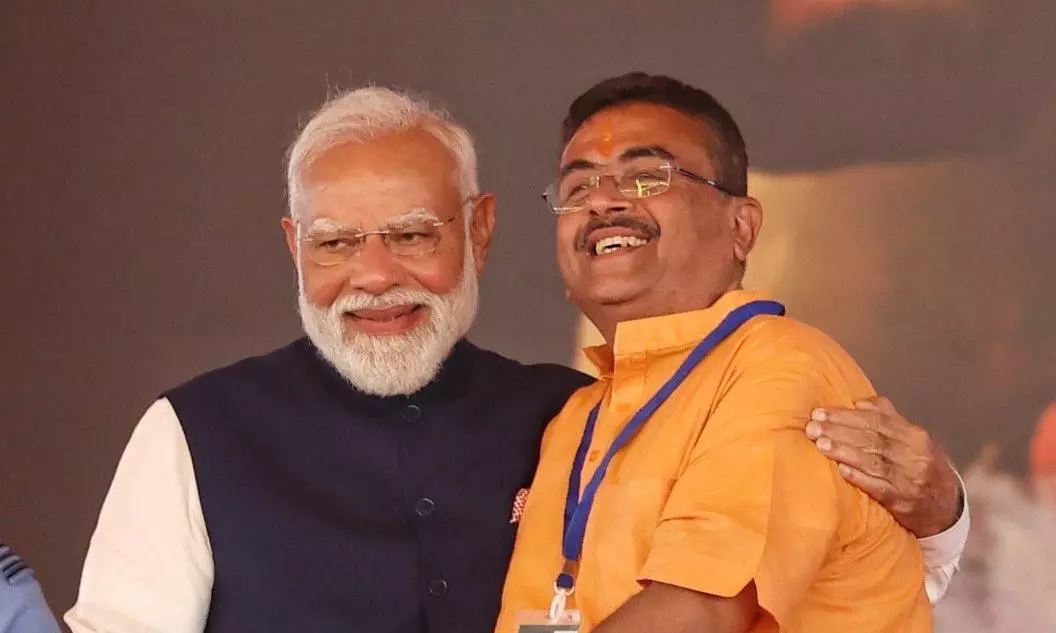
Narendra Modi with West Bengal's first BJP Chief Minister, Suvendu Adhikari.
Among the southern states, Karnataka was the first to experience the rise of the BJP, riding largely on the divisions caused by communally-sensitive disputes
In the aftermath of the 1992 Babri Masjid demolition, West Bengal was among the few states in the country that did not witness communal violence. From then, when a Left Front government was in power, to now, when polarisation has occurred along religious lines, it is no surprise that politics has swung fully right in the state, and the Hindu-first BJP is in power.
The Bengal shift
Communal riots, which were kept in check during the 34-year rule of the Left, returned during the Trinamool Congress's time in power, which began in 2011. For the BJP, the ground proved fertile to inject its brand of politics – to polarise the Hindu and the mainly Muslim minority communities.
The BJP successfully pushed the narrative of infiltration from neighbouring Bangladesh to the hilt to a point where any Bengali-speaking Muslim was a priori viewed as an outsider, until otherwise proved. This is a state with an estimated 25 million Muslims, or 27 per cent of the state’s population.
Also Read: How US diktat has kept apart natural allies India and Iran
The infiltration narrative has been reported extensively across media, and over the years, the spin appears to have worked, despite the fact that these claims have never been backed by tangible and credible data. According to a report in The Federal earlier this week, far from the lakhs of infiltrators claimed by Hindutva groups, there are less than 3,000 cases of suspected Bangladeshis pending investigation and deportation to the neighbouring country, as per the latest figures released by the Indian Ministry of External Affairs.
In addition, the BJP, in a sustained campaign, made it appear that former Chief Minister Mamata Banerjee unduly favoured the Muslim community, calling it “appeasement” politics. Again, the intention was to polarise, and it has reportedly succeeded.
Appeasement and optics
For example, the former state government’s policy of providing monthly remuneration to mullahs and muezzins was alleged to be appeasement, while similar emoluments to Hindu priests were conveniently ignored. Similarly, for the Durga Puja in 2023, the TMC government released Rs 280 crore for the various clubs that put up pandals for the puja. But this was not called appeasement.
Moreover, the latest Assembly election was besmirched with a hurried SIR (Special Intensive Revision) that controversially delisted lakhs of registered voters.
Also Read: Iran war reaches stalemate, prospects of quick solution dim
The worst hit reportedly was the Muslim community, the mainstay of the TMC voter base. Reports, quoting constituency-wise data said that around 65 per cent of the 2.7 million affected were Muslims. Murshidabad district experienced nearly 5 lakh deletions, North 24 Paraganas saw over 3 lakh voters delisted and in Malda nearly 2.5 lakh – these three districts are Muslim-dominated.
Eventually, the BJP won 206 seats in West Bengal, but it could barely win one seat in Tamil Nadu out of a total of 27 it contested and a paltry three in Kerala out of 97 it contested.
While there are several factors for the inability of the BJP to strike a chord among voters in the two southern states, a legacy of communal harmony should rank among the top reasons for the Sangh Parivar’s marginal presence in the electoral politics of the two states.
Southern resistance
Not that the BJP and its Hindutva affiliates did not try. In the run-up to the latest election, they did rake up the Thiruparakundram dispute – over the presence of a Muslim dargah near a Hindu shrine atop a hill close to Madurai city.
But the manufactured controversy fizzled out as the Hindutva activists were not able to cause a schism between the two communities nor able to sustain it until it made a difference. The dargah and the temple have co-existed for decades without causing any discomfort to either of the two communities. So, the contrived dispute did not acquire the political moss to turn it into a potent issue that could have yielded something electorally for the BJP.
Also Read: Doomsday averted, but can Iran war be settled across the table?
In the past, there have been clashes between Hindu devotees and Christian fishermen in the Kanyakumari district – one of the reasons why the BJP has some following there. In the 2021 elections, it won the Nagercoil seat from this district, out of four in the state. Similarly, in Coimbatore, where there have been bomb blasts in the past allegedly linked to Islamic groups, the BJP has always fancied its chances at the hustings there and held a seat there in the previous Assembly.
In Kerala, the issue of women’s entry into Sabarimala was potentially a juicy issue for the BJP. Naturally, when the Supreme Court in September 2018 ruled that women of all age groups could visit the temple, the BJP opposed the ruling and moved quickly to helm the protests by a section of Hindus in the state. However, the Congress, realising the vote-catching potential of the issue, neutralised the BJP's move by also opposing the judgment.
Sabarimala and strategy
The move against the ruling began to gather support, much to the discomfiture of the then-ruling Left, which quickly backed away from open support toward a more non-committal position. It now holds the view that the judgment must be studied by a committee comprising scholars and experts in the field before taking a call. So fearful were the two dominant fronts – the Left and the Congress-led – of the consequences of a Sabarimala-induced polarisation that they virtually closed ranks on the issue and denied an opportunity for the BJP to electorally exploit the ruling.
Also Read: Is the US a military state camouflaged as democracy?
For the time being, the BJP has been unable to make significant gains in the two southern states. But now that the BJP finally has West Bengal in its pocket, it will do two things: one, consolidate its hold over the state by expanding and entrenching its communally polarising narrative; two, shift its attention to Tamil Nadu and Kerala.
Among the southern states, Karnataka was the first to experience the rise of the BJP, riding largely on the divisions caused by communally sensitive disputes, triggered by Hindutva-affiliated groups.
In the early 1990’s, the Idgah Maidan controversy in north Karnataka’s Hubli town was sparked by local Sangh Parivar groups. The Hubli Idgah maidan dispute, coming soon after the Babri Masjid demolition, was dubbed the “Ayodhya” of the South. The fight centred around the usage of the centrally-located maidan, which had been given on lease in 1921 by the Hubli municipality to the Anjum-e-Islam (AeI), a Muslim social service organisation.
Karnataka template
The BJP and local Hindutva outfits demanded that the land be given for flag-hoisting on national days. But the AeI feared that a large crowd could destroy a prayer structure similar to what happened at Ayodhya, and refused. This snowballed into a major controversy, causing a communally polarising narrative benefitting the BJP. From four seats in the Assembly prior to the dispute, the BJP’s numbers jumped to 40 in the 1994 elections.
The Deve Gowda government figured out the potential of the dispute and moved to resolve it, but by then, the BJP, with four seats in the 1989 Assembly, had already jumped to 40 seats in the 1994 polls.
Also Read: Hard to believe, but Trump’s ‘pause’ should mean ‘end of Iran war’
Enthused by the electoral bonanza, the BJP machinery sought out another communally-laced dispute – the Baba Budangiri controversy – over the presence of an ancient shrine atop a verdant mountain range near Chikamagalur, Karnataka’s coffee-growing region, also a much sought-after tourist destination. The shrine, a classic example of the state’s syncretic culture, was shared by both Muslim and Hindu communities. Its official name reflects the joint use -- Sri Guru Dattatreya Swami Baba Budan Peetha.
The BJP and affiliated groups demanded that the shrine be turned over to the Hindu community. The dispute is still simmering, with activist groups as recently as March this year accusing the Siddaramaiah government of soft-peddling the issue.
Surprisingly, the BJP, despite being in power for two terms in Karnataka – 2008-13, and later from 2019-23, has never managed to cross the simple majority mark on its own in Assembly elections. It managed to govern either by splitting the opposition or luring independents.
Limits of polarisation
The BJP leadership has often expressed its desire to come to power on its own, and towards this, it attempted to use its position as the ruling party in its latest stint – from 2019-23 -- to pass laws that would serve the purpose of “othering” the minorities.
The hijab controversy, triggered by the BJP’s move to ban the wearing of the Islamic veil in state schools, directly impacted the Muslim community. Under the benevolent gaze of the government, self-styled Hindutva outfits evicted Muslim traders from Hindu-led community fairs. Parts of Karnataka in the north and south, which had rarely seen riots, were witness to communal tensions, as a result of this communally-laced governance model.
Also Read: Close friends to bitter foes, US-Iran story of a busted partnership
The minority Christian community was not spared either. In 2021, the People's Union for Civil Liberties documented at least 39 violent incidents targeting Christians in Karnataka.
But the BJP’s over-reach backfired. In the 2023 elections, the Congress came back to power with a huge majority of 136 seats out of 224, while the BJP came a distant second, winning around 66 seats. The Muslims voted en masse for the Congress, considered one of the top reasons for its victory. The SIR and the delisting process have now commenced in Karnataka, with independent groups expressing worry over its implications, given the West Bengal example. Its effect on minority voters in the state may determine the outcome of the next election, and that is the cause for concern.
Eyes on the South
The BJP may have done badly in Kerala and Tamil Nadu, but given its track record, the party will not rest until it has the two states in its kitty. The prognosis is fearful as the Sangh groups led by the RSS will actively look for ways to increase their footprint. And, the low-hanging fruit is communal polarisation.
Already, if social media messaging is any indication, the signs are ominous. After initially celebrating the defeat of the DMK in Tamil Nadu, the BJP realises it has been rejected by the new Chief Minister C Joseph Vijay. The actor-turned-politician has instead kept the NDA at a distance, preferring the Congress and other secular parties.
Also Read: Europe’s snub to Trump is a moral victory for Iran
Social media is already abuzz with unsubstantiated and seemingly exaggerated posts referring to Vijay’s religious faith and his family’s purported Christian-centric outlook. It may well be that Hindutva groups are laying the ground for a communally-laced campaign to undermine the fledgling Vijay’s TVK government. Some of the posts are pointing to a twist that could happen sometime, which will benefit the BJP.
This could either be an empty claim or a warning of something sinister over the next few months. As the BJP leadership keeps repeating, it had just one seat in the West Bengal Assembly until two elections earlier. It jumped to 77 in the last elections and now to 206. The route to this success is questionable, but going by recent history, the BJP under the Modi-Shah combine will stop at nothing to replicate West Bengal in Tamil Nadu and Kerala.