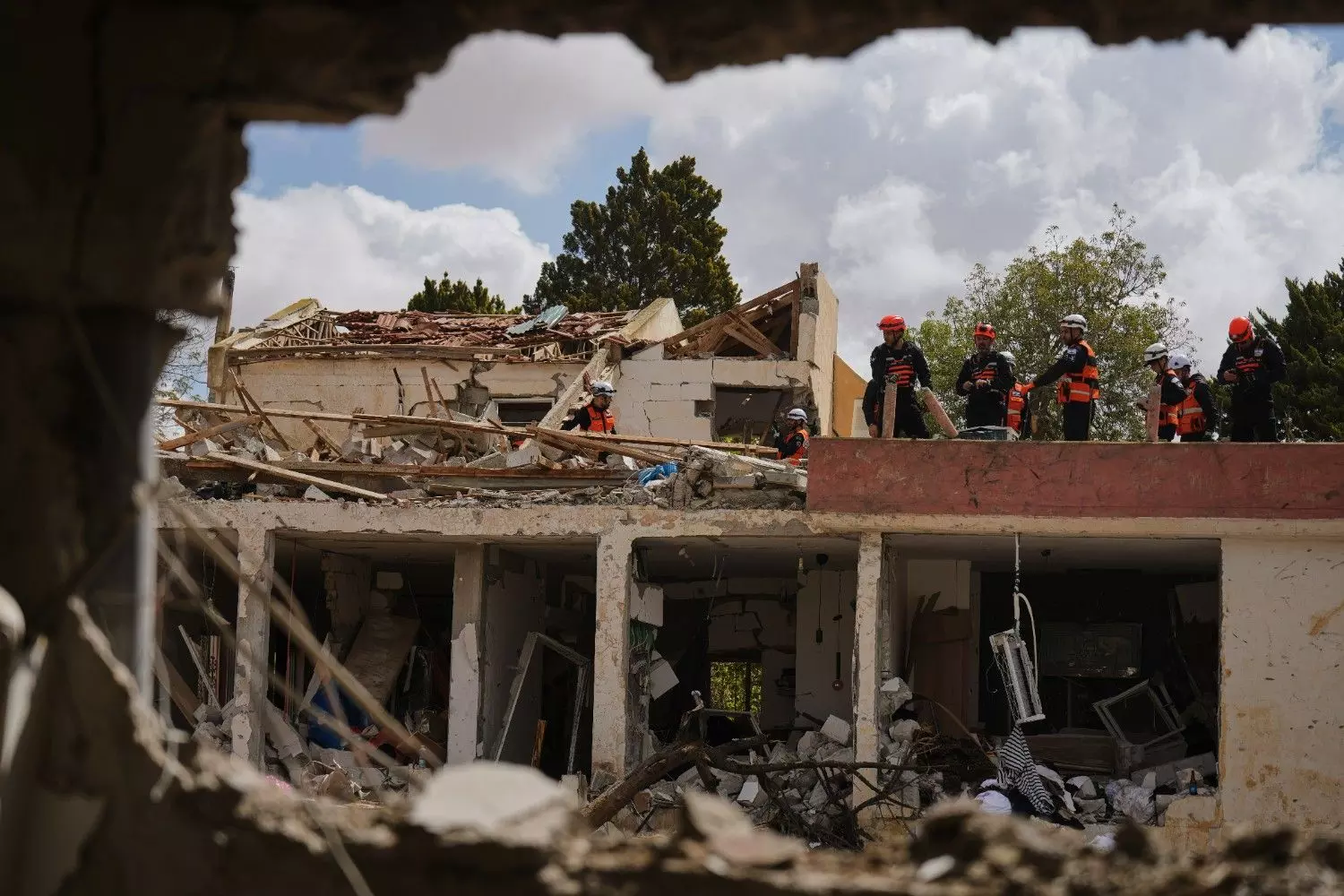
Israeli security forces survey the site that was struck by an Iranian missile in Dimona, southern Israel, on Sunday, March 22. AP/PTI
Crucially, Trump’s five-day pause has come about after he recently talked of “winding down” the war, so peace does appear to be a logical next step
United States President Donald Trump’s social media post announcing a five-day pause in striking Iran’s power stations and energy hubs comes more as a relief than a surprise. Relief as Trump moved away from his 48-hour deadline for Iran to free the besieged Strait of Hormuz. No surprise, as the enigmatic president has a track record of taking such abrupt decisions.
Embedded in the announcement of the five-day pause is the billion (or trillion) dollar question: will the temporary suspension of hostilities lead to a long-term, if not permanent end to the fighting?
Also read: A crumbling Iran could turn out more dangerous
The chances are the “pause” will lend itself to a long-term peace. For, until now, there are no perceptible gains that the US and Israel have notched up in the last four weeks of military strikes on Iran.
Iran continues to retaliate
Other than a few hardcore supporters of Trump and Israel, the rest of the world viewed the military strikes as capricious, illegal and without any provocation. The aims of the belligerents were unclear and unrealistic.
As the saying goes, in the fight between two elephants it is the grass beneath that gets crushed. This was the pathetic state of the Arab Gulf nations which were caught napping by Iran’s relentless targeting of American interests in their countries.
Before Trump and his Israeli factotum Benjamin Netanyahu started the war, they appeared to have made no preliminary assessment as to the military capabilities of Iran. They were carried away by their own rhetoric, which is that the attacks would weaken the Islamic regime and make it ripe for toppling by its opponents within Iran.
Israel’s intelligence agency Mossad and the US’s sleuths were believed to have fed the two countries with information, according to which the Islamic regime in Iran had weakened due to economic sanctions and could be dislodged if the country was attacked.
Also read: Iran war: Trump lit the fire, now wants the world to help extinguish it
Contrary to these assessments and pronouncements, the strikes have simply not gone the way the US and Israel expected it to go. The numero uno of Iran, Ayatollah Ali Khameini, was assassinated, but that made no difference. So were the killings of a string of top officials in the Iranian administrative and military hierarchy. But they were quickly replaced and Tehran continued to retaliate, much to the bewilderment of the world’s super-power and its vassal in the Middle-East, or West Asia.
Arab Gulf nations caught napping
As the saying goes, in the fight between two elephants it is the grass beneath that gets crushed. This was the pathetic state of the Arab Gulf nations which were caught napping by Iran’s relentless targeting of American interests in their countries. None was spared – the “mighty” Saudis, the “rich and influential” Qataris, the “benevolent” Omanis, the “aspirational” Emiratis besides Bahrain and Kuwait.
For the first time since the US spread its allegedly “protective umbrella” over the Gulf nations, these oil-rich monarchies figured out that the much-hyped security was chimerical. Their close links to the US, rather than affording protection actually turned out to be the red rag that exposed them to debilitating attacks by Iran.
And, all this while, Iranian leaders like President Masoud Pezeshkian personally kept in touch with the rulers of the Gulf nations, assuring them Iran had nothing against them, and that they were only targeting US interests in their countries. So, the Gulf countries were caught up in a nightmarish situation – getting hit but unable to do absolutely anything.
Also read: Close friends to bitter foes, US-Iran story of a busted partnership
Over the last four weeks since February 28, when the military strikes against Iran began, each have requested Trump and Iran to de-escalate. Apparently, they were pressuring the US to back off from the strikes. And, this was a pressure that the US could not ignore.
The final straw was the Israeli attack on the South Pars gas facility, jointly shared by Iran and Qatar. Doha was aghast and to make matters worse, Iran retaliated by attacking Ras Laffan, the jewel in the crown of Qatar’s energy source.
This caused the first major break between the US and Israel, with Trump washing his hands off the attack and ordering Netanyahu not to target Iran’s gas infrastructure.
Trump’s deadline
What caused further alarm was Trump’s deadline and the threat to attack Iran’s energy network if it did not free up the Strait of Hormuz. Iran warned it would take out all US-related energy infrastructure in the Gulf nations plus the desalination plants that is the lifeline for the region.
As the world watched with bated breath as Monday (March 23) was the deadline, Trump has backed off. Going ahead with his threat would have meant catastrophe for the entire region. Trump’s pause, therefore, will have to be permanent as there is no way this war can proceed further if apocalypse is to be avoided.
If Trump calculated that his allies in Europe would step in and give the US a breather, that was not to be. The US president publicly scoffed at his Nato allies and other friendly countries’ refusal to have any part in a war that was not theirs. But he must have realised that the US was isolated, no one “appreciated” his motives to strike Iran and he had to go it alone if he intended to continue fighting. Another reason that may have played a role in Trump’s “pause”.
No doubt the combined strikes of Israel and the US have taken a toll on the civilians in Iran, with hospitals, schools and malls hit. A few thousand have been killed while hundreds have been injured. Despite all this, the Iranian appetite for fighting back has not reduced.
As for Israel, which seemed to have miscalculated Iran’s capability the most, the military strikes they had commenced, in tandem with the US, came back to bite it. For one, Iran’s retaliatory strikes on Israel exposed the deficiencies in the Jewish state’s so-called Iron Dome defence system that was claimed to neutralise any missile targeting the country.
“Operation Epic Fury”: an exercise in futility
Shocked Israeli military officials have said they are embarking on an audit of their defences to figure out what went wrong. For Israel, it is a multi-whammy. The reputation of their anti-missile defence system has taken a hit in the world arms market, their smug belief that none can touch them militarily has been demolished, its “secretive” Dimona nuclear facility came close to being hit and the Israeli government is left with nothing to show for the attack on Iran.
No doubt the combined strikes of Israel and the US have taken a toll on the civilians in Iran, with hospitals, schools and malls hit. A few thousand have been killed while hundreds have been injured. Despite all this, the Iranian appetite for fighting back has not reduced. And that probably has forced Trump to back off. Crucially, Trump’s five-day pause has come about after he recently talked of “winding down” the war, so peace does appear to be a logical next step.
Yet, there is a possibility that Trump’s pause is merely a tactical step by the US to manoeuvre itself militarily before carrying out the threat to attack Iran’s power grid. Such is the level of Trump’s credibility that none can dare afford to take his words for what they mean. While nothing can be put past Trump, the chances of a resurgent attack are remote as even he has probably figured out by now that the so-called “Operation Epic Fury” is and was always an exercise in futility.