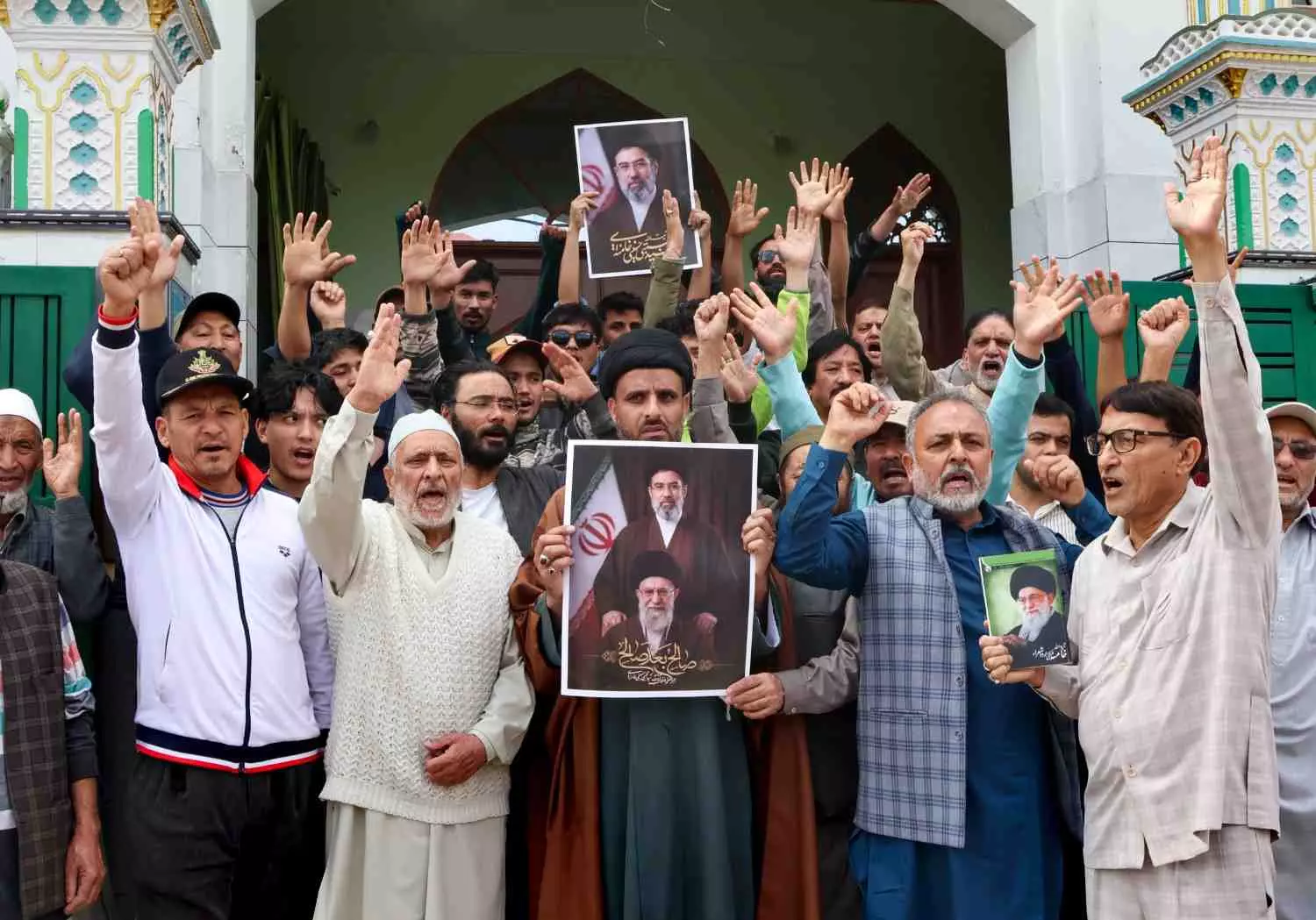
People raise slogans and hold portraits of the late Iran’s Supreme Leader Ayatollah Khamenei in Jammu after news of the ceasefire in Iran. Photo: AP/PTI
The very nature of the discord between Israel and Iran is such that there cannot be a lasting agreement or permanent peace
For those who had only heard of the world coming to the brink of a nuclear conflagration during the Cold War on October 28, 1962, during the Cuban missile crisis, a similar moment returned dramatically on Tuesday (April 7) when US President Donald Trump threatened to annihilate the Iranian civilisation out of existence.
Given Trump's reputation for making bombastic statements, it seemed unlikely he would carry out his threat. Yet, given his reputation for unpredictability, thousands seem to have gone into panic mode, going by reports. The fear was that if Trump carried out his threat and attacked any of Iran’s nuclear reactors, desalination plants, and power infrastructure, the consequences would end the world as it exists now.
A slim hope still remained as Trump is known to be the master of brinkmanship and can stretch an opponent in a tricky transaction. For the last few days, the US president had narrowed his demand to just one, the opening of the Strait of Hormuz. Iran, which had earlier rejected Trump’s peace proposals, gave in to the threat and agreed to open the Strait. The immediate crisis was thus put off at the eleventh hour.
Will the ceasefire transform into lasting peace?
The key question is: whether the ceasefire will transform into lasting peace? Over the last 38 days, since the US and Israel started to launch missiles at Iran, there have been situations when it appeared that the war would end. But, each time, Trump has belied such hopes by escalating attacks on Iran. And, reacting to this, the Tehran government too has remained firm in its core demands, including the right to continue with its nuclear programme.
Also Read: Trump blinks, ceasefire is brokered, but Iran has a warning; what next?
Now that the ceasefire has come about, it automatically does not guarantee lasting peace. For the issue of Iran’s nuclear sovereignty, its ballistic missile programme, and the lifting of sanctions will have to be accepted by Trump’s team. For Iran, the situation is more complex, as giving up on its strategic plans will amount to surrendering its independence and the legitimate right to govern the country as it deems fit.
Both nations want the war to end
It is doubtful whether these issues can be sorted out in the next fortnight, given the complexity and hardening of positions on all sides. What, however, gives hope is that both nations have indicated that they don’t want to continue with this war. For Trump, the military action has gone beyond the initial expectation of it being for a few days. Though Iran resisted valorously, it has suffered widespread death and destruction.
Also Read: Congress calls Pakistan’s role in US-Iran ceasefire 'setback' to PM Modi’s foreign policy
The combined US-Israeli attacks had more recently started to zero in on Iran’s civilian targets, including universities, bridges, hospitals, schools, and commercial areas. In the US, the war saw Trump’s popularity slump, and there were pressures even from among his supporters to call off the war.
Beyond the three warring nations, Iran ensured that the world felt the pain of economic squeeze, drying up of much-needed fuel and gas and several other crucial commodities needed in healthcare, pharmaceuticals, and agriculture.
Israel’s agenda
Israel had its own agenda – that of bombing Iran to the extent possible, neutralise its nuclear and ballistic missile infrastructure, and instigate an upsurge against the Islamic dispensation. But, as in the past, it is under US command and will have to abide by whatever the outcome of the forthcoming negotiations is.
Also Read: Iran-US ceasefire: Tehran’s statement and 10 conditions, what Trump said, and Israel's stance
Another reason for prolonging the war was the narrative: who would be the winner, and who the loser? While some would argue that both of them and the world lost, the two nations are now contending they are the winners. Iran, for standing up to the US and Israel for 38 days and for not giving up its core programmes. Trump, on the other hand, has already declared he is the winner, claiming that he has succeeded in changing the Iranian regime, and for forcing it to open the Strait of Hormuz.
Widespread condemnation
Once a pause is reached, both Trump and Iran will mostly find reasons for converting it to a longer ceasefire, if not permanent peace. The alternative does not make sense as there is already widespread condemnation over the war, its incoherence, and the dangers it poses to the Middle-East, or West Asia, plus its economic impact on the rest of the world.
Also Read: Within hours after ceasefire, Iran says oil refinery attacked
Doubts, however, exist over Israel’s agenda which, reports say, played a big role in sabotaging the first two rounds of negotiations. The first resulted in the 12-day war last June while the second, for 38 days, has just paused. It’s only the US which has the bandwidth to force Israel to abide by a prospective agreement.
Crucial fortnight
The next fortnight will be crucial, as mediators, including Pakistan and Saudi Arabia, will try to find a middle ground that all parties can agree to without losing face. It’s not easy, as the very nature of the discord between Israel and Iran is such that there cannot be a lasting agreement or permanent peace under current conditions.
But, for the world, having smelt doomsday, even peace in the medium-term can be counted as a big achievement.