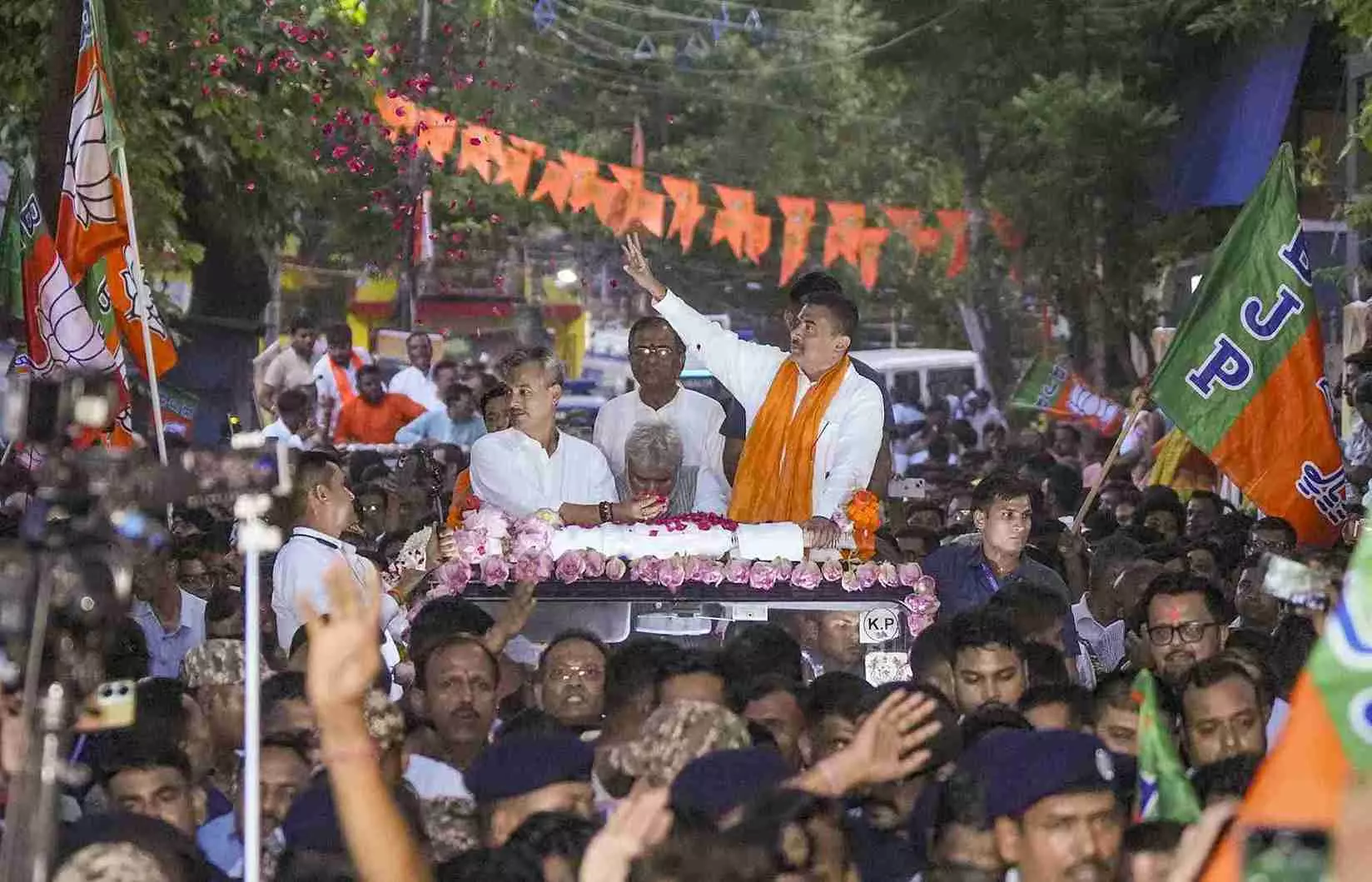
Jyoti Basu’s prophesy echoes today as Islamist surge in Bangladesh fuels BJP’s Bengal sweep, reshaping cross-border politics and heightening regional tensions
The late Jyoti Basu knew this better than anyone. Though his party, the CPI(M), prevented him from taking over as the prime minister in 1996 when he was offered the top job by the coalition of non-Congress and non-BJP parties, Basu took a huge interest in issues relating India-Bangladesh relations. His role in pushing through the Ganges water-sharing treaty and the peace deal in Bangladesh’s embattled Chittagong Hill Tracts is known to many who closely follow relations between India and its eastern neighbour.
When, during a BBC interview, I had asked him the reason for his unusual interest in Bangladesh, an unfazed Basu had replied with a characteristic one-liner: “If Hasina loses out to the Islamist hardliners there, you think we can stop the Hindutva brigade here?” So the communist veteran made it clear it was not just the nostalgia about his ancestral home near Dhaka in pre-Partition Bengal or his personal rapport with Hasina but hard political realities that guided his decisions.
This was much before the BJP had opened its account in the West Bengal assembly or won a parliament seat from West Bengal, but Basu was unwilling to be complacent because he feared events in Bangladesh and West Bengal could substantially influence each other.
Also read: Why Suvendu's BJP govt in Bengal can never truly claim Rabindranath Tagore
When asked about Mamata Banerjee forming the Trinamool Congress by breaking away from the Congress at that time, Basu had said: “It is her business, but why is she bringing them (BJP) here?” Basu was visibly upset with Mamata aligning with the BJP and even joining the Vajpayee government as a minister, because he feared the saffron brigade would piggyback her Trinamool Congress to expand its base in West Bengal.
Basu’s fears come true
Basu is long dead and gone but his worst fears have almost prophetically come true over the past two years. Ever since Sheikh Hasina’s government was toppled in a mass agitation in August 2024, there has been a sharp surge in Islamist radicalism in Bangladesh. Supported by the Muhammad Yunus-led interim government, the pro-Pakistan Jamaat-e-Islami sharply expanded its influence.
Attacks on minorities—Hindus and Buddhists—have sharply multiplied, and dozens of Sufi mazhars (shrines) have been razed to the ground, with both the army and the police playing the spectator. The destruction spree has not spared buildings linked to the legacy of the 1971 Liberation War, including the house of Sheikh Mujibur Rahman, considered the founding father of Bangladesh. Liberation War museums have been ruthlessly bulldozed.
With Hasina’s Awami League banned from contesting elections, the parliament polls in February this year turned out to be a straight contest between two former allies, the Bangladesh Nationalist Party (BNP) and the Jamaat-e-Islami. The BNP won a two-third majority because most Awami League supporters voted tactically to keep the Jamaat-e-Islami out of power.
Also read: BJP made big promises to a debt-ridden Bengal; now how will it deliver?
But the Jamaat-e-Islami, which supported the Pakistan army perpetrate a horrible genocide in 1971 and opposed Bangladesh’s independence, won a record 68 seats in the parliament against its previous best of 18. Jamaat-backed candidates swept the prestigious Dhaka University student union polls and those in other important educational institutions.
Impact on West Bengal polls
Since the polls to the West Bengal state assembly were held just two months after the Bangladesh parliament elections, some spillover was anticipated. Expectedly, the BJP turned Bangladesh into its leading campaign issue as it mounted a no-holds barred effort to unseat Mamata’s Trinamool Congress. “Ghuspet” (illegal migration) from Bangladesh leading to drastic demographic change became the top issue, as BJP leaders, from PM Modi to Home Minister Amit Shah, to candidates contesting the polls, kept attacking the Mamata Banerjee government for encouraging illegal migration from Bangladesh and Muslim appeasement in West Bengal to further “vote bank politics”.
The BJP’s astounding success in achieving Hindu consolidation that explains its sweeping victory this time owes much to the Bangladesh factor. As long as Hasina helmed the country and the pro-liberation elements ran the show, Bangladesh was seen in West Bengal as a benign, friendly neighbour united by language and culture. With Hasina pulled down and thousands of Awami Leaguers fleeing into India, mostly West Bengal, the ghost of 1946-47 returned to haunt voters in West Bengal.
Also read: After Bengal, is Kolkata Municipal Corporation set to turn saffron?
The Jamaat’s stellar performance in constituencies bordering India, especially West Bengal, had a direct impact: 51 of the 68 seats won by Jamaat candidates were on the Indian border, almost all of them in districts adjoining West Bengal. Therefore, BJP candidates contesting seats on the Bangladesh border could point to the Islamist surge right across a porous frontier, and their “Hindus in danger” cry began to resonate with voters. Not unexpectedly, the BJP swept the 44 constituencies right on the Bangladesh border and another more than 50 adjoining them. The high level of Hindu consolidation even helped BJP win seats with high concentration of Muslim voters.
What now?
The BJP’s coming to power in West Bengal has escalated the social media war between the “two Bengals”. Radical Islamists in Bangladesh are screaming hard over “huge atrocities” against West Bengal Muslims, pointing to high SIR deletions, recent restrictions on performing namaaz on streets or on cow slaughter. Some are attacking new Chief Minister Suvendu Adhikari as repeating in West Bengal the kind of alleged Muslim-baiting already seen in Assam under Chief Minister Himanta Biswa Sarma. The youth leaders who brought down Hasina have often threatened to “overrun North East”, and even some former Bangladesh Army veterans have posted about “possible conquest of Kolkata”.
Reactions from West Bengal are no less attacking. Even reels of CM Adhikari from his aggressive election campaign are heavily circulating in the social media. One reel where Adhikari is seen pitching for Sheikh Hasina as the “legitimate prime minister of Bangladesh” and asserting that she should be taken back with full honours has created a storm.
Also read: What explains Bengal’s saffron shift? 6 reasons why Mamata was decimated
Senior BNP leaders have avoided the offensive pitch of Jamaat-e-Islami and their allies in the National Citizens Party but they appear worried over the impact of such heightened tensions on bilateral issues. Many say it limits their options to improve ties with India.
The fight over water
While the Bangladeshi Home Minister Salahuddin Ahmed has downplayed social media accounts of “huge atrocities against Muslims” by dismissing them as unfounded, other BNP leaders appear worried over several issues, especially river water sharing. Senior BNP leaders have told this writer that Tarique Rahman is yet to get any clear message on whether India will extend the Ganges water-sharing treaty which expires in November this year. MEA sources are also tight-lipped on the issue. But senior Indian diplomats say India is closely watching Bangladesh’s recent moves to get China involved in the Teesta river management project. Bangladesh says India’s failure to sign the water-sharing treaty on Teesta since 2009 has forced Dhaka to seek Chinese assistance. It is well known how Mamata Banerjee played spoilsport when the Manmohan Singh government was on the verge of signing the Teesta water-sharing treaty early in the last decade. Which is why Awami Leaguers have openly rejoiced her recent defeat and welcomed Suvendu Adhikari’s pro-Hasina pitch.
But that may not help improve relations with the Tarique government which has formalised the ban on Awami League.
Also read: Suvendu's blitzkrieg in first week as CM: Border fencing to bulldozers to RG Kar
The renewed thrust on border fencing in West Bengal by the new BJP government is also another factor that could heighten tensions. The recent upswing in Bangladesh-Pakistan relations, especially in areas related to military cooperation and intelligence sharing, has also rattled Delhi. Especially, regular visits to Bangladesh by known Pakistani jihadi bigwigs like Ehtesham Zahir, believed to be close to Lashkar-e-Taiba chief Hafeez Saeed, and the recent bonhomie between Jamaat-e-Islami and the hardline Ahl-e-Hadith, whose seminaries in Rajshahi were visited by Jamaat chief Shafiqur Rahman, have raised red flags in Indian intelligence.
(The Federal seeks to present views and opinions from all sides of the spectrum. The information, ideas or opinions in the articles are of the author and do not necessarily reflect the views of The Federal.)