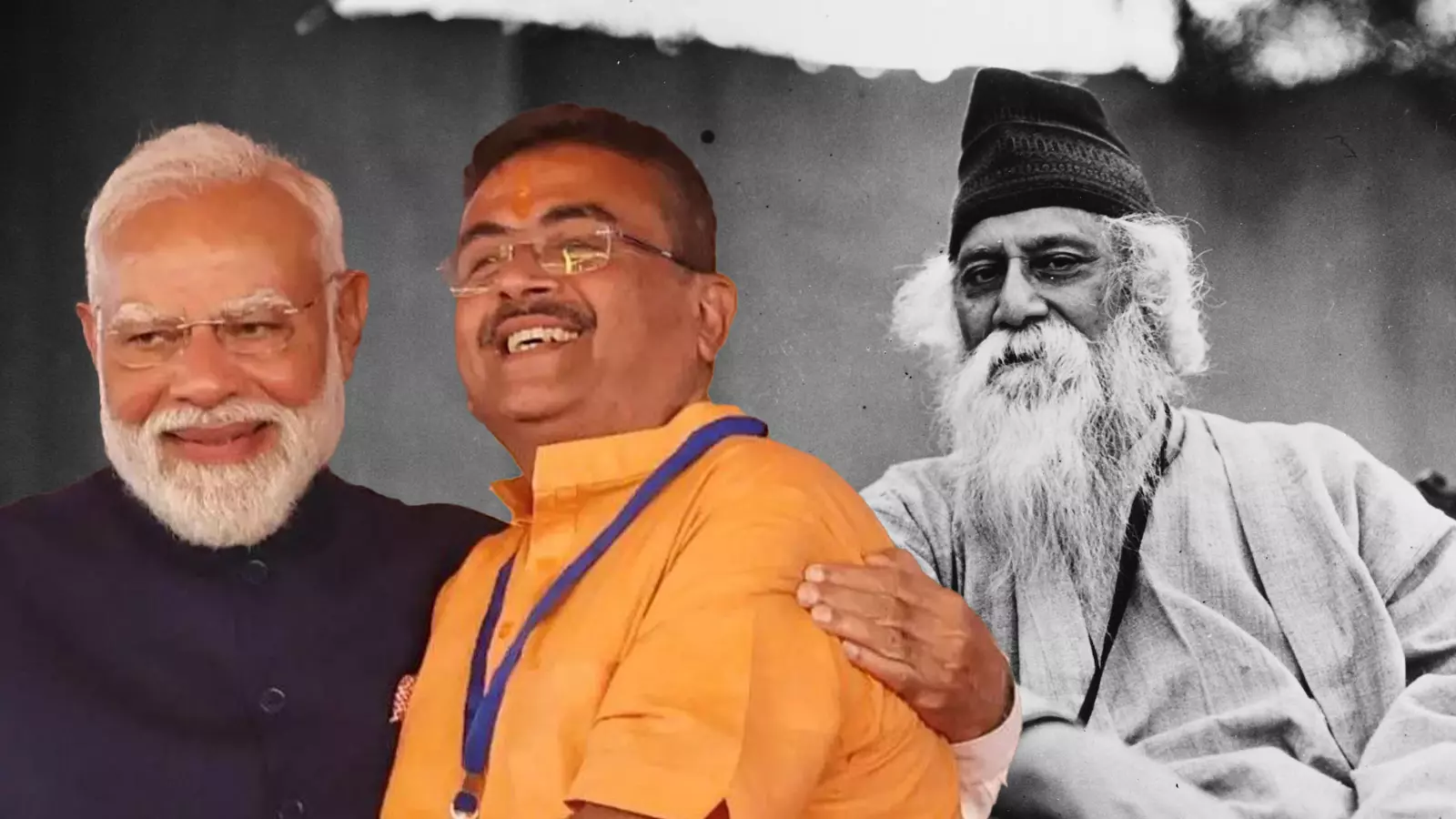
West Bengal's first BJP government has displayed a symbolic reverence for Rabindranath Tagore but has the saffron party really abided by his beliefs?
Despite a highly symbolic swearing-in ceremony on Pochishe Boishakh, the Suvendu Adhikari government’s early actions contradict Tagorean humanism
It is widely known that the BJP decided to hold the oath-taking ceremony of its inaugural government in West Bengal on Pochishe Boishakh (the 25th day of Boishakh, the first month of the Bengali calendar, which fell on May 9 this year) — celebrated as the birth date of Rabindranath Tagore, per the vernacular calendar.
It's a widely celebrated day to underscore Bengali pride and the state’s rich cultural and artistic traditions, and the BJP picked it with the political objective of appropriating the legacy of the ‘Gurudev’ or ‘Kaviguru’.
Also read: Symbolism, social arithmetic define Bengal’s first BJP ministry as Suvendu takes oath as CM
Predictably, the newly anointed Chief Minister, Suvendu Adhikari, headed from Kolkata's Brigade Parade Ground, venue of the ceremony, straight to Jorasanko Thakurbari, the ancestral home of the Nobel laureate, also called the Bard of Bengal, in the city's north part.
Against Tagore's worldview
However, barely days after assuming office, several decisions of the BJP government are conspicuous for being against the grain of Tagore’s worldview and his stated positions on the fundamental characteristics of not just Bengal, but also India.
These include the saffronisation of the state with its first step, as detailed earlier. The swearing-in ceremony, with its overtly Hinduised character, poses a direct threat to the state’s syncretic secular fabric.
Beyond symbolism, the BJP will find it tough to appropriate Tagore because his views on almost every aspect of life, society and nation are at complete odds with the tenets of the saffron party, its ideological fountainhead, the RSS and other affiliates.
Furthermore, Kshudiram Tudu has been controversially given the charge of the minority and madrasa education department. In the run-up to the BJP’s victory, he had made several controversial statements, calling for a ‘crackdown’ on madrasas.
He repeated these statements while raking up the charge of these institutions being ‘illegal’ without substantiating his accusation.
To return to Adhikari and a limited number of ministers taking oath, the tone and tenor of the entire ceremony was inlaid with religious characteristics, made unmistakable with prominent Hindu iconography, devotional slogans, and large-scale public rituals.
Blatant majoritarianism
While there is no grudging on the choice of the date, the decision to position Prime Minister Narendra Modi on the dias, besides illustrations of Goddess Durga, in addition to imagery depicting a famous temple dedicated to Goddess Kali, was intensely ‘problematic’.
The function was also conspicuous for more than one Hindu religious chant before the formal events. There was also a recitation of the Bhagavad Gita by hundreds of thousands of devotees and gathered BJP supporters.
Also read: Anupam Kher’s role as Tagore sparks outcry: Is he the right choice?
Hindus in Bengal account for less than 71 per cent of the total population, and any official State function that depicts only Hindu iconography is blatantly majoritarian in character.
In the decades after the BJP’s formation in April 1980, the party consciously appropriated the legacy of nationalist icons. This started with the declaration of ‘Gandhian Socialism’ as its formal credo. However, when this did not pay dividends in the 1984 Lok Sabha polls, the crafty philosophy was replaced with Integral Humanism, the treatise propounded by Deen Dayal Upadhyaya.
Appropriating Tagore
From the 1990s, the BJP, handicapped by the absence of nationalist icons of its own, began appropriating leaders from the Congress niche — Sardar Vallabhai Patel, Netaji Subhash Chandra Bose and several others. The party took advantage of the relative ‘neglect’ of these iconic leaders by the Congress party and its governments.
In continuation of this trend, the BJP has embarked on the path of appropriating Tagore as the latest icon whose name will be chanted and portraits will be displayed at government functions, like on the inaugural day.
As part of the saffron party's ‘Operation Appropriate Tagore’, Adhikari chose to visit Jorashanko Thakurbari, aware that it would convey immense political and cultural symbolism. The twin events were aimed at countering the charge levelled against the BJP — that it was a representative of ‘outsiders’, or what Mamata Banerjee repeatedly stated, "Boihiragoto".
Tagore's views vs Sangh ideology
Beyond symbolism, however, the BJP will find it tough to appropriate Tagore because his views on almost every aspect of life, society and nation are at complete odds with the tenets of the party, its ideological fountainhead, the Rashtriya Swayamsevak Sangh (RSS), and other affiliates.
For instance, the poet, novelist, essayist and artist’s imagination of India had the idea of universal humanism as its epicentre, while the RSS has always articulated the idea of cultural nationalism, which in practice conveys the imagination of religious nationalism.
Also read: Suvendu's blitzkrieg in first week as CM: Border fencing to bulldozers to RG Kar
Furthermore, as against the Sangh Parivar’s notion of India being a Hindu Rashtra (infamously claimed by RSS chief Mohan Bhagwat that the objective to ‘make’ India a Hindu Rashtra was unnecessary because “it already was”), Tagore had argued that India was a civilization of several strands.
Many decisions of the BJP government, taken within days of assuming office, stand in total violation of Tagorean ideas. For instance, days after Adhikari visited Jorashanko, his government arrested activist Garga Chatterjee on the basis of allegations relating to social media posts concerning EVMs.
In this opinion, turning India into a religion or culture-based nation would lead to the destruction of its social and spiritual diversity which effectively defined her. Such a nation, according to Tagore, would be like an ‘iron net’ whose efficiency would be far in excess of the worst individual tyrannies.
Since 2014, the depiction of the entire medieval period of Indian history is depicted as a millennium of slavery and foreign rule. But in the well-known poem Bharat Tirtha, or The Indian Pilgrimage or even A hymn to India, Tagore wrote these immortal lines:
“No one knows whence and at whose call came pouring
endless inundations of men
rushing madly along—to lose themselves in the sea:
Aryans and non-Aryans, Dravidians and Chinese,
Scythians, Huns, Pathans and Moghuls--
all are mixed, merged and lost in one body…”
In 1908, Tagore wrote a letter to his friend, AM Bose, where he said, “Patriotism can’t be our final spiritual shelter. I will not buy glass for the price of diamonds and I will never allow patriotism to triumph over humanity as long as I live.”
Contradicting Tagore's thoughts
This view is in complete contrast to the attacks that the Modi government was waged against political adversaries in recent years. In today’s India, Tagore certainly would not have endorsed the kind of hyper-nationalism practised by the BP and its governments, where the slightest criticism of even a single government policy is labelled as anti-national and cases are lodged against critics.
Love for other humans was for Tagore, undeniably, more important than affection for the nation. Because he prioritised ‘universal truth’ or ‘moral values’ over ‘country’ or the ‘nation’, his true legacy will eternally be ranged against the current official rhetoric of ‘Indian First’.
Also read: Yogi, Himanta or Suvendu: Who will succeed Modi?
Very precisely, in the above-mentioned context, Tagore was of the view that any form of sectarianism that evolved from a rigid form of nationalism was but an obstacle in the path of man's natural freedom and spiritual development. Tagore further considered nationalism to be essentially war-mongering and anti-social.
Arrest of Garga Chatterjee
Several decisions of the BJP government, taken within days of assuming office, stand in total violation of Tagorean ideas. For instance, days after Adhikari visited Jorashanko, his government arrested activist and public intellectual Garga Chatterjee on the basis of allegations relating to social media posts concerning EVM functioning during the recent Assembly election period.
His arrest was evidently at the Election Commission (EC) of India's behest. Instead of clearing almost ceaseless questions over the EVM's malfunctioning in favour of the BJP's candidates, the poll body chose not to be the ombudsman, as is expected when citizens feel the elections were not very fair, and pressed for action against an eminent citizen of the state.
Chatterjee has clearly been made an ‘example’. The message to other civil society and political activists is unmistakable: Do not ask questions regarding processes overseen by any arm of the State. In this case, the EC is not being seen as an impartial institution. Instead, it is being considered as an arm of the State.
Also read: Bengal heist: How BJP captured the state by hollowing out democracy
There are several other decisions which the BJP government has taken in the few days it has been in office, and can be considered to be violative of Tagore’s principles.
The People’s Union of Civil Rights has stated that it considers Chatterjee’s “arrest as a deeply disturbing escalation in the criminalisation of political speech and democratic dissent. The use of coercive criminal process against an individual for expressing apprehensions, criticisms, or political opinions, concerning electoral processes strikes at the heart of constitutional democracy”.
This is incontestably the position that Tagore would have taken if he had been a witness to such acts of coercion. This irrefutable fact makes the BJP’s efforts at appropriating Tagore little but political deception.
(The Federal seeks to present views and opinions from all sides of the spectrum. The information, ideas or opinions in the articles are of the author and do not necessarily reflect the views of The Federal.)