With a radical Gen Z faction waiting for orders even as the Modi govt smarts from students’ protest, all eyes will be on what the PM chooses to say from the Red Fort this year
A nation does not stand still. It moves forward and back. There are trying times. India has seen many such moments – the assassination of Mahatma Gandhi involving a conspiracy of Hindutva fanatics only five months after independence with a view to sowing chaos and grasping power, the India-China border clash of 1962 which left a mark on the public mind, the famine of 1967, the Emergency, or the assassination of former prime minister Indira Gandhi in the aftermath of Operation Bluestar. But even in moments of anxiety, agony, anger, and despair, there has never been any doubt about people’s faith in the operating systems inherited from the Constitution.
Optimism, trust in short supply
It was the fundamental political, economic, social, and governance values that brought free India into being and helped us overcome the periods of stress. But this Independence Day, optimism and trust appear to be in short supply. It will be interesting to see what forms of spin Prime Minister Narendra Modi will employ to lull the country when he takes the mike to address his fellow Indians from the ramparts of the Red Fort this week.
Also read: As Gen Z rises, Modi's magic falters and Rahul finds his voice
At his Red Fort outing last year, the prime minister spoke of a Demography Mission. Fear was sought to be created that India was being overrun by “infiltrators” in language meant to serve as the infamous communal dog-whistle. Modi had first raised this fear in one of his more unseemly speeches while campaigning ahead of the 2024 General Elections. And this has led to the Election Commission’s Special Intensive Revision (SIR) of electoral rolls, which has created terror in every state.
After SIR, did EC find infiltrators?
The figures available a few weeks ago suggested 5.58 crore Indians have already been deprived of their right to vote. This is close to 10 per cent of the electorate that voted in 2024. By the time the SIR exercise is done for the whole country, many more will doubtless be struck off as Indian voters, probably also as Indian citizens, achieving aims envisaged in the dubious Citizenship Amendment Act (CAA) which was crafted to strike at the roots of a composite anti-colonial Indian nationalism that bore fruit in 1947.
It seems clear, looking at the picture, that India, on the eve of the 80th anniversary of her Independence from colonial subjugation, seems to be in the thick of an ideological upheaval, if not an open ideological war.
Also read: Bhagwat speaks Gen Z's language, but Sangh's script hasn't changed
An interesting question is how many “infiltrators” have been found in the SIR process? The EC, now a regime pocket borough, having long surrendered its autonomy, is silent on this, though the question has been asked many times by many.
When the EC was in the hands that were eager to get every adult Indian to vote in the country’s first general election in 1952 after India became a republic, democracy in the country seemed to want to be authentic. This caught the attention of the world. Today it is another story.
War against democracy
The SIR has been rolled out as a voter-elimination strategy for ideological and political reasons at the behest of the most powerful Indian holding constitutional office, who points a finger at fellow voters without proof. The voter elimination will end up denying state benefits and causing loss of citizenship.
The attempted calculated ousting of voters from the electoral roll is in fact a rebellion against the democratic order led by those at the very top. It is an ideological confrontation with democracy, ironically in the name of democracy, presenting itself as a cleaning of the voting roll.
Also read: Are RSS and BJP playing good cop-bad cop with Gen Z protestors?
It seems clear, looking at the picture, that India, on the eve of the 80th anniversary of her Independence from colonial subjugation, seems to be in the thick of an ideological upheaval, if not an open ideological war. This war, which has its own causes and clear identity, feeds into the opposition to the anti-democracy front opened against the electorate of India, in other words, its own citizens, by the establishment itself.
The 'other Gen Z'
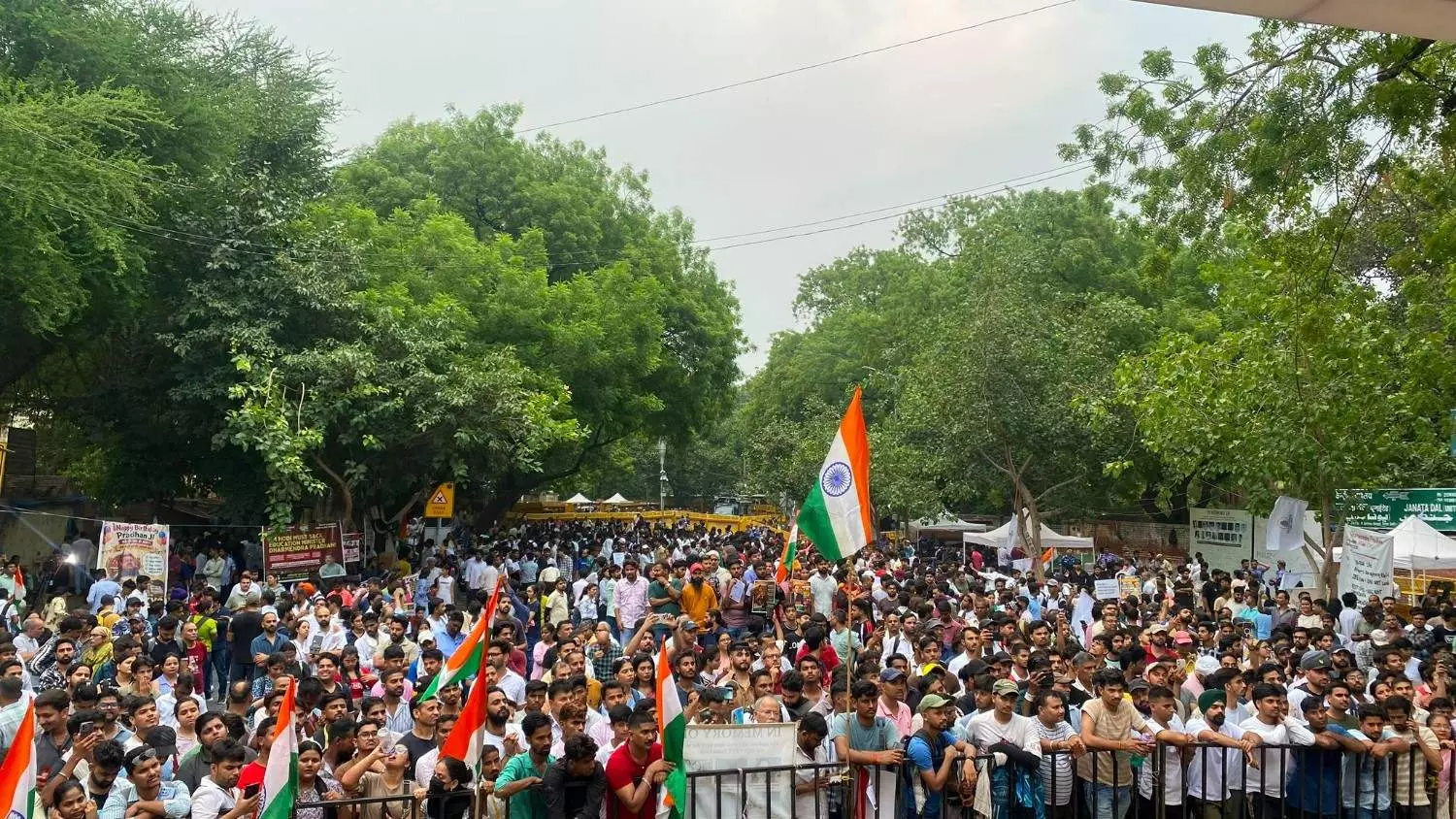
Just weeks ago, a mammoth protest of students and youth at the Jantar Mantar in Delhi, within a stone’s throw distance from Parliament, laid state power low, forcing the resignation of Dharmendra Pradhan, a minister in Modi’s cabinet, from an unyielding government that prided itself on not appearing to be weak as it endeavoured to centralise, in totalitarian fashion, all political, administrative and social power unto itself.
The previous version of Gen Z represented dangerous uncivil elements of civil society. No tear gas, lathi charge, or pellet shootings were used for them. They were embraced and pampered by law enforcement in states where the ruling party held influence.
This so-called ‘Gen Z’ power is multi-class, multi-caste, multi-faith, and pan-India. Its acceptability, if anything, continues to expand. But let us keep in mind that this is a new ‘Gen Z’ that we see now. An earlier mobilisation of a similar age group had been done by the wielders of state power after the Modi government took charge in 2014.
Also read: Damage control, not course correction: Decoding Modi's response to CJP protests
This previous group represented dangerous uncivil elements of civil society who were quite often in cahoots with law enforcement. No tear gas, lathi charge, or pellet shootings were used for them. On the contrary, they were embraced and pampered by law enforcement in states where the ruling party held influence. And this earlier Gen Z made its presence felt around themes of pseudo-religion and superstition while marking out a clear “other” on the lines proposed by the ruling party and its ideologues. On their marches, rose petals were showered by high officials of Uttar Pradesh Police, showing proximity to the state apparatus, not rebelliousness.
Contemporary vs primordial
The earlier Gen Z have merely been eclipsed by the Gen Z we saw at Delhi’s Jantar Mantar recently – they have not vanished. They lie in wait for their opportunity, for orders from above. In class, caste and age terms, they are both similar. But the newer version defines itself by its secular credo, protesting on the most pressing issues of our times, such as education and employment, by challenging state power. Their earlier counterparts upheld a very different cause, an entirely different credo.
Also read: Asking Amit Shah to resign: Why it is Congress' boldest gambit yet
Both cohorts exist in the same time dimension and are the principal protagonists, for now, of the ideological war that we are seeing unfold. While one exists with the blessings of state power and big capital, the other contests these very elements. At issue is the contemporary versus the primordial. But there is no gainsaying the battle of ideas as well as the battle on the ground.
It is into this dawn that the country will awake this Independence Day.
(The Federal seeks to present views and opinions from all sides of the spectrum. The information, ideas or opinions in the articles are of the author and do not necessarily reflect the views of The Federal)