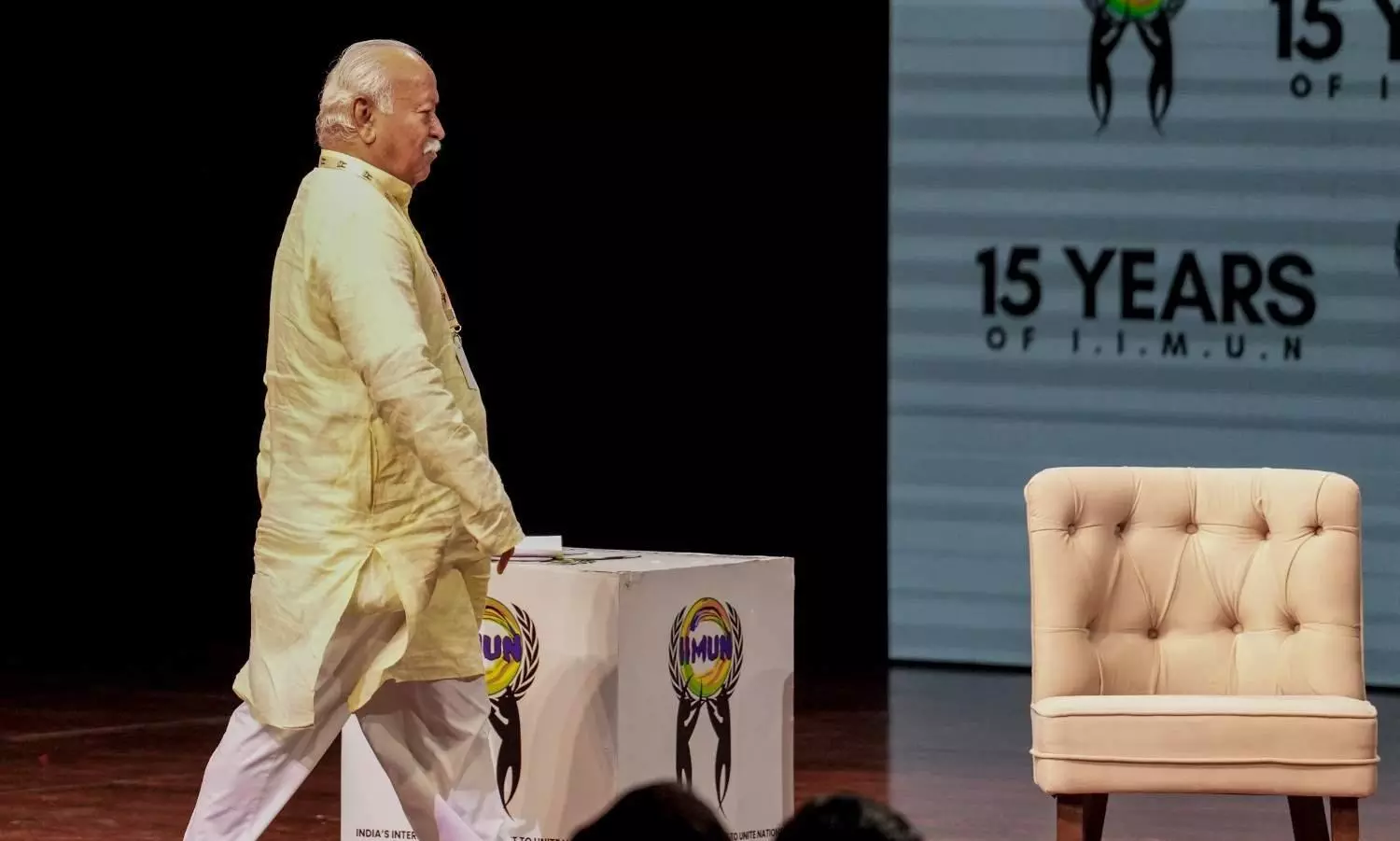
RSS chief Mohan Bhagwat at an India's International Movement to Unite Nations (IIMUN) event in Mumbai, Maharashtra on Thursday (August 6). Photo: PTI
The RSS chief’s outreach to young protesters signals a tactical bid to absorb youth anger, but his refusal to confront the Sangh Parivar's ideological fault lines exposes the limits of the makeover
The outreach to Gen Z, albeit to a selectively chosen audience with little participatory presence, in the wake of protests by students and youth, by RSS chief Mohan Bhagwat and his empathetic stance during an interaction in Mumbai, has to be seen as a tactical effort to open channels of communication with the young despite rising youth anger.
By agreeing to alter the nature of the event from a top-down speech by the Sarsanghchalak, to a Q&A session with Rishabh Shah, founder-president of India’s International Movement to Unite Nations (IIMUN), a private organisation which hosts MUN (Model United Nations) events, the RSS chief positioned himself as a sympathetic, listening elder.
Political calibration, not ideological shift
Quite clearly, Bhagwat’s attempt was to safeguard the Sangh Parivar from becoming the primary target of youth frustration. The event, however, cannot be marked for any spontaneous ideological shift, but as a calculated political calibration.
While the Sarsanghchalak attempted to be open-minded on issues that ricocheted in multiple directions during the protests in New Delhi and an estimated 100-odd cities and towns across India (continuing for different reasons in Ranchi), he fell short on multiple issues that were either long-standing ideological blind spots of the Sangh Parivar, or were the matters on which the saffron fraternity has been traditionally evasive.
Also Read: RSS chief Bhagwat backs Gen Z, says protesting doesn't make them anti-national
Significantly, Bhagwat’s efforts at depicting himself as a person who uses the Gen Z vocabulary (‘clock it’ or ‘LGBTQ+’ for instance) are aimed at projecting the RSS as a contemporary body and not a moribund organisation to the urban youth.
Using new political or social language
The use of new political or social language is also not a new phenomenon for the RSS, and has been in practice from the time the Sangh Parivar chose the agitational chariot of the Ram Janmabhoomi Movement to get onto the centre stage of Indian polity. Even Bhagwat has altered his phraseology in the past. For instance, during public lectures he delivered in Vigyan Bhawan in New Delhi in 2018, he moved away from using MS Golwalkar’s terminology for non-Hindus – ‘internal challenges’ - and updated the description by asserting that "Hindutva is incomplete without Muslims" and stating that all Indians share "the same DNA".
Also Read: CJP to launch countrywide 'Kya Bolti Public' campaign, focus on youth, education and unemployment
Back then, Bhagwat spoke the language of his audience, again a carefully-selected one, as he has done again in Mumbai. The truth, however, is that the RSS ‘DNA’ has not changed – for instance, he used the term LGBTQ+ to acknowledge that non-heteronormative identities are a natural part of human society, but did not go beyond the path he has traversed or stated what has already been said by him or functionaries of the RSS.
No budging from patriarchal, majoritarian doctrine
He advocated for social accommodation, empathy, and a formal legal framework for same-sex companionship. But he remained within the ‘Hindu’ Lakshman Rekha (moral line) and did not endorse same-sex marriage, arguing again that he was against "tampering" with tradition.
This was little but reducing fundamental constitutional equality to a matter of societal permission. The RSS is not budging from its core patriarchal and majoritarian doctrine. Essentially, Bhagwat's interaction was little beyond image management and pre-emptive co-optation or absorption of youth anxiety.
‘Soft patronage’ of Gen Z
But, can “Big Brother” stop being the elder in the mind? A word or two of praise for Gen Z was of course aimed at gaining entry into their mind-space by the use of a facade. Bhagwat did not even think twice before ‘infantilising’ them, describing them as "emotional", and prone to not thinking with a "calm mind".
This is little but ‘soft patronage’ which allows the RSS to accept youth energy only so long as it can be guided and disciplined by Sangh hierarchy. In this process, the Sarsanghchalak attempted to soften the RSS’s rigid, conservative image and prevent youth discontent from turning into anti-establishment mobilisation.
Duplicitous reality of Sangh Parivar
The problem, however, lay in the duplicitous existence of on-the-ground vigilante action groups, ranging from student groups like the ABVP and state apparatuses which frequently crack down on campus dissent. The RSS chief presents a reflective public posture, while the wider organisational machinery continues ploughing its majoritarian agenda.
To be specific, in this public conversation with Rishabh Shah, the Sangh-approved interlocutor Bhagwat spoke of protests being a "legitimate form of democratic dialogue". But the same RSS affiliates mentioned above, or the state machinery, routinely label student dissidents and protesters as "anti-national".
Also Read: BJP backs Bhagwat’s Gen Z outreach, Opposition flags ‘RSS-BJP contradictions’
In fact, a key giveaway was in Shah’s concluding line: “Andolan (agitation) is not everything, there is a thing called samvad (dialogue).” He probably remains unaware of continuing conflict between the government and ruling party with its adversaries and critics due to the absence of dialogue, be it in Parliament, with protesters on the streets, or even other public spaces.
In the interaction, Bhagwat praised the impulse to protest but avoided holding the political establishment directly accountable for the policy failures (such as privatised education or unemployment) which drove protests that provided public context for the event.
Balancing act with BJP
Quite clearly, this is another example of an RSS balancing act: criticising systemic symptoms to maintain moral authority without burning bridges with the ruling BJP.
After the verdict of the 2024 Lok Sabha polls when the BJP failed to secure a parliamentary majority and became dependent on allies to form the government, Bhagwat first made it known publicly that he personally had a “problem” with the emergence of the Modi cult.
Yet, after Operation Sindoor, and again after the sequential BJP victories in the state assemblies of Bihar in November 2025 and West Bengal in May 2026, the Sarsanghchalak appeared to be coming to terms with Modi’s hegemonic presence, within the BJP as well as in the Sangh Parivar.
Also Read: RSS chief Mohan Bhagwat: Gen Z is highly emotional, easily drawn to 'visibly authentic' causes
Once again, the Sarsanghchalak did not camouflage the direction of his stricture – “for leadership, the first thing is: you have to lead from within, lead by example… When we hear leadership, a picture comes to mind — someone standing up front, giving speeches, winning elections, preaching to people. It doesn’t work that way. Real leaders are those who remain behind, they work from within…”
He does not use Modi’s name ever in this section, or even the entire interaction. But the name of the Prime Minister keeps jogging in the minds of everyone either listening to a video or reading a report of the event.
Bhagwat’s oblique criticism of Modi’s traits is an echo of historical tension between the RSS (which favours collective, cadre-based authority) and Modi’s hyper-individualised political dominance.
Sangh has benefited from Modi cult
But this distinction smacks of disingenuousness. After all, the Sangh and its fraternity have benefited from the Modi cult, with it being the prime reason for the Parivar’s dominance in virtually all walks of life and across a huge geographical spread of India.
Also Read: RSS chief Bhagwat to engage with Gen Z at IIMUN event in Mumbai after student protests
Furthermore, the RSS has even silenced affiliated organisations. For instance, has the ABVP brought up any of the issues that are agitating such a vast body of students across regions? Or, how many times have we heard the Swadeshi Jagran Mancha amid the plethora of Free Trade Agreements (FTAs), Comprehensive Economic Partnership Agreements (CEPAs), and Trade and Economic Partnership Agreements (TEPAs) that have been signed under Modi’s watch?
Talk-show format
The format of Bhagwat’s interaction mirrored a talk-show with a captive audience to clap resoundingly, cheer jubilantly, whistle appreciatively, always on cue.
Even though this was not the first time that Bhagwat got on stage with Shah – he had addressed like-minded youngsters in 2016 and 2020 - the RSS leadership worked on presenting the event to the uncritical observer as a watershed moment of ideological evolution.
Although planned in advance, the RSS and Bhagwat personally went along in creating an impression that the event was in response to the recent protests and to enable the organisation to convey its “sympathies” and “support”.
Some positive takeaways
Despite all that has been stated, there were “positives” in Bhagwat’s remarks. Foremost, of course, was the de-stigmatisation of dissent by declaring that protesters were not anti-national but “our own people”.
This might appear at conflict with Modi’s assessment of protest of “any” kind. But, even while being symbiotically linked, the RSS and Modi have parallel lives and each is engaged in the betterment of one’s own situation.
Also Read: 75-year retirement to caste census: Decoding Mohan Bhagwat’s speech
Other “good” takeaways include Bhagwat conceding that the economic crises that students and youth highlighted with their protest, is a harsh reality – jobs are non-existent, the education system is flawed, and the majority of degrees are yielding just pocket money, if at all.
Importantly, Bhagwat also backed the long-standing progressive demand to allocate 6 per cent of GDP to public education, and called for an end to the commercialisation of schooling.
When the mask slipped
The mask, however, slipped on basic issues. On caste for instance, while stating that reservations are essential due to social discrimination, he prompted the well-off beneficiaries to "voluntarily give up" benefits. Quite clearly, Bhagwat places the burden of structural injustice on individuals and not systemic inequality.
But, Bhagwat stumbled plumply on the issue of state violence and pleaded that he knew little about what “really happened”, although the scenes have been recorded for posterity.
(The Federal seeks to present views and opinions from all sides of the spectrum. The information, ideas or opinions in the articles are of the author and do not necessarily reflect the views of The Federal)