Rahul Gandhi's resignation demand tests whether the BJP's most powerful troubleshooter can be held accountable the way Dharmendra Pradhan was
Not long after the resignation of Dharmendra Pradhan as Union Education Minister was secured under the pressure of the Cockroach Janata Party (CJP) protest, and quite likely conceded as a government tactic to quietly disperse the protesters at Delhi’s Jantar Mantar, Leader of the Opposition, Rahul Gandhi, has raised the pitch by calling for the resignation of the Union Home Minister, Amit Shah.
In his constantly interrupted speech in the Lok Sabha on July 29, with even senior ministers heckling, Rahul had pointed the finger at the home minister (who was not present in the Lok Sabha at that time) for “ordering the firing” at the protesting students during their march towards Parliament on July 20. But he had not been able to complete the logic of his argument. This he did a few hours later while addressing a press conference on the issue.
Two sides of a coin
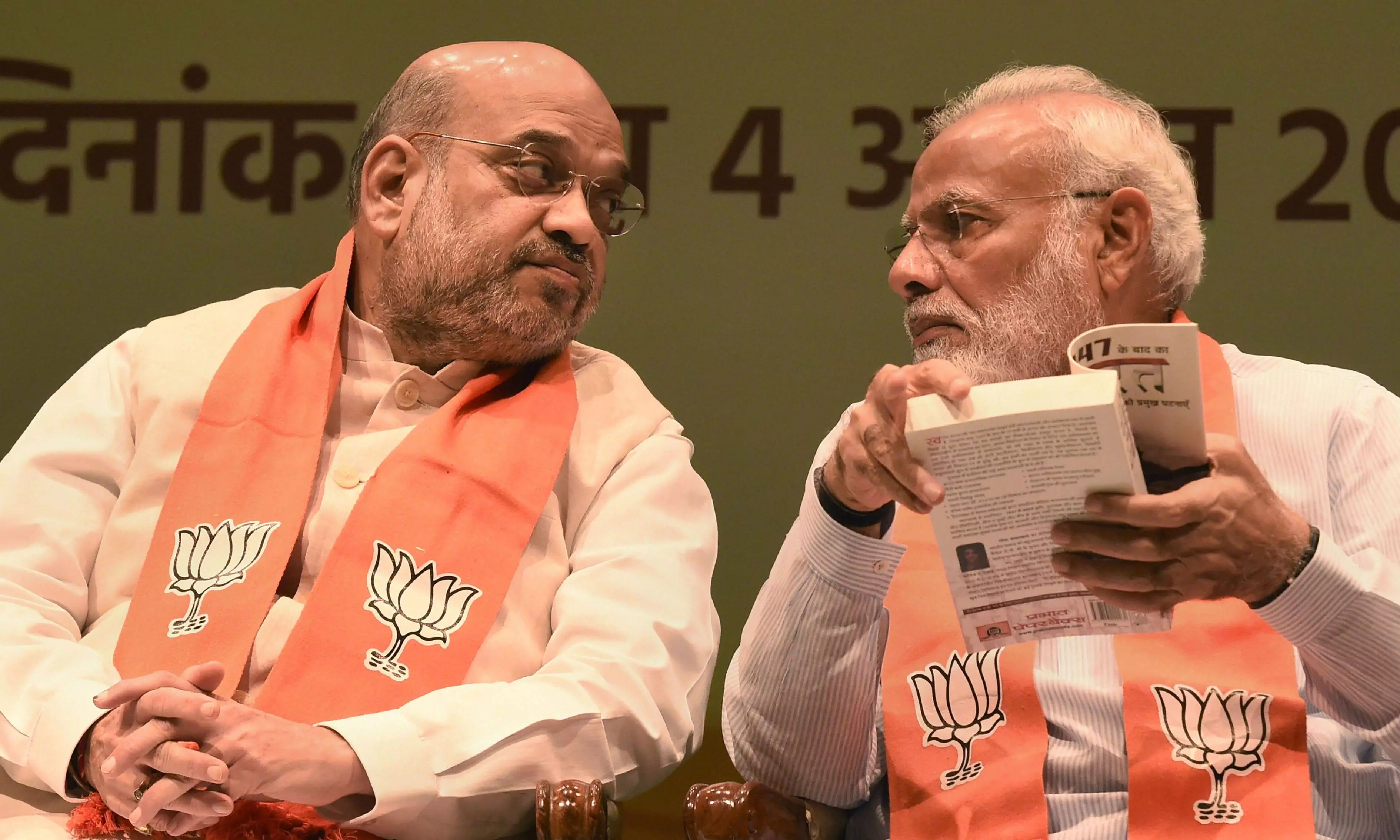
Calling for the home minister’s resignation in any government is serious business. In the Modi regime, it is to ask for the unthinkable – and can be hazardous. Shah has the reputation of being Narendra Modi’s ‘operations’ man from their days together in Gujarat. He is Modi’s go-to person for everything – political, pragmatic, devious or deadly, or just expedient. The home minister and the prime minister are joined at the hip in politics. In Modi’s India, one is incomplete without the other.
With roadblocks removed and manufacturing legislative majorities becoming child’s play, Shah could make things happen anywhere in the country, and he did. Except for the defence forces, the home minister’s hands were on every button that activates the coercive authority of the State as well as the governing party.
Also read: Rahul Gandhi turns up heat on Amit Shah as Parliament showdown escalates
As Narendra Modi’s stature rose—from an RSS pracharak or full-time volunteer to the chief minister of Gujarat, Amit Shah’s influence and career grew in tandem. Shah became the minister of state for home. It was widely understood then that the deadliest magnitude of power in that quadrant of the government lay in his dexterous hands. Not for nothing was he Modi’s man for all seasons. Ahmedabad is full of tales of their exploits.
Shah: skillful executor of wishes
When Modi’s stature rose even higher when he became the country’s prime minister, Shah first became the czar of the BJP as the party’s president and established his grip over the party machinery. This was for himself and for Modi. Not long after, as the Union home minister, he was the India czar’s skillful executor of wishes with a bag-load of tricks which got heavier with time, circumstance and needs.
Entrenching their power over the system, over every lever – the secretariat, the judiciary, the election commission – and over friend and foe, was deemed crucial to the project of ruling for the next 50 years in a manner of speaking, if fate didn’t intervene.
With roadblocks removed and manufacturing legislative majorities becoming child’s play, Shah could make things happen anywhere in the country and he did – from Kashmir to West Bengal, with Bihar thrown in mid-way and Haryana and Maharashtra falling along the flanks. The governments of Madhya Pradesh and Rajasthan had fallen earlier. Except for the defence forces, the home minister’s hands were on every button that activates the coercive authority of the State as well as the governing party.
Modi the face, Shah the enforcer
If Modi is the words and imagination man in the service of his strategic aims, Shah can be called the action hero with tactics to boot with which to stitch up the job – quiet, tidy, not overtly threatening or bullying. His speeches in Parliament are pedestrian, inelegant. But he isn’t there to win elocution contests, or display debating acumen; he is the enforcer.
Also read: The unmaking of Brand Modi: How ‘56-inch chested’ PM bowed to youth power
On one occasion he even let a minor Hindi obscenity fly in Parliament during a speech. That was the street fighter on duty. Naturally someone like him won’t be all high and mighty about so-called Gen Z obscenities at the protest site, or bemoaning the loss of ‘sanskaar’ (values).
So, this is the kind of man the Congress leader took on in Parliament and subsequently called for his resignation. But did the home minister orchestrate the excessive police violence on peaceful young protesters whose most severe crime was to spout obscenities against the high and mighty in the system including Prime Minister Modi?
Did Shah order firings at CJP protest?
It’s clear he did not clear the firing of pellets on a peaceful crowd the minute it happened. For a long time the police denied this, but the lies became unsustainable. The Supreme Court has observed that the rules permit the firing of pellets though this has not occurred before except in Kashmir and even then it shook the government. The judges didn’t flash their views then.
Another question is that was live ammunition used on the Delhi protesters? The assertion was made by a young woman from Ranchi who was at Jantar Mantar. Reportedly a government hospital has corroborated her statement that a bullet grazed her ear. (We know of course that live ammunition on protesters was used in Bihar about the same time.)
Also read: CJP protests expose Modi's Achilles' heel: A government unused to listening
But let’s return to the home minister and how the question of the seriousness with which the government has treated the issue of violence on peaceful protesters and on the issue of a stringent new law to check corruption in the examinations universe since paper leaks are widely accepted as a serious malady and led to the ‘cockroaches’ to protest in the first place.
Govt mum on systematic crackdown
It’s remarkable that on such a sensitive occasion the prime Minister and the home minister were both absent from Parliament and the show was run by a junior minister of the prime minister’s office, the amiable Jitendra Singh. The best explanation that one could conjure up is that, according to the rules, the firing was ordered by the area magistrate and not the home minister.
The resignation of Pradhan is certainly a novelty, and something which is difficult to believe even now in light of the BJP-RSS’ approach to ideology and politics and their primary mode of thinking.
But in the crucial parliamentary debate, the minister of state had nothing to offer on the systematic, step-by-step planning and the organisation that went behind the strategy of tackling the July 20 ‘morcha’ of students and youth. There was an overnight change in Delhi’s police administration. The commissioner was removed on the eve of the police crackdown on the youth and students, and a favoured one was inducted. It is to be noted that Delhi’s commissioner of police reports to the Union home minister.
Why the buck stops at Shah
That makes the buck stop with the home minister of India for the July 20 violence on peaceful protesters. The violence looked carefully planned. It did not look like being a part of the cosmic scheme. But the judiciary seems a long way from figuring this, as may be seen in numerous sensitive matters involving state versus citizens in recent years. It latches on to technicalities over substance. Is it the real bulwark of people’s rights against encroachment by the state? Perhaps, it is time to look within.
Also read: ‘CJP’s decision to suspend agitation a tactical mistake’
Abhijeet Dipke, the founder of CJP is not obtuse, however. He lost no time in supporting Rahul’s demand for the home minister’s resignation. But he may be innocent of the ways of politics in the Modi era. Asking for any minister to resign is bad enough in this age but asking for the home minister to go may be tantamount to treason in today’s political jurisprudence. So, watch out.
Pradhan’s ouster – rare BJP precedent
The resignation of Pradhan, a minister of the Narendra Modi government, under pressure of a public agitation, happened on July 25 but is an unexpected and rare occurrence for a BJP regime at the Centre which has more than the adequate numbers in Parliament. It is certainly a novelty, and something which is difficult to believe even now in light of the BJP-RSS’ approach to ideology and politics and their primary mode of thinking.
The BJP-RSS, while notionally accepting parliamentary democracy are self-proclaimed adherents and fanatical propagators of the ideology of Hindutva or a Hindu-supremacist State, which is an altogether different species from a democracy in which a minister’s resignation under public pressure flows from the concept of accountability of a government to the people.
But, as senior BJP leader and top Union minister Rajnath Singh had spelled out, as early as 2015 at a press conference, minsters of a BJP-led NDA government do not resign, unlike Congress ministers. Unlike in the Vajpayee years, Modi had won the BJP-led NDA a comfortable parliamentary majority just the preceding year and was in no trouble in running the show on Hindutva ideological lines.
CJP must watch out
The recent student-youth protest at New Delhi’s Jantar Mantar which forced Modi to sacrifice his education minister will need to factor in this basic attribute of a BJP regime. Pradhan was dropped from the Union cabinet all right, but he was lionised by BJP MPs who made a show of publicly garlanding him in Parliament House. Union Home Minister Amit Shah issued a lengthy press statement profusely lauding Pradhan. It hardly seemed the man was going out under a cloud. He himself walked about as though he was a hero, not a failed minister whose tenure had seen dozens of instances of exam paper leaks and a questionable education policy and shrunken educational budgets.
Also read: Rahul Gandhi turns up heat on Amit Shah as Parliament showdown escalates
That means the going is likely to get tougher for the CJP and its young supporters nationwide if they attempt to re-start their protest following police proceedings against activists in violation of oral assurances given by senior minister and former BJP president JP Nadda who negotiated on behalf of the government.
Realistic calculations need of the moment
The BJP-RSS believe in absolute or total control over the political, electoral, economic and social system in the country and will, therefore, not countenance demands for their ministers to resign as that weakens the optics of total control. If the education minister had to put in his papers under the pressure of a massive people’s protest, the faltering minister is still praised to the skies by the ruling establishment, revealing its basic attitude to the issue of accountability.
With the Congress leadership going ahead to demand the home minister’s resignation on the heels of the education minister’s, a new turn in political dynamics appears to be in the offing. The ‘cockroaches’ have succeeded in dispelling the pall of fear in the country. Nevertheless, the government’s opponents would need to make realistic calculations. Tapping political discontent is an art and a craft although it is not a lost art.
(The Federal seeks to present views and opinions from all sides of the spectrum. The information, ideas or opinions in the articles are of the author and do not necessarily reflect the views of The Federal)