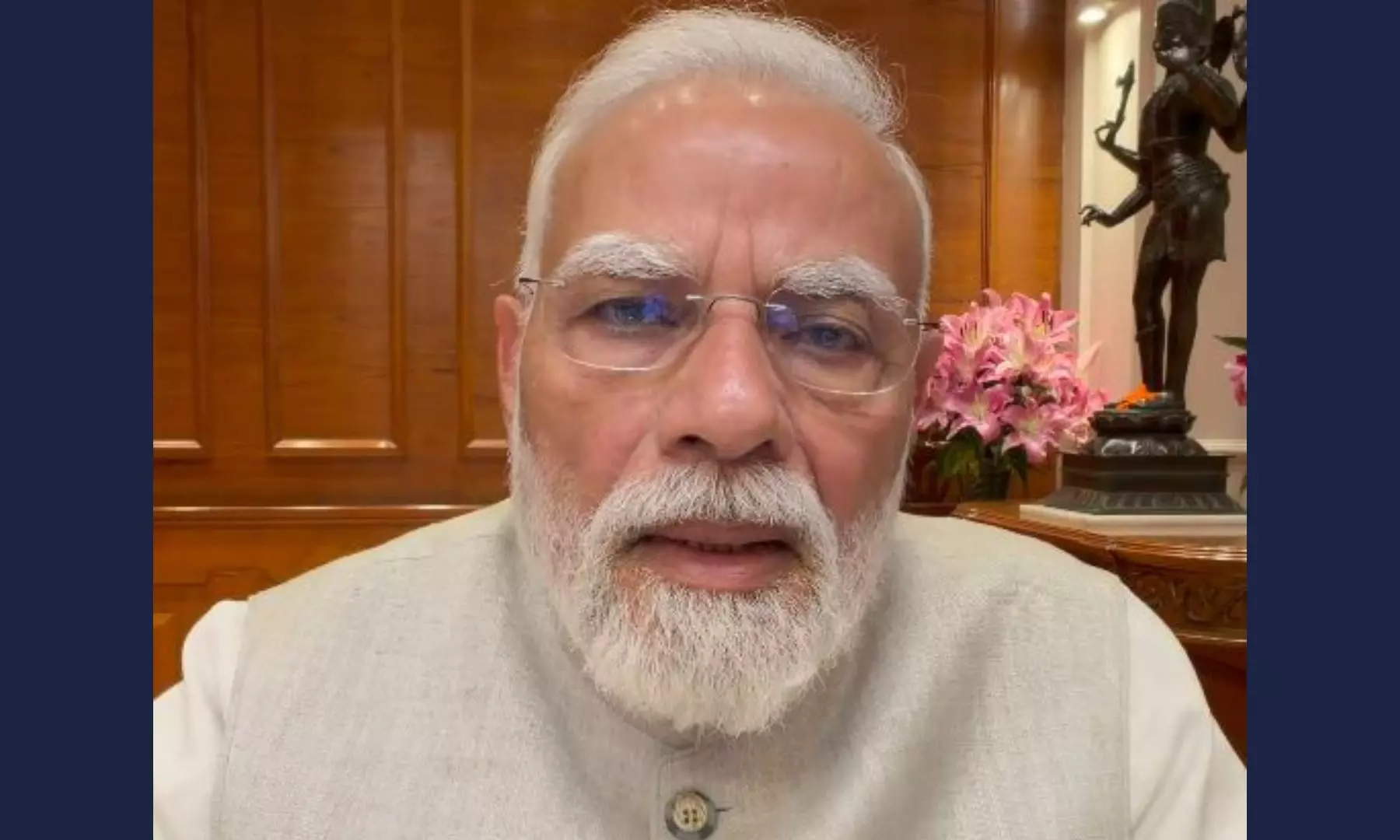
PM Narendra Modi addressing the youth in a new social media post. Photo: X/@narendramodi (Screengrab)
As exam scams spark youth anger, Bhagwat's evasions, Modi's fading applause and Rahul's growing connect suggest a generational shift is underway
Has Gen Z’s agitation against tainted examinations revealed a major chink in Prime Minister Narendra Modi’s legendary communication skills? Is he losing his customary connect, both on substance and style, with an important segment of young India?
Besides, do the standard themes of the Sangh Parivar’s agenda resonate with the same zest as they have done since Modi came to power? Above all, is Gen Z responding more readily than in the past on the issues that the Leader of the Opposition, Rahul Gandhi, is raising?
These are among a host of questions regarding the situation which has emerged in large parts of the country.
Signs of a shift
A look at RSS Sarsanghchalak Mohan Bhagwat’s interaction with Gen Z on August 6, Modi’s address at the convocation of IIT Delhi on the 8th and the response at Rahul Gandhi’s well-attended public meeting consisting of the youth, also on August 8, provide clues to these questions.
Also Read: The unmaking of Brand Modi: How ‘56-inch chested’ PM bowed to youth power
Bhagwat participated in a carefully choreographed interaction through a Q&A session with Gen Z. Only one young man asked him questions relating to issues which are uppermost in the mind of the agitating members of today’s youth.
The rest ranged from dialogue and protest without being dubbed anti-national to the need for education reform to social media. They also included queries on the validity of Indian civil society’s contacts with its Pakistani and Chinese counterparts, LGBTQ rights, including on same-sex marriages, why the RSS membership is open only to males, climate change and reservations.
The tone of the questions was respectful, though the young man did ask Bhagwat if force should not have been used against the protestors.
Bhagwat and Gen Z
The RSS’s chief's responses were on predictable lines though he lauded Gen Z and went to the extent of saying that they were not anti-national and more “honest” than the present generation. However, he evaded the question on the use of force against the protestors because he claimed he did not have full information on the circumstances of the situation.
Bhagwat stressed the need for educational reform and asserted that in addition to the government, society should be involved in the educational system and that it should not be for profit. These are fine sentiments, but the fact is that education is now big business and the youth want action and not words alone.
The RSS chief rightly said education should prepare the youth for productive work and entrepreneurship and not only for jobs. And that social status should not be associated with the nature of employment.
Ideals and reality
Again, there can be no quarrel with this ideal, but would it cut any ice with the vast number of the young? This is especially relevant to those who come from the disadvantaged and discriminated sections of society, in the Hindi heartland. They have few opportunities for becoming entrepreneurs, and for them a government job is a pathway to stability and improvement of social status.
On these issues, the RSS chief’s responses displayed a gap between the Parivar’s thinking and the social ground realities.
Also Read: Bhagwat speaks Gen Z's language, but Sangh's script hasn't changed
On the other issues, Bhagwat stayed close to traditional RSS positions. Substance apart, while his demeanor was pleasant his language and tone were not those that impact with all sections of the youth. They speak in a different idiom and imbibe information and form opinions through the latest modes of social media.
Modi’s message
Modi’s address at the 57th Convocation of the IIT Delhi was standard fare. He spoke of the challenges that the IIT students would have successfully overcome in coming to and then being successful at this premier institution.
He cautioned that life outside the campus would now be different and that “Whenever a challenge seems too big, do not be afraid — break it into smaller parts”. He also rightly advised them that success in life demands an ability to ask the right questions.
Rahul is not a ‘natural’ when it comes to public speaking. He lacks Modi’s panache and eloquence. Yet, now perhaps, these ‘liabilities’ are being transformed into ‘assets’ with Gen Z.
All this was sound advice, but what was missing, and may be in the minds of the faculty and students — both those who had completed their degrees and those who were studying — still was where India stood in this age of the Fourth Industrial Revolution. There was no clear focus on the need for India to come to the forefront in fundamental science and research and not restrict itself to only developing applications based on the work in fundamental areas done by other countries.
Also Read: Are RSS and BJP playing good cop-bad cop with Gen Z protestors?
Modi did mention, “India is working towards economic self-reliance, technological self-reliance, industrial self-reliance – building the strong foundation of a Viksit Bharat. On this foundation, you must construct a grand and beautiful Viksit Bharat”.
He also said, “There are many more sectors where India is beginning a new journey, and the nation looks to you with responsibility and hope. Artificial intelligence, data centres, critical minerals, deep sea exploration, batteries, power storage, energy security, electric mobility, quantum computing – all these fields await your talent, innovation, and leadership. And I too am waiting”. The question is why is this journey beginning now when the Fourth Industrial Revolution is already a decade old.
Fading enthusiasm
That would not have been an unnatural reaction in the mind of Modi’s audience. This was illustrated by its lukewarm response to Modi saying that the National Research Foundation had been established and a funding of Rs 1 lakh crore was being “arranged” for the research sector. So weak was the response that he had to ask whether he should repeat the amount in English. All this showed that the great enthusiasm he evoked among all audiences in the past has eroded.
Also Read: NEET row: Universities flinch when students practise what they're preached
Rahul Gandhi is not a ‘natural’ when it comes to public speaking. He lacks Modi’s panache and eloquence. Often, his political addresses in Parliament or outside seem more appropriate for a think tank session than a political forum. This is reflected both in his choice of themes and his delivery.
Yet, now perhaps, these ‘liabilities’ are being transformed into ‘assets’ with Gen Z. Their concerns today are not becoming sanskari as the Sangh parivar would like them to be, but to get jobs, especially in the government apparatus, which, at least in the Hindi belt, is seen as the path to security and status.
This is especially so for the so-called weaker sections of society and the lower middle class as well as parts of the middle class. No wonder the tainted examinations evoked such a huge adverse response from in these areas. Rahul Gandhi has succeeded in tapping into this anger.
Rahul’s connect
Rahul's language and apparel are also those that Gen Z can identify with. In his Prayagraj meeting, he spoke of themes that resonate with the disadvantaged youth–the broken educational system, the exorbitant costs of coaching to qualify for educational institutions, the leakage of papers, the production of data and its use by major corporations.
He made some of the young come on to stage and relate their experiences which is common to almost all of them. He evoked an enthusiastic response seen when during the 2014 election campaign Modi spoke of “achhe din” (good days) which would come when he assumed office.
Also Read: Why CJP’s protest stands apart from previous mass movements
Rahul Gandhi’s difficulty now lies in channelling the response he is evoking into viable political capital. This is no easy task. This is particularly so when he is faced with a master politician like Modi and the Sangh parivar’s formidable electoral machine. However, Rahul Gandhi is now getting a favourable response from a large section of the youth who identify more easily with him than they do with either Modi or Bhagwat.
(The Federal seeks to present views and opinions from all sides of the spectrum. The information, ideas or opinions in the article are of the author and do not necessarily reflect the views of The Federal.)