



Behind the optics lies a familiar BJP instinct: manage the narrative, not the discontent
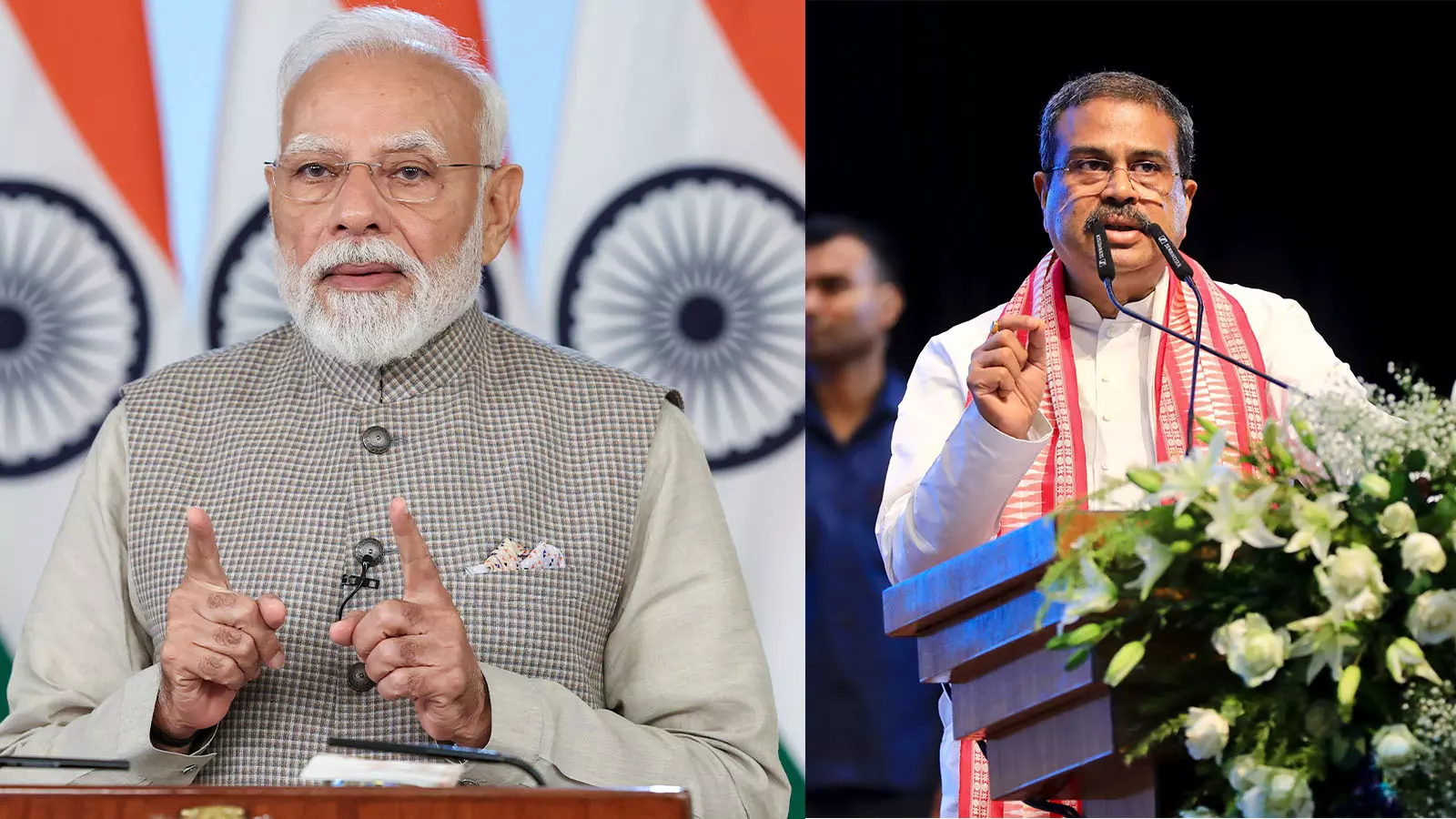
When Prime Minister Narendra Modi reached out to the young protesters at Jantar Mantar in New Delhi and other parts of the country through his recorded Instagram videos and this was followed by the resignation of Dharmendra Pradhan as Union Education Minister, it seemed that the prime minister was genuinely responding to youth power.
It seems that Instagram videos were made after inputs from intelligence agencies that it was necessary to defuse the protests before they grew in size and in intensity. The spin that is being put on the intelligence inputs is that before ‘foreign elements’ gain hold of the protests, the protesters should be made to go home. The resignation of Pradhan was the price the government chose to pay to ‘safeguard national interests’.
BJP building counter-narratives
Apparently, BJP president Nitin Nabin had a meeting with the heads of the youth wings of the party to get an assessment of the situation. The party is now busy building counter-narratives to rationalise Pradhan’s resignation. The clear intent behind the prime minister’s Instagram videos and Pradhan’s resignation is damage control. The Centre's response was tactical, and not a necessary course correction of its unbending inflexibility which is characteristic of the Modi political style.
On the face of it, the NEET-affected youth in these six states may be small, and the party may feel safe enough to prepare for the elections with local issues and local social and caste formations in mind
With state Assembly elections due next year in Uttar Pradesh, Punjab, Goa and Uttarakhand, the party strategists are forced to take a look at the impact of the Cockroach Janta Party (CJP)-led anti-NEET exam paper leak protests, and the influence and power of this segment of the young voters. Most of them are middle-class, and they also come from families where parents voted for the BJP and Modi.
Also read: The unmaking of Brand Modi: How ‘56-inch chested’ PM bowed to youth power
The CJP founder, Abhijeet Dipke, did indicate that Modi had wasted his years in office by playing the Hindu-Muslim card, which warmed the hearts of the secularists. He has also made a visual statement by carrying the picture of BR Ambedkar, showing that the Constitution, Ambedkar’s legacy, is their lodestar in the celebration at Jantar Mantar after Pradhan’s resignation. So, the videos that showed that a section of protesters wanted to agitate against reservations are likely to be scotched. The challenge that the BJP leaders, Modi included, face is how to manage the disaffection within its own middle-class constituency.
The party strategists, most probably led by Union Home Minister Amit Shah, if speculation about the rift between party president and the poll strategist-in-chief since 2014 is to be taken with a pinch of salt, would be reckoning whether the middle-class students and their families who had joined the CJP form a crucial element of the electorate in the poll-bound states.
On the face of it, the NEET-affected youth in these six states may be small, and the party may feel safe enough to prepare for the elections with local issues and local social and caste formations in mind. That could, however, prove to be short-sighted because smartphone and Instagram access is available to nearly 400 million of the 18-30 age segment. Messages go viral in no time, and so does the ‘josh’ of the messages. It would indeed be difficult to predict the impact the Gen Z segment will have on the electoral contests, but this segment will dent both the image and the numbers for the party.
BJP’s monolithic leadership structure
Gen Z protests have succeeded in countering the numbing optics that Modi and his campaign team had wielded for more than a decade now. The Instagram reels of the protesters effectively shot down the BJP/Modi 'propaganda' blitz. Electoral statistics show that the success of Modi and of the BJP has not been as resounding as the mainstream media, especially the compliant television news channels, made it appear. The BJP vote share in 2014 was 31 per cent, in 2019 37.3 per cent and in 2024 36.56 per cent.
The prime minister wants to continue with his headmaster ways, talking down at the protesters. This will be counterproductive. In UP, Chief Minister Yogi Adityanath continues the angry tirade of a school administrator
Interestingly, BJP had won 302 seats in 2019 and in 2024, 240 seats. The difference in vote share was less than one per cent. The same in Uttar Pradesh, a Hindutva bastion of the party since the late 1990s. In the Uttar Pradesh state Assembly elections, the BJP won 302 of the 403 seats with a vote share of 39.67 per cent in 2017, and in 2022, it had won 255 seats with an increased vote share of 42.20 per cent. The anomalies inherent in a first-past-the-post system are evident, but it also shows that the party’s dominance among the voters is not as pervasive as the BJP and the media would have us believe.
Also read: CJP protests expose Modi's Achilles' heel: A government unused to listening
Young BJP MPs in Lok Sabha like Bansuri Swaraj, Tejasvi Surya, Anurag Thakur are showing no signs of reaching out to the young protesters because Prime Minister Modi wants to do it himself. The party’s monolithic leadership structure is not to be tampered with. All that the young MPs can do is to continue to sing the praises of the leader. The mood among the protesters is nowhere near the deference that the BJP MPs show towards Modi. A clear example can be seen in the merciless lampooning of Modi’s Instagram messages.
What is the lesson for BJP from CJP protest?
The younger members in the BJP will have to loosen their limbs as it were, smile more and laugh more at themselves. They are unable even to laugh at the protesters’ memes about the government and the party. The grimmer their expressions, the youngsters on the streets will make more fun of them. The prime minister’s Instagram video campaign will not reduce the mindset barrier that now exists between Modi and the youngsters with their irrepressible laughter.
Also read: CJP's Dipke dares 'emperor' to reveal degree after BJP targets his education funding
The prime minister wants to continue with his headmaster ways, talking down at the protesters. This will be counterproductive. In UP, Chief Minister Yogi Adityanath continues the angry tirade of a school administrator. The BJP may manage to win the state Assembly elections despite Gen Z protesters, but they have lost whatever little respect they had among the passive majority of voters. The lesson of the CJP protest at Jantar Mantar for the Modi government in the last week of July is a simple one: Do not take yourself seriously. But the BJP has chosen to go about their business with greater seriousness than before.
(The Federal seeks to present views and opinions from all sides of the spectrum. The information, ideas, or opinions in the articles are of the author and do not necessarily reflect the views of The Federal.)
