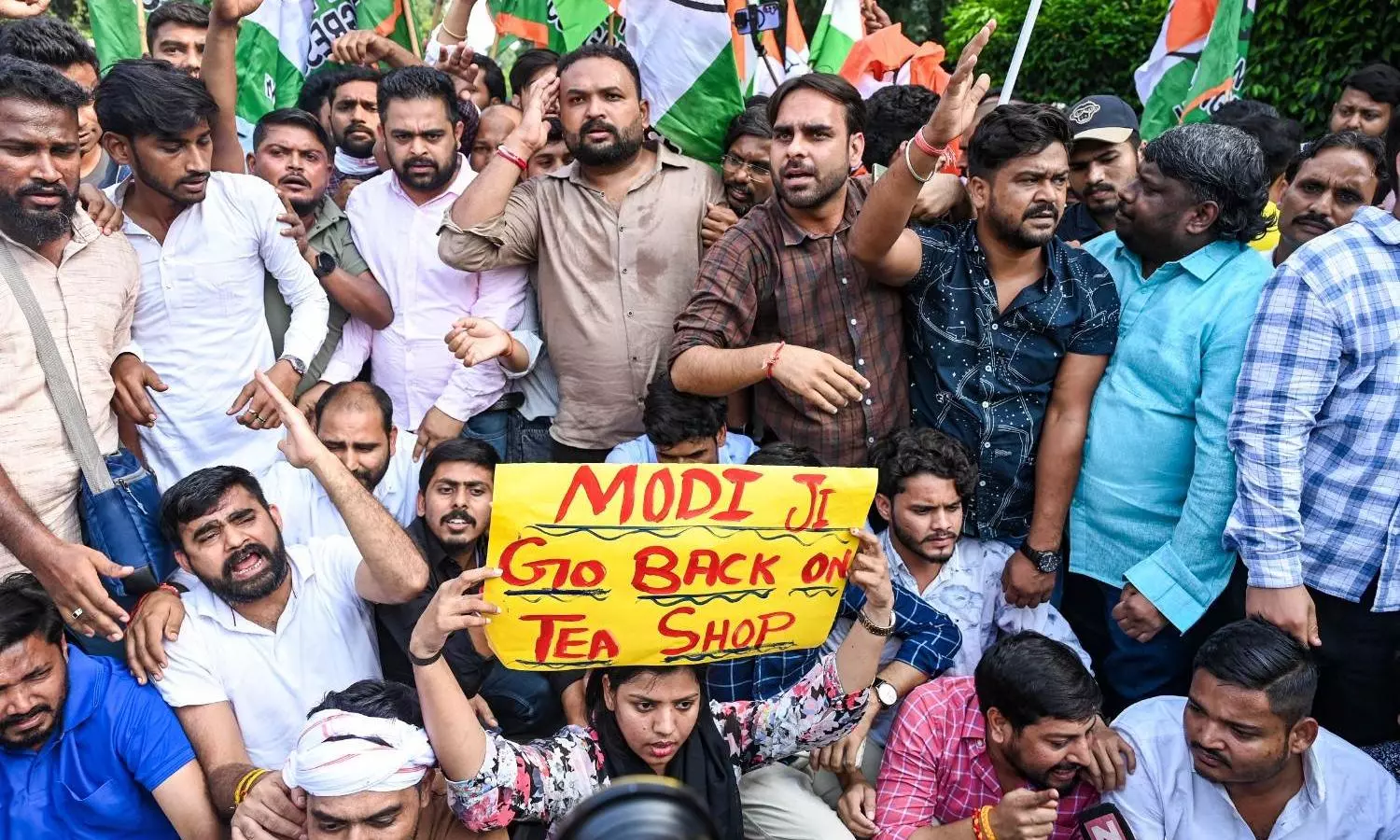
As youth groups and Opposition parties rally behind a single slogan, Centre's answer of barricades and shuttered Metro stations is only fuelling the movement
The recent round of protests, with the principal demands for the resignation of Chief Election Commissioner (CEC) Gyanesh Kumar, and an immediate halt and complete rollback of the nationwide Special Intensive Revision (SIR) exercise, have to be seen as a part of a sequence of events that got kick-started with the completely uncalled-for “cockroach jibe” by the Chief Justice of India, Surya Kant.
The most crucial deduction from what transpired during Jantar Mantar 1.0 was not the resignation of the then Education Minister Dharmendra Pradhan. Instead, the manner in which the protesters forced Prime Minister Narendra Modi to capitulate in the face of concerted and escalating public demonstrations resulted in the dramatic and sudden lifting of the pall of fear over protesting in the country.
NEET paper leak-SIR link
Innumerable people who had not joined the protests began believing that if Modi could ask one of his trusted aides to step down due to the agitation, similar action could force him to concede more ground.
Almost overnight, people, whose grievances had accumulated over the past 12 years, but were kept on the back burner out of dread, began articulating these pent-up demands.
Also read: Foreign hand in anti-SIR protests? Prove it, or drop it, Mr Nabin
Large sections of the youth, who had become thoroughly de-politicised over the past few years, suddenly appeared to have always been a politicised lot.
What we have witnessed over the past few days is not a wild swing from one unconnected issue to another. Much as the issues of the NEET paper leak and the SIR of electoral rolls may appear dissimilar, they are symbiotically connected, for they impact the future of people, as professionals and as citizens.
Effectively, the streets have belonged to people for whom the issue was more important than the label or banner under which they were marching. Lok Sabha Leader of Opposition Rahul Gandhi rightly recognised this and very generously welcomed all, even those outside his party’s or his allies’ cadre. What has mattered was the thunder for Gyanesh Kumar’s removal and for the cancellation of the SIR process.
Out of Modi’s syllabus
Even before Jantar Mantar 1.0 emerged as a serious political challenge for the current political regime, it had started becoming evident that this was one round where Modi was failing to devise a counter strategy.
Much as the issues of the NEET paper leak and the SIR of electoral rolls may appear dissimilar, they are symbiotically connected, for they impact the future of people, as professionals and as citizens.
The latest round of protests has further amplified the sense that he is yet to devise a suitable ploy or tactic, save rolling out the security hardware.
Also read: Will India ever regain its much-acclaimed, fair electoral process?
Quite clearly, Modi and his aides lost sight of what their goal should be. Instead of politically weakening the emergent movement against the CEC and the SIR, the government’s objective these past days was to prevent an assembly at Jantar Mantar to prevent an updated edition of the previous sit-in.
But, as the events demonstrated, the more forces Modi marshalled, the greater was the commitment and determination to make a splash on the streets.
Common Minimum Programme
Over the past few days, we have witnessed the same set of issues and common slogans being mouthed, but by diverse groups. It almost appeared that a Common Minimum Programme has already been consensually arrived at by the BJP’s adversaries.
In response, all that the government has issued are draconian executive orders and directives to the security personnel to prevent public assemblies at all costs. The government also overlooked several judicial orders, including from the Supreme Court, but the judges have been too mild-mannered to question why their orders have been treated with contempt.
Also read: Why Modi's 25 years in power mark the biggest consolidation of power in Independent India
The government forgot that even the most vicious of emperors could never eliminate protests solely by the deployment of security forces. Modi has failed to comprehend that the Cockroach Janta Party (CJP) may have been conceived in satire, but it has developed as a political idea, even though its leaders remain away from conventional party politics.
Opposition takes the cue
Quite on their own steam, Opposition parties too have decided to pursue a common cause. Their shared aim is no different from that of the CJP and other youth and students’ organisations, which too have chosen to write a common manifesto.
As a result, the demand has been the same over a series of days of protests—CEC and SIR “must go” and the changes in the electoral rolls thus far must be rolled back.
Besides mobilising the police and other security forces, all that the government could think about is to de-notify Jantar Mantar as a site for staging protests.
No lessons learnt
Quite clearly, the government did not learn from experience, when on the first day of the protests in this round, people chose to mark out several other Jantar Mantars in the capital city. They made it clear that “protests at any site” were always better than “no protest at that site”.
Also read: Indian voter is angry, but Gyanesh Kumar can still atone for his ‘crimes’
Moreover, as the dramatic intrusion into the heavily garrisoned Jantar Mantar area by the CJP leaders and activists on the morning of October 13 demonstrated, by disallowing protests at this site, it has been converted into a permanent “goal post” of sorts—every group of protestors will henceforth make efforts to stealthily sneak in, and hoist a flag, shout a slogan, click a selfie and post on social media.
The latest round of protests has further amplified the sense that Modi is yet to devise a suitable ploy or tactic, save rolling out the security hardware.
For a regime and a leader who were considerably a creation of social media, it is being undone by it. If Modi mocked the political flock that opposed him, labelling someone as “jersey cow” or another as a “50 crore ki girlfriend”, an anonymous lot too coined their disdain for him – “56 inch ka chhota bandar”.
Jantar Mantar 2.0 that could not fully be, too, has its version — “57 Metro stations shut by the man with a 56-inch chest”. Quite clearly in both scorns, the intention is to belittle Modi.
Modi’s 25th year
Over the past few days, Modi has been celebrating his 25th year in public office, marking his beginning in October 2001 as Chief Minister of Gujarat and later continuing from May 2014 as Prime Minister.
Ironically, this celebration has happened at the time when he’s politically at his weakest and even in this round of protests he failed to put together a political strategy to counter the rising correctness and support of protesting forces.
Also read: SIR voter deletions: Can INDIA Bloc turn discontent into a movement?
The first day of Jantar Mantar 1.0 was conspicuous by the extent of force used against the protesters. That level of brutality against a peaceful lot was a manifestation of political defeat besides being evidence of failed intelligence.
In this episode of protests, excessive marshalling of security forces—an unprecedented number of them being mobilised from others states and locations—was also a marker of political defeat of the regime.
Crucial Assembly elections
It is unlikely that having reached this far, either the Opposition parties or the CJP would scale down their ambitions and return to the bunkers.
The political parties will, of course, keep an eye on the next round of assembly elections—due in Uttar Pradesh, Uttarakhand, Punjab and Manipur in barely four months. There are other important state polls towards the end of 2027, Gujarat being the most crucial one.
Also read: When State elects the people: Notebandi, votebandi and the inversion of democracy
Regardless of the CJP choosing to stay aloof from electoral politics, although this position may change in the period ahead, its campaigns will only weaken the BJP further.
A new phase of Indian politics
What India witnessed on the streets of Delhi on the days that the INDIA bloc marched to the Supreme Court and presented a memorandum, besides also submitting a petition, was no ordinary political march.
The thousands of protesters, who marched through Central Delhi’s avenues, cocked a snook at assembled security personnel.
This is not the end of a campaign. Instead, it is the launch of a new phase of politics of the sort that India has not witnessed for long.
(The Federal seeks to present views and opinions from all sides of the spectrum. The information, ideas or opinions in the articles are of the author and do not necessarily reflect the views of The Federal.)