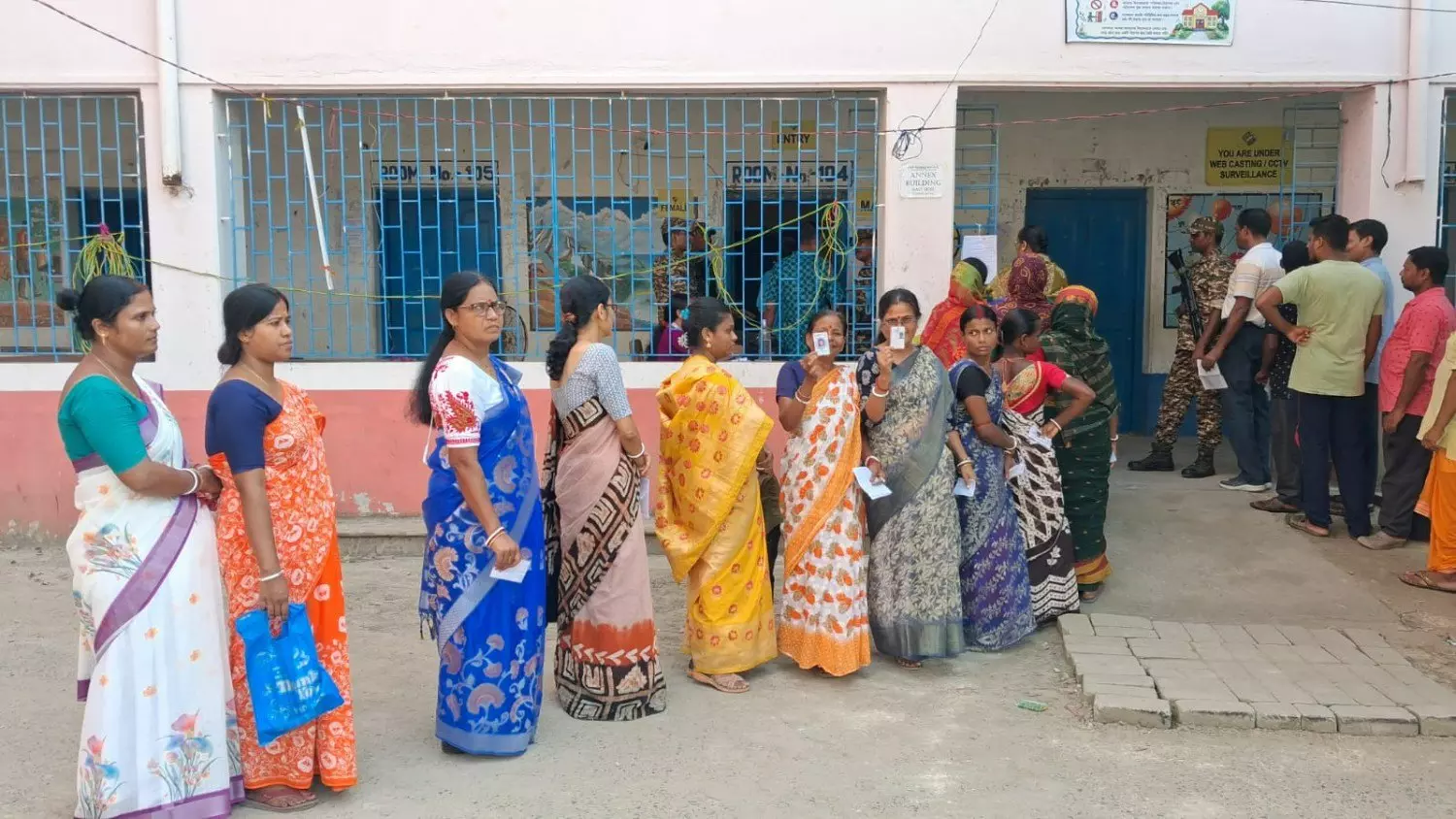
As an individual, born in India to Indian parents, getting to vote has never been an issue until now.
The year was 2004. The BJP’s “Shining” India was going to polls and the incumbent Vajpayee government was the favourite to win. In the Al Jazeera website newsroom, where this writer worked at that time swarming with both Arabic and English journalists from various countries, it was smugly assumed that a “majority Hindu nation would elect a Hindu-first political party, the BJP”.
The results, that upended the Vajpayee government and brought in the Congress-led alliance, stunned the journalists. Many of them, sceptics, who had been sure that a Hindu-nationalist government would not be defeated in a Hindu majority nation, grudgingly conceded that India was among the few nations where elections were fair, under an independent Election Commission.
For the few journalists from India in the Doha newsroom, it was a moment of pride – that a nation, despite its image abroad as a struggling economy, poor, and with many more warts – conducted elections so well and so above board.
Also read: 'Gyanesh must go': Najeeb Jung's 3 suggestions to address EC SIR crisis
At that moment, none could have imagined that a day would arrive when the above board electoral process would be subverted and the last hope for 140 crore Indians would be so brutally compromised.
EC facing pressure from ruling parties
In the nearly eight decades since the first elections were conducted, the Election Commission had faced pressure from ruling parties on various occasions, but never had there been a capitulation on the scale being witnessed today – where in the guise of a Special Intensive Revision (SIR), at least 13 crore Indians have reportedly been disenfranchised in one fell swoop.
Elections in India have always meant suspense and unpredictability for every contestant – with no exception. None could enter the fray with a 100 per cent chance of winning.
As an individual, born in India to Indian parents, getting to vote has never been an issue until now. Having professionally covered innumerable elections across the country over the last four decades, conducted almost always in a festive atmosphere, the changes are striking. No eligible voter – irrespective of caste and religion — was ever in danger of being excluded. Of course, in every election, some names would go missing from the voters’ list causing considerable heartburn but rarely was there an accusation against the state or the Election Commission of it being a deliberate move.
Also read: SIR voter deletions: Can INDIA bloc turn discontent into a movement?
Even during the Emergency that saw all individual freedoms suspended, there was no known attempt by the Indira Gandhi government to tamper with the electoral roll. In that tightly-controlled period of 21 months, the government could have, without much difficulty, manipulated the elections and ensure its victory. But no. In general elections that followed the lifting of the Emergency, the ruling Congress suffered one of its worst defeats in India’s electoral history.
When the mighty fell in polls
In fact, elections in India have always meant suspense and unpredictability for every contestant – with no exception. None could enter the fray with a 100 per cent chance of winning. India’s track record is replete with examples of the “high and mighty” reduced to dust, sometimes at the hands of minnows, in a single election.
Who can forget the defeat of the powerful PM Indira Gandhi by Raj Narain in Rae Bareli in 1977, the defeat of Atal Behari Vajpayee in Gwalior in 1984 by Madhav Rao Scindia, the victory of an almost unknown Congress candidate Narayan Kajrolkar over the architect of the Constitution, Dr B R Ambedkar. The list is long...but the point is none could take the voter for granted.
In most cases, where a government had been judged to have fallen short, or failed, it was the voter who had the last laugh. Again, the examples are many. Take the ruling Congress-led UPA 2.0. Reports of corruption and mis-governance during its second term sealed its fate, making way for the BJP government under Prime Minister Narendra Modi in 2014.
Since the nation’s Independence, various governments have tried to appoint Election Commissioners seemingly “friendly” to ruling parties.
Without the fairness and transparency in the electoral process, it is doubtful if Modi’s team or, for that matter, any Opposition party could have come to power. The irony is stark, when seen in light of the latest developments involving the Election Commission. Because this element of unpredictability and chance is in danger of being snuffed out through the ongoing SIR process.
Election Commission's current crisis
Several democracies around the world, entrenched and aspiring, have struggled to honour the electoral process and the results of elections – where ruling dispensations have oftentimes resorted to violence to remain in power. Sudan, Chad and parts of Central Africa have been wracked by violence triggered by ruling dispensations which have tinkered the electoral process.
Also read: Indian voter is angry, but Gyanesh Kumar can still atone for his ‘crimes’
Even the top dog democracy United States of America has not been spared this when supporters of defeated US presidential candidate Donald Trump launched an attack on the Capitol in Washington DC in 2020.
Another established democracy Brazil soon followed, when followers of the vanquished Jair Bolsonaro tried to storm federal government buildings including the presidential palace following the victory of his opponent Inacio Lula da Silva in January 2023.
India has so far not witnessed anything but peaceful transfers of power – again, largely due to the credibility of the electoral process. But given the manner in which the current Election Commission has attempted to tinker with the fundamentals apparently to favour the ruling BJP, it raises the question whether the integrity of the electoral process was taken for granted – leading to the current crisis.
How Seshan changed EC
Since the nation’s Independence, various governments have tried to appoint Election Commissioners seemingly “friendly” to ruling parties. There have been instances when these commissioners have reportedly favoured the ruling dispensations in cases of disputes and poll complaints. T N Seshan put an abrupt end to this cosy relationship by exercising his authority to the full as Chief Election Commissioner from 1990-96.
Seshan showed what a truly independent CEC could do. He used all the powers under him to mercilessly neutralise any advantage that ruling parties, representatives and anyone in government had over those who were aspiring to win. So driven was Seshan that all political parties were shaken by his focussed attempts to make electioneering as ideal an exercise as possible. His simple and honourable objective was to create a level playing field for all contestants in an election.
All parties including the Congress, the various Janata Dals and the BJP got together to get the Constitution amended to clip the wings of the CEC in a contentious move. Seshan challenged this in court but failed. A single CEC gave way to a three-member panel of Election Commissioners, with the CEC just one of them, the so-called “first among equals”. The idea was to make decision-making in the EC more democratic and to distribute power among the three, rather than one who could turn “dictatorial” like Seshan.
The sobering lesson from the SIR exercise is that India’s electoral system is not as hardy as it was thought to be. The system has holes that can be exploited by vested interests to skew the process.
At the time, this was seen by critics as a dilution of the Election Commission with a view to preventing it from acting independently. Since all parties were for it, this was grudgingly accepted by voters. Paradoxically, in retrospect, this doubtful move appears to have come at the right time. For it affords a sliver of hope to salvage the electoral process.
The sobering lesson from SIR exercise
Imagine a situation where there was only one CEC, like in Seshan’s time. The current CEC Gyanesh Kumar could have legally gone about his business of the controversial SIR – with none to rein him in. Because of a three-member panel, the resulting checks and balances have come in to play. It has enabled the two other ECs to record their objections and observations to the reportedly unilateral decisions taken by the CEC. And, thanks to the Indian Express’s investigation, this has been exposed.
Gyanesh Kumar is therefore now open to questioning to a point where the SIR, along with its infirmities, is now on shaky grounds – which, many would agree, is a silver lining in the midst of the dark deeds of the last few months, starting from the Bihar Assembly elections.
The ultimate tragedy when governments encourage activities like the subversion of the electoral process is it tends to set a precedent that can be worked upon by a successor government in the future to further its power.
The Emergency may have been imposed by Indira Gandhi to save herself and her government, but it showed how the Constitution can be tinkered with at best or abused at worst for others in the future. For example, Emergency-like conditions can be imposed on the nation without formally declaring it – a lesson learnt from 1975 – something that the Modi government has been accused of.
The sobering lesson from the SIR exercise is that India’s electoral system is not as hardy as it was thought to be. The system has holes that can be exploited by vested interests to skew the process.
And more worrying, for a democracy that depended mainly on elections to make governments accountable, there is no guarantee how long this will last. Can it exist only if governments allow it to, or does something needs to be done to make it genuinely tinker proof?