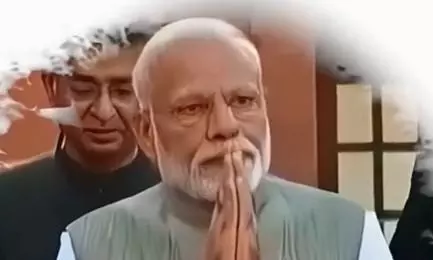
Modi’s silver jubilee in office is marked by democratic contestation rather than unchallenged authority. Photo: X | @DDNewslive
Modi’s silver jubilee in power marks an extraordinary political run, but the landscape may have altered now amid mounting protests by a resurgent INDIA Bloc
As an accomplishment, any unbiased assessment of Prime Minister Narendra Modi occupying a seat of power consecutively for 25 years would conclude that this is no mean an achievement, and the party is well within its rights to celebrate the occasion.
However, the fact too cannot be denied that the festivities have unfortunately come close on the heels of his personal and political aura fading and touching the lowest point in the graph of his direct public appeal.
Modi’s political vulnerability
In fact, political vulnerability has been nibbling at his heels ever since the BJP lost its exclusive parliamentary majority in the 2024 Lok Sabha election and has thereafter been dependent on coalition partners.
Yet, there have been occasions when he pulled out of the numerical deficit with policy decisions that boosted his ratings – Operation Sindoor in 2025, most famously. He even led his party in reversing the electoral setback, beginning barely a few months after the Lok Sabha poll – bagging Haryana and Maharashtra sequentially in 2024 and following this with significant victories through 2025 in Delhi and Bihar, in alliance with the Janata Dal(U).
Also Read: From seva to spectacle: How Modi’s birthday became a political project
But the icing on the electoral cake was reserved for this year when Modi led a no-holds-barred political assault on Mamata Banerjee’s citadel in West Bengal. Eventually, he successfully took away not just the state but also her party, although the latter snatch raised several questions, and not all of them have been resolved yet.
After Modi assumed the office of the Prime Minister, it became evident that the use of public events was not merely a communications tactic; it is a central pillar of his political strategy.
Despite that, few within the party grudged Modi’s penchant for events and played along when party, state, and official funds fused into a composite whole on September 17. It was the day Modi turned 76, one more than the age which he used randomly since 2014 to leave out party veterans from any official position and push them into the virtually non-functional Marg Darshak Mandal.
Proclivity for staging grand events
Modi’s proclivity for staging grand events became evident on the day he took oath for the first time as Gujarat’s chief minister. The ceremony, normally a routine function at the state governor’s residence, was held in a sports stadium and described by a media report from that time as an “extravagant function that was unparalleled for its scale and ostentation”.
This ceremony marked the beginning of a conscious strategy to transform routine public events into grand political spectacles designed to project authority, popularity, and modern efficiency. Rather than using the Raj Bhavan in Gandhinagar, the ceremony was shifted to the open-air Sardar Patel Stadium in Ahmedabad (renamed as Narendra Modi Stadium in February 2024).
Also Read: How 'combative' INDIA Bloc plans to turn EC row into a mass movement
This relocation virtually turned a constitutionally-mandated procedure into a stadium-sized public rally. The event featured massive backdrop banners, floral decorations, and elevated staging. This setup maximised visibility for photojournalists and TV cameras, ensuring the imagery dominated news coverage. In a sign of what was to follow, even after Modi became Prime Minister, the ceremony incorporated traditional rituals, Vedic chants, and blessings from prominent Hindu spiritual leaders, blending political power with religious authority.
The grandeur stood in sharp contrast to the still devastated homes and properties in Kutch, destroyed in the earthquake on January 26, 2001. Inadequate and inefficient relief and rehabilitation projects of the state government under Keshubhai Patel was one of the reasons for Modi being deployed by the BJP’s national leadership. Despite administrative austerity being the call of the moment, Modi opted for a grand, confidence-building spectacle. The swearing-in ceremony set the template for Modi’s signature event-management style throughout his tenure as Chief Minister and later as Prime Minister.
Key elements of template
The key elements of the template need a recall to comprehend his desire for pomp and show along with political messaging:
- Framing public occasions not as routine protocols but as high-production spectacles, to convey strength, decisiveness, and grandeur.
- Providing an opportunity to make the events tailor-made for live television broadcast, bypassing traditional media filters and establishing a direct visual connection with the electorate.
- Ensuring such ceremonies are noted as proof of legitimacy with large venues establishing support of the assembled audience comprising mainly party cadre, RSS workers, and more than a sprinkling of curious members of the public.
Political strategy
After Modi assumed the office of the Prime Minister, it became evident that the use of public events was not merely a communications tactic; it is a central pillar of his political strategy. On an everyday basis over the past quarter of a century, it can be argued that his event management style has evolved from localised state-level mobilisation to high-production international diplomacy and deeply symbolic statecraft.
Be it the annual Vibrant Gujarat Summits to establish Gujarat as an economic engine, the Rann Utsav and International Kite Festival to invoke and link regional cultural pride directly to his political brand, 3D holographic projection rallies during the campaign for assembly elections in 2012, or Modi’s global diplomacy events – Howdy Modi in Texas in 2019 and, of course, the G-20 and BRICS Summit - all establish India's rising global stature, and Modi's centrality within it.
Also Read: PM running out of words and ideas? Modi's shortest, least consequential I-Day speech yet
His style of politics has always carried varied messages. He even made statecraft a sacred act, as established by repeated events at the Ram temple in Ayodhya and the new Parliament building in New Delhi. Such ceremonies were aimed at projecting Modi as a custodian of state tradition that was pronouncedly Hindu.
Fundamental shift in Modi era
Despite consciously choosing to be a ceremonially-oriented leader (not a ceremonial premier because he has always remained a hands-on manager or boss), the emergence of unprecedented structural and political vulnerabilities at this juncture cannot be overlooked.
Currently constrained by coalition partners – witness, for instance, their responses on issues related to the Election Commission and the Chief Election Commissioner, Gyanesh Kumar – the ground reality of Modi being hemmed in by a variety of forces, ranging from rejuvenated opposition parties under the INDIA banner to the new political phenomenon, the Cockroach Janata Party, marks a fundamental shift in the Modi era. This has taken away some of the sheen from Modi’s silver jubilee in office.
Centralisation of political power
Despite multiple challenges dogging him now, there is no denying that the past quarter of a century represents the most significant consolidation and centralisation of political power in post-Independence India – way beyond the authoritarian years during the Emergency imposed by Indira Gandhi.
These are also the years during which Indians have witnessed all that the phrase ‘the good, the bad, and the ugly’ encapsulates. There have been several innovative policies that were introduced over the years under Modi’s leadership and have benefited the people, including the poor. Likewise, there have also been many programmes or initiatives which remain questionable.
Also Read: The unmaking of Brand Modi: How ‘56-inch chested’ PM bowed to youth power
There have also been several decisions, political as well as administrative, which turned out to be fairly abhorrent. Most of these have been either applauded, scrutinised, or outrightly condemned over the years. These issues are tightly intertwined with the questions regarding the Election Commission’s impartiality that are currently dominating the headlines. There are also matters related to his failure to revive the economy in a manner that reduces widening disparity and provides common citizens with more resources to enhance their purchasing power and not be dependent on state doles for subsistence.
Three time periods
However, it would be analytically naive to bunch the entire period of 25 years as one uniform timeline of dominance. Instead, Modi’s time in the two public offices has to be seen as a three-act arc: Construction (2001–2014), Zenith (2014–2024), and Contestation (2024–2026).
Modi now presides over a regime actively negotiating its survival and attempting to regain its hegemonistic character, within the classic framework of Indian democratic politics: coalitions, social movements, and institutional checks.
Although it is often stated that Modi’s was an unscheduled elevation to the chief ministerial chair following Keshubhai Patel’s removal, which kick-started his journey, it can be contended that he had been in preparation mode for several years, especially after being deputed to New Delhi in 1998 on being appointed National General Secretary (Organisation).
Also Read: PM Modi reflects on 25 years in office: ‘Improving lives my constant endeavour’
An indication of this is the existence of his personal website, www.narendramodi.com, at the time he assumed office, fully functional and acting as one of the platforms over which the entire ceremony was webcast live. This particular website was registered and launched to host articles, public addresses, and political updates during his time as BJP General Secretary (Organisation) and his early days as Chief Minister of Gujarat.
With India's top-level domain (.in) becoming widely available and popularised from the mid-2000s, Modi's team established www.narendramodi.in as his primary web address to reflect a national identity.
Regime negotiating its survival
Planned innings or otherwise, now there is no denying that Modi has crossed yet another monumental milestone in his political career. However much he would have liked events not to turn out the way they have, Modi’s silver jubilee in office is marked by democratic contestation rather than unchallenged authority. This is an era he ends, not as an unchallenged leader or as an impenetrable monolith, but as the head of a regime quite like many that preceded him. This includes the one headed by his one-time party elder, Atal Bihari Vajpayee.
Also Read: Damage control, not course correction: Decoding Modi's response to CJP protests
Modi now presides over a regime actively negotiating its survival and attempting to regain its hegemonistic character, within the classic framework of Indian democratic politics: coalitions, social movements, and institutional checks.
The weeks, months, and years eventually, depending on his capacity to write his destiny or be forced to do so, will decide how historians of the future assess him and analyse the Modi years.
(The Federal seeks to present views and opinions from all sides of the spectrum. The information, ideas or opinions in the articles are of the author and do not necessarily reflect the views of The Federal)