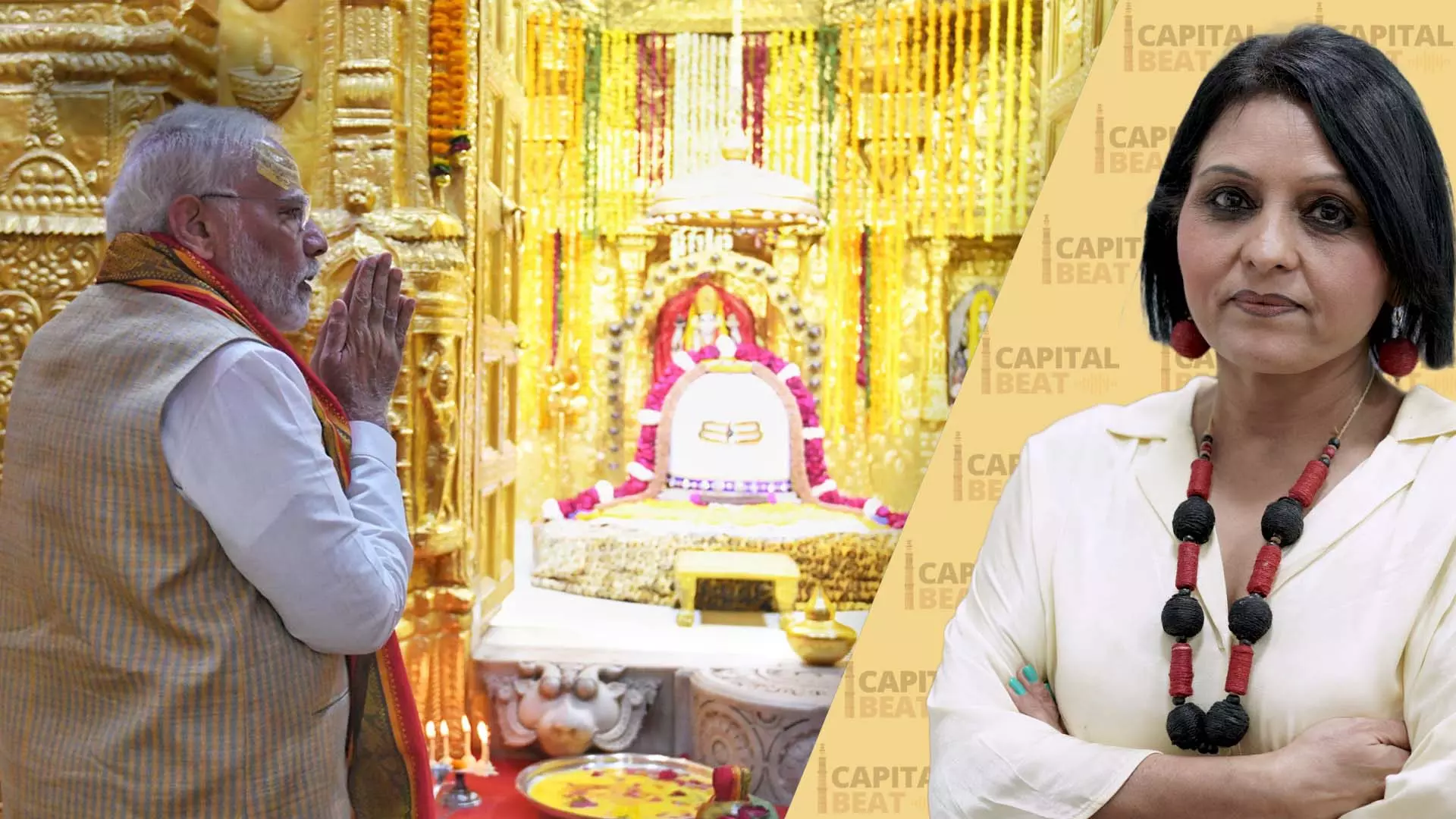
Somnath blog and ‘Jai Somnath’ closing line: What Modi and BJP signal
Modi’s Somnath blog invokes history, civilisational memory, and political messaging at a charged moment, and BJP uses it to the hilt

This Capital Beat episode featured senior journalists Nilanjan Mukhopadhyay and TK Rajalakshmi discussing Prime Minister Narendra Modi’s blog marking 1,000 years since the first attack on the Somnath temple in 1026 AD, and the political messaging around the closing line, “Jai Somnath”.
The discussion opened by linking the blog’s timing to the Supreme Court’s refusal to grant bail to Umar Khalid and Sharjeel Imam, described in the transcript as two accused in the 2020 Delhi riots whose continued incarceration has drawn international attention.
The panellists focused on how the blog frames “civilizational resilience”, references “invaders”, and includes criticism of Jawaharlal Nehru, along with how BJP spokespersons amplified the message after the blog’s release.
Nehru and history
Mukhopadhyay described Nehru-bashing as a consistent theme in Modi’s political messaging. “When is Prime Minister Narendra Modi not taking potshots at Nehru?” he remarked, calling it a “running agenda” since 2014.
Also read: Nehru sought public funds for 'Babri Masjid', Sardar Patel opposed, says Rajnath
The episode also referenced criticism aimed at historians, with Mukhopadhyay stating that the blog’s attack is “not just on Nehru but also on… various historians… saying… they have provided a distorted history of Somnath’s temple.”
Mukhopadhyay raised a specific objection to the blog’s historical claim regarding Ahilyabai Holkar, stating, “Ahilyabai Holkar did build a temple but not rebuild that temple… she built a small temple close by.”
Reconstruction claim
The panel discussion treated the Ahilyabai Holkar reference as an example of what Mukhopadhyay called “distortions”, while also asserting that rebuilding Somnath in the late 18th century was not presented as a broad “sentiment of religious nationalism” at the time.
Mukhopadhyay described it as “peculiar” for the prime minister to engage in historical narration, and framed this as outside “his terrain”, listing governance responsibilities and pending issues as priorities he would rather see addressed.
The episode also linked the Somnath blog to a broader pattern of public events, referencing an official commemoration around “Vande Mataram” and suggesting the government moves “from one event to another” to keep attention focused away from delivery-related questions.
BJP amplification
The transcript cited BJP press conferences after the blog, naming spokespersons Sudhanshu Trivedi and Shehzad Poonawalla, and referencing remarks about the “M factor”.
Mukhopadhyay framed the party’s messaging as consistent with a broader effort: “The idea is to further the cult of Mr Modi at every level.” The discussion also described the blog as “potentially written by someone else and released in Modi’s name.”
Also read: Delhi riots case: Bail for five, jail for two leaves families balancing relief and sorrow
The episode characterised the blog’s style as rhetorical and emotive rather than substantive, stating it uses “very flowery language” to “make an emotional impact” and “stir up… Hindu consciousness”, and linked this to what Mukhopadhyay called a “majoritarian mindset”.
Political message
Rajalakshmi addressed what the programme framed as the political message of invoking Somnath while referencing “Mehmood of Gazni” and “invaders”. She contrasted the blog’s medieval focus with what she described as the government’s lack of attention to an international development involving Venezuela.
Rajalakshmi stated that she would have been “pleasantly surprised” if the Prime Minister had addressed a “third M” involving “the Venezuelan president Maduro” and described the absence of a detailed statement as evidence of “misplaced priorities”.
The discussion also described the blog as reinforcing “divisive ideology” by repeatedly invoking medieval-era invasions, while asserting that “all history and everything… begins at that point” in such political framing.
Diversion question
The host’s question framed the blog as possibly designed to deflect attention and asked whether it functioned as a diversionary tactic. Rajalakshmi stated it “comes out of context” and then cited a separate political environment in which she said polarisation was being attempted through “SIR” and “Bangladeshi infiltration”, alongside a reference to “a series of hate crimes”.
Also read: 2020 Delhi riots: Why SC denied bail to Umar Khalid, Sharjeel Imam
Rajalakshmi stated the blog could have expressed concern about current developments instead, and described it as “another attempt to… whip up… irrational sentiments… narrow sentiments… bigoted sentiments”.
She also questioned authorship directly, stating that whether Modi wrote it or whether it was “ghost-written” was unclear, but it was published under his name.
End goal framing
The host then asked Mukhopadhyay what the “end goal” was, including whether the message was directed at specific political audiences in states such as West Bengal, Gujarat, and Uttar Pradesh.
Mukhopadhyay framed the blog within a longer political arc, describing it as part of a decades-long effort since 1986 to “communalise Indian society” and give a “majoritarian turn to politics”, beginning with the Ram Janmabhoomi movement.
Mukhopadhyay described a phase in the 1990s and the Vajpayee era when contentious issues were “kept in the back seat”, listing Article 370, Ram Mandir, and the Uniform Civil Code as the three issues named in the transcript.
RSS reference
Mukhopadhyay cited a past exchange referenced in the transcript involving “Professor Rajendra Singh or Raju bhaiya”, described as the then sarsanghchalak of the Rashtriya Swayamsevak Sangha, and recounted the analogy used: “When you have flu… you don’t do a certain set of things… once they are better… they would be actually coming back to the agenda.”
The discussion then moved to the post-2002 period and the BJP’s political messaging after 2004, stating that despite the party’s internal reading of defeat, Modi remained “very steadfast” on platform and agenda.
Also read: Why has India stopped short of condemning US action against Venezuela?
Mukhopadhyay described the broader objective in terms of presenting India “more and more as a Hindu country as a civilizational whole”, with “others” expected to live “on our terms and conditions”.
Nehru paragraph
The episode then focused on the blog paragraph that described Sardar Vallabhbhai Patel’s role after 1947, the Somnath temple inauguration on May 11, 1951, and the presence of Dr Rajendra Prasad, alongside the blog’s claim that Nehru was “not too enthused” and did not want the President and ministers to associate with the event.
The transcript also included a reference to KM Munshi and his works on Somnath, including the book titled Somnath: The Shrine Eternal.
Rajalakshmi questioned whether Modi was quoting archival resources and stated that the paragraph was “interpretation”, raising the issue of “who recorded that history” and calling for the cited source to be made public.
Babri comparison
Rajalakshmi then made a direct comparison to the Babri Masjid demolition, describing it as an example of how political movements were orchestrated and how “caricaturing… of the minority community started”.
She stated that history presented by BJP leaders “has to be taken with a huge sack of salt”, and described “distorting history” as part of what she called their agenda.
Rajalakshmi framed the broader political project as presenting India as a Hindu nation and asserted that the RSS and BJP’s intent was clear in the transcript: “they are not going to stop short of… their Hindutva… agenda.”
'Jai Somnath' line
The host read out the blog’s concluding lines cited in the transcript, including the statement that if Somnath rose again and again, India could “restore… glory… before the invasions”, followed by references to “Sri Somnath Mahadev”, “Vikasit Bharat”, and “Jai Somnath”.
Also read: India reacts to US capture of Venezuela's Maduro, calls it 'matter of deep concern'
The host then framed a question around whether the messaging consolidates support and isolates Muslims electorally, using the terms “isolate” and “electorally irrelevant” as part of the question within the transcript.
Mukhopadhyay responded by stating that before commenting, it was necessary to note “Mr Modi has been selectively used history”, and then asserted that Modi omitted Gandhi’s position on reconstruction.
Gandhi and funding
Mukhopadhyay stated that Patel was moved when he visited Somnath in September 1947 and pledged reconstruction, but added that Modi “conveniently leaves out” that Gandhi supported reconstruction while insisting “the government will not be connected with it”.
Mukhopadhyay stated that at Gandhi’s insistence a trust was formed and public funds were raised, describing reconstruction as “completely rebuilt by public money… not from the government.”
He also described Nehru’s letter to Dr Rajendra Prasad as asking him not to attend “as the president of India” and that the Indian state should not be present at the inauguration.
State and faith
Mukhopadhyay stated that Nehru was “not… opposed to the reconstruction per se” but insisted the state must be “very fair” and not provide funding for “just one religious community.”
He then raised the hypothetical issue of how to approach religious destruction across history, referencing Buddhist shrines and temples and invoking an example about Ayodhya in the 7th century mentioned in the transcript, including references to Chinese pilgrims and “Buddhist… remnants”.
Mukhopadhyay referred to the Places of Worship Act and stated that August 15, 1947 was set as the cut-off date for the status of places of worship, adding that the BJP opposed it then and opposes it now, and would prefer the Supreme Court to find it unconstitutional.
The transcript ended with a closing exchange where the programme noted it would be seen “to what scale do blogs like these resonate with the people” and how much consolidation follows from such politics.
(The content above has been transcribed from video using a fine-tuned AI model. To ensure accuracy, quality, and editorial integrity, we employ a Human-In-The-Loop (HITL) process. While AI assists in creating the initial draft, our experienced editorial team carefully reviews, edits, and refines the content before publication. At The Federal, we combine the efficiency of AI with the expertise of human editors to deliver reliable and insightful journalism.)