Why has India stopped short of condemning US action against Venezuela?
India’s calibrated diplomacy amid US action in Venezuela signals a shifting global balance

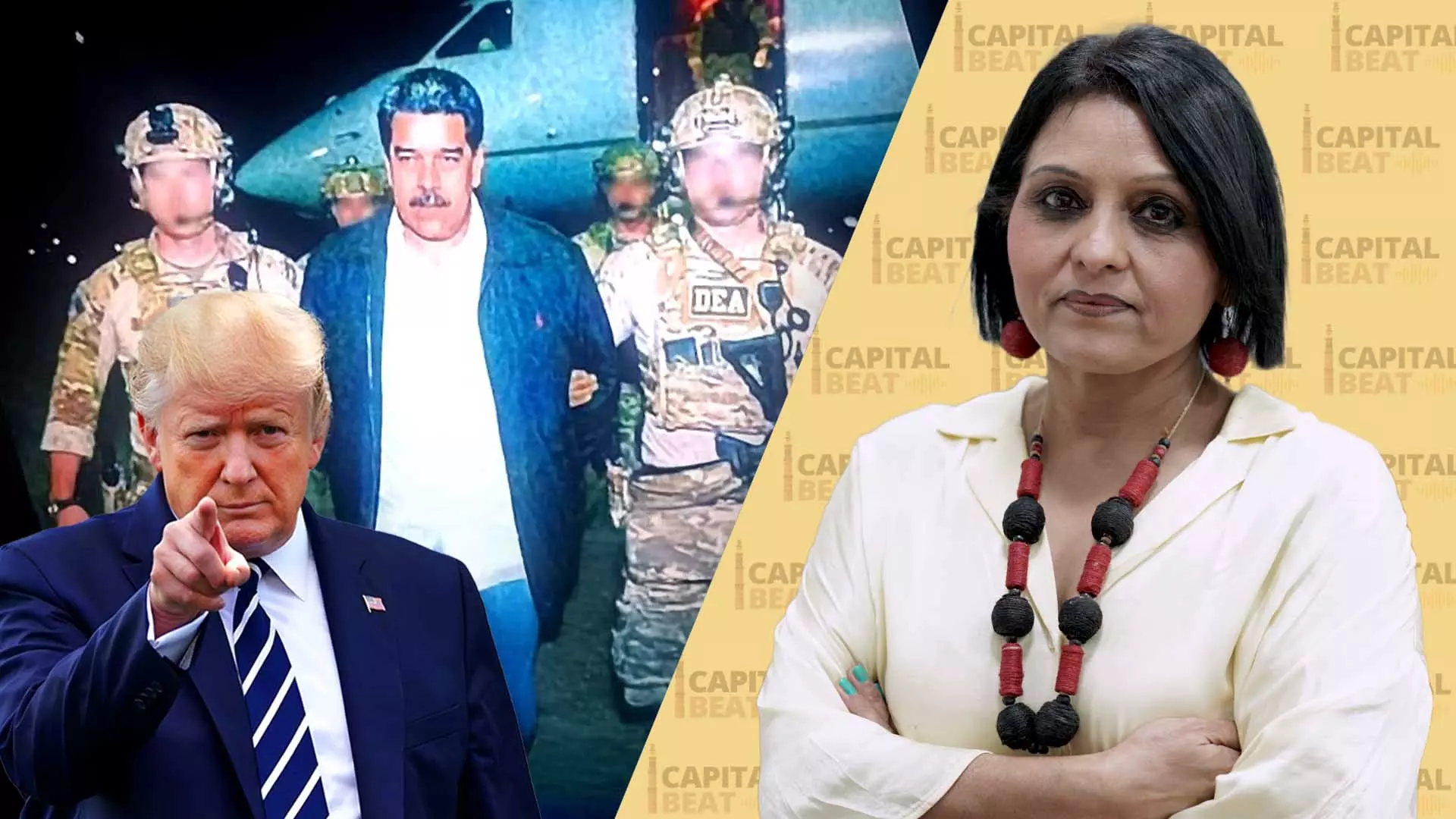
In this episode of Capital Beat, senior journalist Sanjay Kapoor and author and policy expert Pushparaj Deshpande examined India’s response to the United States’ military action in Venezuela, focusing on sovereignty, global power shifts, BRICS, and the implications for India’s foreign policy positioning.
The discussion unfolded against the backdrop of the "capture" of Venezuelan President Nicolás Maduro and the First Lady by US forces, an action that has drawn condemnation from several countries, including BRICS members Russia, China, and Brazil. India, however, issued a measured statement expressing concern and advising its citizens against travel.
The panellists discussed why New Delhi refrained from issuing a stronger condemnation and what the episode reveals about India’s current approach to international crises.
The episode opened with a comparison between India’s historical foreign policy positions and its present stance. Sanjay Kapoor recalled that India has earlier taken clear moral positions on issues such as the Vietnam War and the Suez Crisis, even when it lacked economic or military strength.
Kapoor stated that earlier eras prioritised moral conviction over material power, particularly during the non-aligned movement. He said that this approach eroded over time, with strategic autonomy now often translating into neutrality that avoids taking sides.
Also read: Nobel Prize 'costs' Machado Trump’s backing in post-Maduro Venezuela: Report
“We harp on strategic autonomy, but that really gives you a freedom to support the winners,” Kapoor said, adding that India’s neutrality after the Venezuela action mirrored its silence during the Gaza conflict.
He argued that such positions had become the norm and were driven by the belief that avoiding confrontation would yield diplomatic or economic benefits.
BRICS, neutrality, and global perception
Kapoor highlighted that India’s approach stood in contrast to other BRICS nations. He noted that Russia, China and Brazil openly opposed the US action, while India maintained neutrality despite its participation in the same grouping.
“We are maintaining a certain kind of neutrality,” Kapoor said, adding that this pattern risks undermining India’s credibility within BRICS and globally.
He further warned that continued neutrality in cases involving sovereignty violations could weaken India’s standing when it seeks international support in future crises.
Venezuela, resources, and US strategic objectives
Deshpande addressed speculation that India’s muted response was linked to energy interests or investments. He rejected that explanation, noting that India’s oil imports from Venezuela were negligible and that India did not have significant bilateral trade with the country.
“India’s investments in the ONGC and the oil fields are marginal,” Deshpande said, pointing out that Venezuela’s under-invested refining capacity limited its contribution to global oil production.
Also read: Xi Jinping takes 'bullying' dig at US after capture of Venezuela’s Nicolas Maduro
He argued that the primary reason for India’s restraint lay in its relationship with the United States and President Donald Trump’s broader geopolitical strategy.
Deshpande described the US action as part of a resource-driven strategy, aimed at securing oil, gold, freshwater reserves and critical minerals in Latin America amid growing competition with China.
Trump, tariffs, and pressure on India
The discussion linked the Venezuela episode to US trade and tariff pressures. Deshpande said Trump has repeatedly claimed to have mediated between India and Pakistan, using such assertions to extract trade concessions.
He also addressed claims that US pressure had reduced India’s Russian oil imports, calling them inaccurate and noting that imports from Russia have increased in recent months.
“The reason they haven’t taken a firm stand is because President Trump wants validation,” Deshpande said, adding that India was wary of antagonising Washington amid ongoing trade negotiations.
Spheres of influence and a shifting world order
Deshpande described the Venezuela action as part of an emerging spheres-of-influence doctrine, where major powers assert control through kinetic action. He referenced statements suggesting US interest in Greenland and Canada, linking them to future access to energy resources as climate change alters geography.
Also read: India reacts to US capture of Venezuela's Maduro, calls it 'matter of deep concern'
He warned that such actions could mark the beginning of a Cold War 2, characterised by intense competition for resources and influence.
“When we look back five or six years from now, this will mark the onset of the Second Cold War,” Deshpande said.
Currency, BRICS, and de-dollarisation
The episode also explored the role of currency politics. Deshpande noted that Venezuela had moved towards selling resources in non-dollar currencies, shifted away from the SWIFT system, and expressed interest in joining BRICS.
He argued that these steps threatened dollar dominance and may have contributed to US hostility.
“President Trump has effectively bought a lifeline for the dollar by taking kinetic action against Venezuela,” Deshpande said, adding that such actions could accelerate efforts by other countries to move away from the dollar.
Risks for global stability
Both panellists warned that such interventions could increase global instability. Deshpande said countries might conclude that nuclear capability was the only effective deterrent against external intervention.
Also read: US-Venezuela conflict will cause negligible impact on India trade: GTRI
“A nuclear weapon is the only way to guarantee your national sovereignty,” he said, warning that this logic could make the world more insecure.
Kapoor echoed concerns about unchecked use of military and economic tools, including tariffs, to maintain US dominance.
India’s strategic dilemma
Kapoor argued that India’s reluctance to take principled positions stemmed from a desire to remain on the right side of Washington. He said President Trump’s public praise of Prime Minister Narendra Modi, combined with tariff threats, created pressure on New Delhi to avoid confrontation.
“He continues to call him a good man and then threatens India with tariffs,” Kapoor said, describing this as a deliberate strategy.
He added that India’s reliance on personalised diplomacy and avoidance of moral positions had narrowed its strategic options.
Consequences for India’s global standing
The panellists linked India’s present foreign policy challenges to a loss of moral authority built during the non-aligned era. Deshpande noted that India had earlier stood against apartheid and supported Palestine when many countries did not.
“That moral credibility has completely gone for a toss now,” he said, pointing to repeated abstentions on Palestine-related votes at the United Nations.
Also read: China tells US to release Venezuelan President Maduro, his wife ‘at once’
Kapoor warned that failure to stand on principle could leave India isolated in future crises.
“If you are not willing to stand up for people when they need it, who’s going to stand for you when you are in need?” he asked.
(The content above has been transcribed from video using a fine-tuned AI model. To ensure accuracy, quality, and editorial integrity, we employ a Human-In-The-Loop (HITL) process. While AI assists in creating the initial draft, our experienced editorial team carefully reviews, edits, and refines the content before publication. At The Federal, we combine the efficiency of AI with the expertise of human editors to deliver reliable and insightful journalism.)