



Nehru sought public funds for 'Babri Masjid', Sardar Patel opposed, says Rajnath
Rajnath Singh claims Nehru wanted to fund the 'Babri Masjid' with public money and says Sardar Patel blocked the move; also cites Somnath temple and Patel’s legacy

Defence Minister Rajnath Singh on Tuesday (December 2) alleged that when the first Prime Minister, Jawaharlal Nehru, wanted to build the "Babri masjid" using public funds, Sardar Vallabhbhai Patel blocked the move.
"Pandit Jawaharlal Nehru wanted to build the Babri Masjid (in Ayodhya) using public funds. If anyone opposed this proposal, it was Sardar Vallabhbhai Patel, born to a Gujarati mother. He didn't allow the Babri Masjid to be built using public funds,” said Singh.
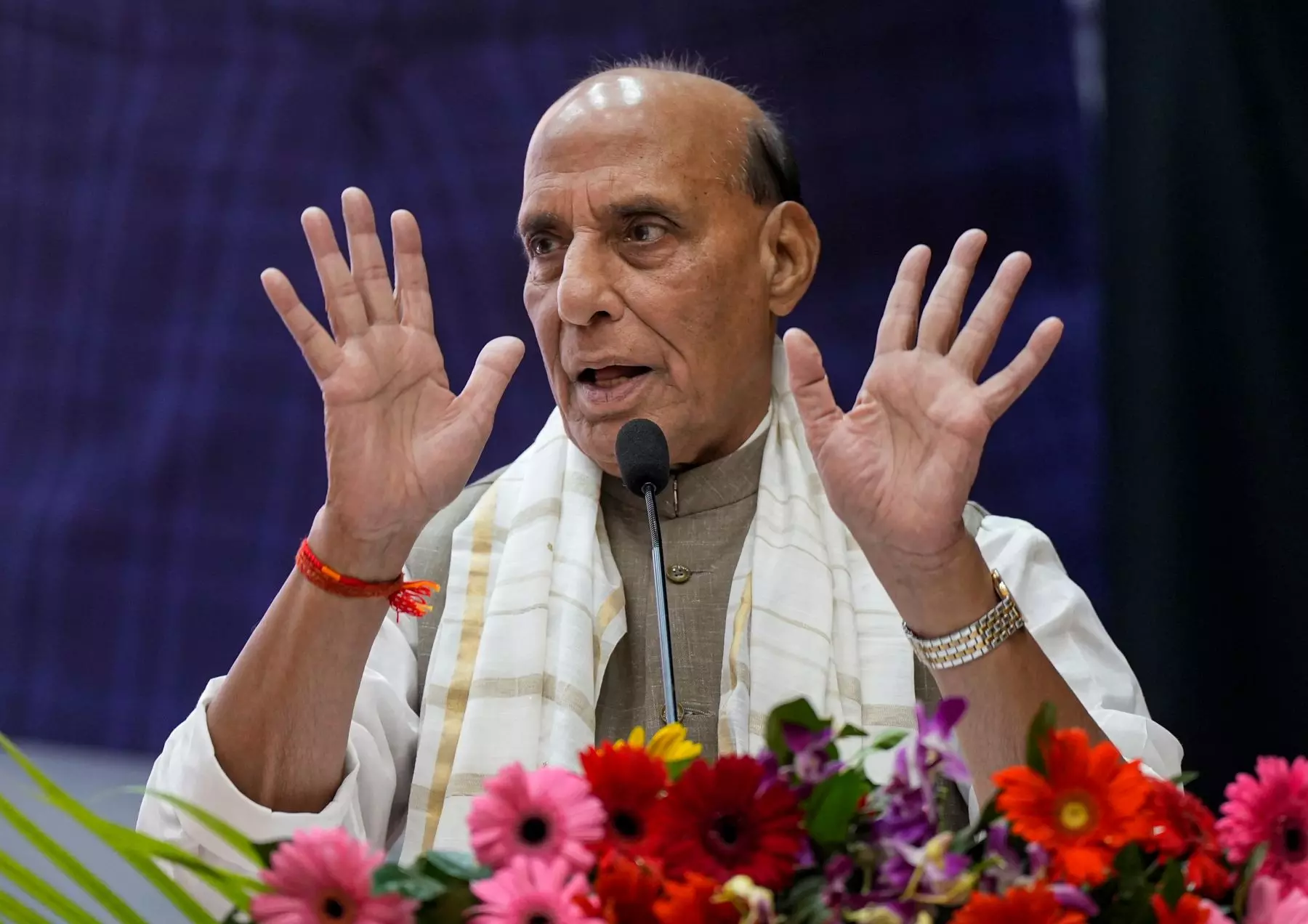
He was addressing a 'Sardar Sabha' at Sadhli village in Gujarat's Vadodara district, organised by Mera Yuva (MY) Bharat under the Ministry of Youth Affairs & Sports to commemorate the 150th birth anniversary of Patel.
Nehru-Patel argument on Somnath temple
Elaborating further, the Defence Minister said that when Nehru brought up the issue of the restoration of the Somnath temple in Gujarat, Patel clarified that the temple was a different matter because Rs 30 lakh required for its facelift had been donated by common people.
Also Read: Rajnath Singh says India’s Indo-Pacific focus not against any nation
"A trust had been established, and not a single penny of the government's money had been spent on this (Somnath temple) work. Similarly, the government didn't give a single rupee to construct the Ram Temple in Ayodhya. The entire cost was borne by the people. This is called real secularism," he added.
‘Patel could have become PM’
Singh claimed that Patel could have become the Prime Minister, but he never hankered for any position. Despite ideological differences with Nehru, he worked with him because he had given a promise to Mahatma Gandhi, the defence minister added.
Also Read: US, India sign 10-year defence framework amid trade tensions
He claimed that Nehru became the president of Congress in 1946 because Patel withdrew his nomination on Gandhi's advice, despite a majority of the Congress committee members proposing his name.
‘PM Modi upheld Patel’s legacy’
Alleging that some political forces wanted to erase Patel's legacy, Singh said that it was Prime Minister Narendra Modi whose crucial role re-established Patel as a shining star in the annals of history.
Also Read: India approves Rs 79,000 crore defence procurement for Army, Navy, IAF
“After Patel died, common people collected funds to build a memorial for him, but when this information reached Nehruji, he said Sardar Patel was a leader of farmers, so this money should be spent on building wells and roads in the village. What a farce! Building wells and roads is the government's responsibility. The suggestion of using memorial funds for that was absurd," said Singh.
Another salvo against Nehru
The Defence Minister further stated that this indicated that the government of that time wanted to hide and suppress Patel's great legacy at all costs.
"Nehruji awarded himself the Bharat Ratna, but why was Sardar Vallabhbhai Patel not honoured with the Bharat Ratna at that time? Modiji decided to honour Sardar Patel appropriately by building the Statue of Unity. This is truly commendable work by our PM," Singh said.
Also Read: Border instability fuels new types of crime, says Rajnath
As for Operation Sindoor, the Defence Minister said that it is proof that India gives a befitting reply to those who do not understand the language of peace and goodwill. He also dismissed arguments that Patel was too old to become the Prime Minister.
"This is completely wrong. Morarji Desai was over 80 years old. If he could become prime minister of India, why couldn't Sardar Patel, who was under 80?" asked Singh.
‘Patel’s values upheld in Operation Sindoor’
Singh said if demands raised by Patel had been heeded at the time of Kashmir's merger, India wouldn't have had to grapple with the Kashmir problem for so long.
Also Read: Op Sindoor just a trailer; every inch of Pakistan within BrahMos range: Rajnath
He said Patel always believed in resolving problems through dialogue. "However, when all avenues were blocked, he didn't hesitate to adopt a tough approach. When the need arose for Hyderabad's merger, Patel took that stance,” said Singh.
"Had he not adopted a tough stance, perhaps Hyderabad would not have been a part of India," said Singh, referring to Patel's tenure as the first home minister of India. He said the Modi government has also upheld this value through Operation Sindoor.
(With agency inputs)