



Opposition seeks clarity on US, EU trade deals, pans govt for ‘opening farm sector’
Opposition parties demand transparency in Parliament, slamming the government for agreeing to open farm sector and cut Russian oil imports to make US trade deal

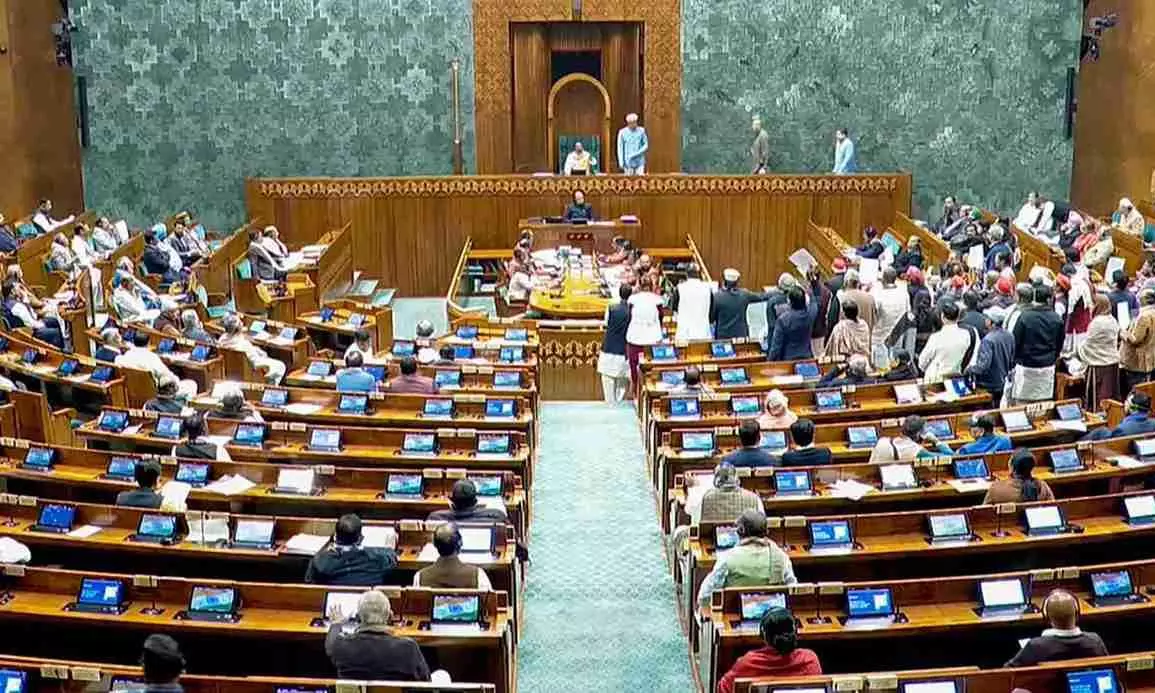
The announcement of 18 per cent tariff on Indian goods by US President Donald Trump coupled with zero per cent reciprocal tariffs on the US and the vagueness surrounding the deal prompted objections and protests from the Opposition on Tuesday (February 3).
Of particular concern are opening the agriculture sector to American farm produce and reducing Russian oil imports to please Trump.
The Congress demanded that the Modi government take Parliament into confidence on the details of the US as well as the European Union (EU) trade deal, while alleging that Prime Minister Narendra Modi has “completely surrendered” to appease Trump at the cost of Indian farmers.
‘Modi has surrendered’
“India stands diminished by this unfortunate sequence of events,” said Congress general secretary in-charge communications, Jairam Ramesh. He added that from the information Trump has provided, it is abundantly clear that Modi has “completely surrendered”.
“From the information President Trump has provided, it is abundantly clear that Prime Minister Modi has — like he did on May 10, 2025 — completely surrendered. He has most definitely appeased President Trump. India stands diminished by this unfortunate sequence of events,” he claimed.
Also read: Who is Sergio Gor, the diplomat said to have clinched US-India trade deal?
Ramesh said the text of both the EU and the US trade deals must be laid on the table of both Houses of Parliament and debated, “especially since the US Secretary of Agriculture Brooke Rollins has issued a statement claiming that India has liberalised agricultural imports from the US”.
India and the EU, on January 27, sealed a landmark free trade agreement to create a market of two billion people.
Need for clarity
Members of several opposition parties staged a walkout from the Rajya Sabha while raising the issue of the Indo-US trade deal and demanding a discussion on it.
Opposition MPs from Rajya Sabha, including Ramesh, Digvijaya Singh, and Randeep Surjewala, AAP’s Sanjay Singh, RJD’s Manoj Jha, among others, protested in Parliament premises and alleged that the interests of farmers in India had been compromised by the government.
Congress’s Lok Sabha MP Shashi Tharoor said, “We very strongly feel there is a need for clarity”, as all there is so far is President Trump’s tweets and press statements, with no details.
Also read: India’s trade deal with the US is not reciprocity, it is submission
“President Trump talks about India purchasing USD 500 billion worth of US goods; our entire import bill is USD 700 billion, how can we spend USD 500 billion on the US? ... He mentions we will purchase American agricultural goods; apparently the American secretary of agriculture is saying that the Indian market will be open to American farmers; we need to understand the terms of all of this because there have very significant political implications for India’s farmers.”
The government must take Parliament into confidence and clearly explain what has been agreed to, he added.
“Obviously, a trade deal is good for India. We need the vast American market…18 per cent is better than 50 per cent; we all know that, but we need to understand all the details before we can celebrate. At the moment, we have a situation where the Congress is asking questions, the BJP is not providing any answers,” Tharoor told reporters.
Sovereignty and safeguards
Senior Congress leader and former Commerce Minister Anand Sharma hoped that the trade deal reached is as sovereign equals and safeguards India’s core interests in the sensitive agriculture, dairy and pharma sectors. “Government must take parliament and nation in confidence,” he said on X.
In a post on X from its official handle, the Congress hit out at the government and said India has the right to know details of the trade deal. “Just like the ceasefire, the announcement of the trade deal was also made by US President Trump. It has been stated that the trade deal is being done ‘on Modi’s request’,” the party said.
Also read: India-US trade deal: Top 10 things we know so far from Modi-Trump statements
There is talk of opening the agriculture sector for America in the statement as well, the Congress said and asked what exactly is the deal. The party further asked how the security and interests of our farmers have been ensured.
It has also been said that the Modi government will not buy oil from Russia, but will buy from America and Venezuela instead, the Congress pointed out and asked whether the Modi government agreed to this condition.
Support for farmers gone?
The CPI(M) politburo also issued a statement rebuking the “euphoria” in the corporate media as being completely misplaced, as the “details of the agreement are not yet available. It is only when the full scope and details of the trade deal are available, one can make a proper assessment”.
“…Indian goods imports will face a (sic) 18 per cent tariff, while India reduces tariffs and non-tariff barriers on US goods to zero. Eliminating tariffs will result in flooding the country with US goods which will adversely impact industries and workers’ livelihoods. Removal of non-tariff barriers would mean eliminating subsidies and other measures which support Indian farmers,” the statement pointed out.
Also read: US-India trade deal | Trump's claim raises doubts over scope and timelines: GTRI
“Trump has claimed that India has agreed to stop buying Russian oil and committed to buy $500 billions (sic) worth of US energy, technology and farm products. This, if true, shows up the highly unequal nature of the trade deal with India in a subordinate position, circumscribing its sovereignty,” it added.
The statement ended with a demand for the government to place the full trade agreement in the Parliament and in the public domain for a thorough discussion.
(With agency inputs)