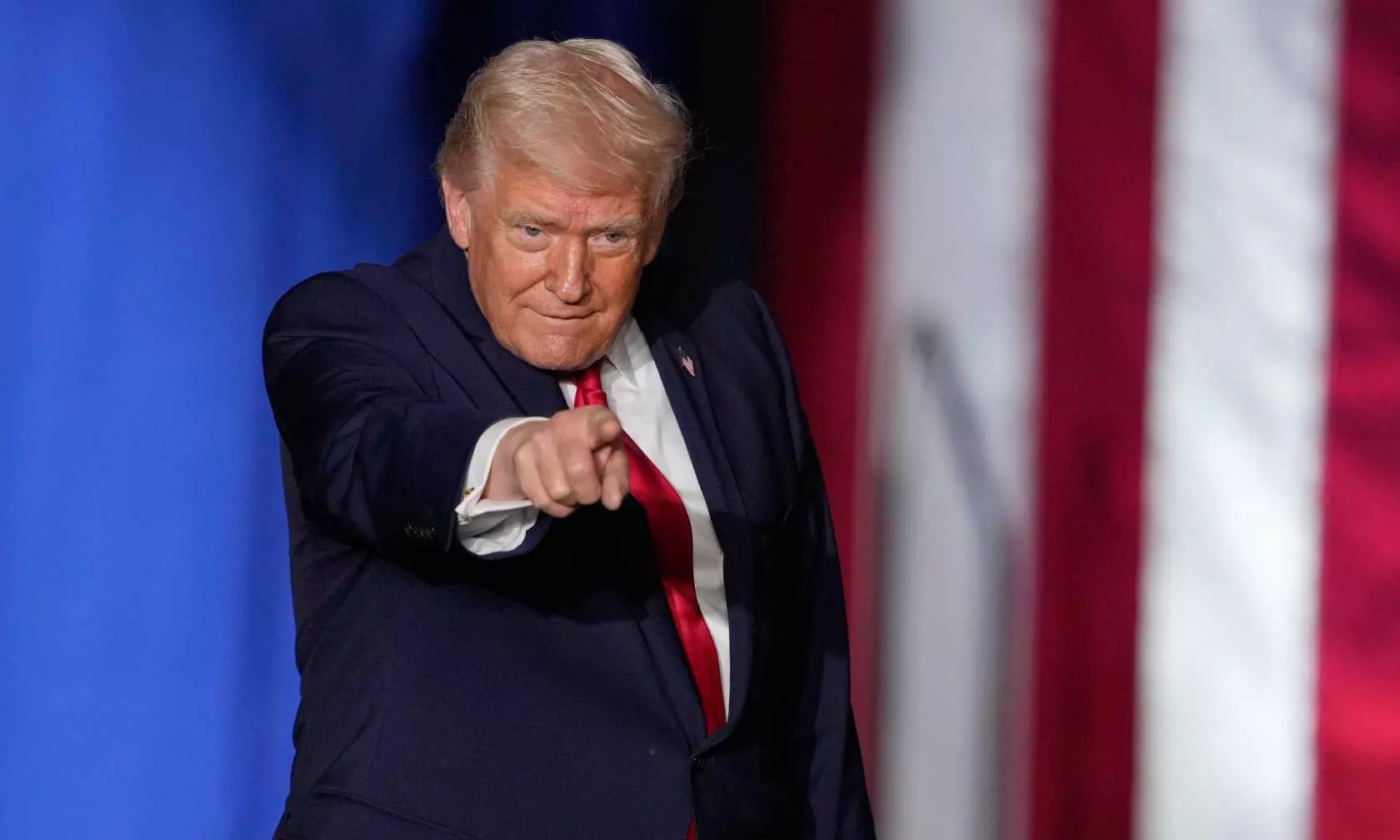
Trade policy must serve the people — not political optics, not fear, and not the applause of a foreign strongman. Photo: PTI
Zero tariffs would grant US agribusiness unprecedented access to India’s rural economy; US corporate interests are embedding themselves deep within India’s financial system; India must not sell its autonomy for the illusion of relief
The Narendra Modi government’s newly-announced trade deal with the United States marks a historic abdication — not merely of tariff sovereignty, but of trade autonomy and national independence itself. For a government that rose to power on the promise of muscular nationalism, the optics are jarring: India celebrating what looks increasingly like a one-sided economic settlement dictated by Washington.
Asymmetry repackaged as generosity
President Donald Trump, announcing the agreement on Monday (February 2), declared that India would slash tariffs and non-tariff barriers on American agricultural and manufactured goods to zero. In return, the United States would lower its so-called “reciprocal tariff” on Indian exports from 25 per cent to 18 per cent. This is not reciprocity. It is asymmetry repackaged as generosity.
Also Read: India-US trade deal: Top 10 things we know so far from Modi-Trump statements
Trump went further in a Truth Social post on February 2, boasting that Prime Minister Narendra Modi had committed India to “BUY AMERICAN” on a vastly expanded scale — pledging over USD 500 billion in purchases of US energy, technology, agricultural products, coal, and other goods. India, in effect, is being repositioned as a guaranteed market for American surplus production at a time of domestic political stress in the US.
Intrusion into India’s foreign and energy policy
More striking still was Trump’s claim that Modi had agreed to halt purchases of Russian oil and redirect imports to the United States and “potentially, Venezuela.” This is an extraordinary intrusion into India’s foreign and energy policy. Trump even suggested this shift would help “END THE WAR in Ukraine,” a claim that says less about geopolitics than about Washington’s expectations of Indian compliance.
Also Read: US-India trade deal | Trump's claim raises doubts over scope and timelines: GTRI
Those expectations were soon confirmed. The new US envoy to New Delhi, Ambassador Sergio Gor, made clear that India’s agreement to stop buying Russian oil was the price for withdrawing a punitive 25 per cent levy — bringing total tariffs down from 50 per cent to 18 per cent. The message was unmistakable: energy policy, trade access, and foreign alignment are now bundled together.
India, long proud of its strategic autonomy, appears willing to discard decades-old partnerships and subordinate its economic future to the preferences of an erratic American administration.
Modi’s gratitude without disclosure
Prime Minister Modi’s response was swift and effusive. Posting on X, he thanked Trump “on behalf of the 1.4 billion people of India” and celebrated the reduced tariff on “Made in India” products.
What he did not say is more revealing than what he did.
Modi made no reference to India’s reported commitment to zero tariffs and the dismantling of non-tariff barriers. He offered no clarity on concessions related to intellectual property rights, services trade, or the contested moratorium on customs duties for electronic transmissions — issues confirmed by officials familiar with the negotiations.
Also Read: Feb 3 News Live: Trump announces US-India trade deal, lowers tariffs to 18 pc
Most notably, he remained silent on zero tariffs for American agricultural imports into an economy where more than 800 million people depend on farming, most on holdings of just a few acres.
The contrast is stark. US agriculture is dominated by roughly 30,000 large, heavily-subsidised producers generating hundreds of billions of dollars annually. Indian agriculture — the country’s largest employer — produces fragile livelihoods, chronic debt, and deep vulnerability to price shocks.
A one-way deal
After seven months of punitive tariffs — 25 per cent imposed on the pretext of a USD 40 billion trade surplus, and another 25 per cent slapped on India for purchasing Russian oil — the revised 18 per cent US tariff is being presented as a concession.
In reality, it is arbitrary and inconsistent. Under Trump’s MAGA calculus, Pakistan faces 19 per cent, Bangladesh 20 per cent, and Indonesia 19 per cent. India’s marginal “reward” bears no relation to the scale of its concessions.
Granting zero tariffs to American farm products — despite a long history of trade disputes over poultry and other goods — is not liberalisation. It is unilateral disarmament.
Also Read: Piyush Goyal on India-US trade deal: ‘No sticky issues, moving towards closure’
A former Indian trade negotiator warned that zero tariffs on US grains, dairy, poultry, goat and sheep products, genetically-modified corn and soya, fruits, and vegetables could devastate rural India. This is not ideological alarmism; it is economic arithmetic.
The first consequences are already visible. New Delhi has abruptly cut cotton import duties from 11 per cent to zero, officially to help textile exporters. The likely result is the crushing of millions of small cotton farmers in Gujarat, Maharashtra, and Telangana — while Indian textiles continue to face a prohibitive 50 per cent US tariff. This is not strategic adjustment; it is capitulation.
The EU rehearsal
The much-publicised India–EU framework agreement, billed as the “mother of all deals,” now looks less like an exception than a rehearsal. Analysts note that concessions offered to Brussels — sweeping market access, acceptance of carbon border taxes, and deforestation penalties — closely resemble what Washington has extracted, and possibly less.
According to a former Indian trade envoy, India may have conceded even more to the United States, particularly in agriculture and services.
Questions also remain over whether India accepted US demands to extend the moratorium on customs duties for electronic transmissions, an issue New Delhi had forcefully opposed at the WTO ministerial meeting in Abu Dhabi in March 2024.
Long-standing red lines — protecting farming, resisting genetically-modified crops, safeguarding food sovereignty — are visibly eroding. Zero tariffs would grant US agribusiness unprecedented access to India’s rural economy.
Services and financial exposure
In services, the pattern repeats. Under the banner of “liberalization”, American corporate interests are embedding themselves deep within India’s financial system.
Amazon’s acquisition of Bengaluru-based fintech Axio, granting it a direct lending licence, is emblematic. In December, reportedly under pressure from US and European insurers, India permitted 100 per cent foreign ownership in insurance — a sector it had fiercely protected even during the negotiations that created the World Trade Organisation.
The official justification — capital inflows, competition, efficiency — is familiar. The reality is strategic exposure. Financial infrastructure is not just another market; it is a pillar of economic sovereignty.
Also Read: Scott Bessent slams EU-India trade deal over Ukraine war 'hypocrisy'
Questions also remain over whether India accepted US demands to extend the moratorium on customs duties for electronic transmissions, an issue New Delhi had forcefully opposed at the WTO ministerial meeting in Abu Dhabi in March 2024.
Meanwhile, Washington continues to impose Section 232 tariffs — 25 per cent on steel, aluminium, vehicles, auto parts, copper, furniture, lumber, and trucks. A WTO panel ruled these measures illegal. The US ignored the ruling.
This asymmetry — binding commitments for India, impunity for America — defines the deal.
The deeper agenda
Indian civil society warned of this moment last year. An open letter by the Forum for Trade Justice — Why India Must Not Give in to US Tariff Blackmail — argued that tariffs are merely leverage for deeper, irreversible demands.
The real danger is not tariffs. It is the quiet, permanent erosion of sovereignty.
These include patent evergreening that would undermine India’s globally-vital generic drug industry; abandonment of digital taxes and data localisation in favour of US tech giants; preferential access for American firms to India’s public procurement market; and pressure to realign foreign policy — cutting oil imports from Russia, Iran, and Venezuela, weakening BRICS, and abandoning local-currency trade initiatives.
This is not trade negotiation. It is strategic coercion.
The real cost
What is at stake is not market access. It is India’s right to decide its own economic and political future.
Any agreement that trades long-term policy autonomy for short-term tariff relief is not a win — it is a loss disguised as diplomacy. In its rush to appease Washington while projecting strength at home, the Modi government risks something far more consequential than an export slowdown: the gradual transfer of decision-making power to a foreign state.
Also Read: Explained: How Europe expects India-EU trade deal to boost its economy
The real danger is not tariffs. It is the quiet, permanent erosion of sovereignty.
India must not sell its autonomy for the illusion of relief. This moment demands transparency, parliamentary scrutiny, and democratic debate. Trade policy must serve the people — not political optics, not fear, and not the applause of a foreign strongman.
(The Federal seeks to present views and opinions from all sides of the spectrum. The information, ideas or opinions in the articles are of the author and do not necessarily reflect the views of The Federal)