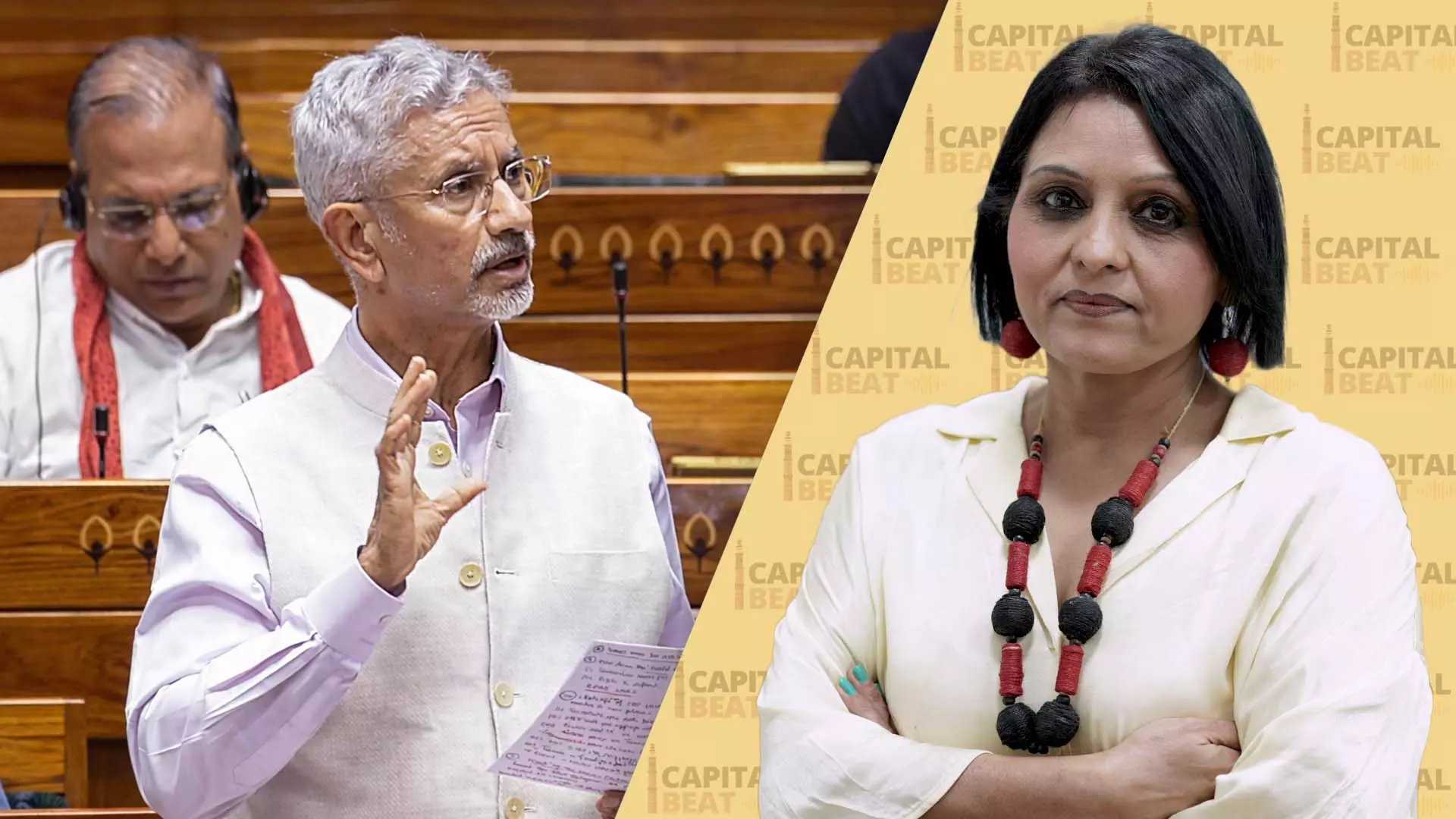
'Jaishankar dodged the hard questions on West Asia'| Capital Beat
Opposition walks out as Jaishankar's West Asia statement draws fire in Parliament

“It was very disappointing… it sounded as if he was speaking under military censorship,” said veteran journalist and international affairs expert Sanjay Kapoor, sharply criticising External Affairs Minister S Jaishankar’s statement on the West Asia conflict in Parliament.
The minister’s remarks triggered a political storm, with opposition MPs walking out and demanding a short-duration discussion on the escalating crisis in West Asia. Critics argued that Jaishankar’s statement was too “generic” and failed to address crucial questions about India’s position, the geopolitical consequences of the conflict, and the safety of Indian citizens in the region.
In this episode of Capital Beat, The Federal spoke to Sanjay Kapoor, international affairs expert and veteran journalist; Sujata Paul, Congress spokesperson; Sarvesh Tripathi, Samajwadi Party spokesperson; and Pushparaj Deshpande, author and policy expert, to understand the implications of Jaishankar's statement and the political battle unfolding in Parliament.
Statement sparks controversy
External Affairs Minister S Jaishankar addressed Parliament on the escalating conflict in West Asia, outlining India’s approach to the crisis. However, the speech immediately drew protests from the opposition, who argued that the issue deserved a full debate rather than a brief statement.
In his remarks, Jaishankar emphasised three guiding principles behind India’s response. First, he said India supports peace and urges all parties to return to dialogue and diplomacy. Second, he stressed that the safety and well-being of the Indian community in the region remain the government’s top priority. Third, he highlighted the importance of safeguarding India’s national interests, including energy security and trade flows.
Also Read: Dubai’s safe-haven status tested as Iran war unsettles Asian investors
He also pointed out that the Gulf region remains a major trading partner for India, accounting for nearly USD 200 billion in trade annually. The minister said the government had issued advisories through Indian embassies, engaged regional leaders diplomatically, and evacuated stranded Indians where necessary.
Yet the statement was met with slogan-shouting in the Lok Sabha and a walkout by opposition members in the Rajya Sabha. Opposition leaders argued that the gravity of the crisis warranted a detailed parliamentary discussion under procedural rules.
'Silence on key issues'
Sanjay Kapoor was particularly critical of what he described as the “silence” in Jaishankar’s statement on key developments.
“I think it was very disappointing. It gives the impression that he was speaking in a place where there was military-level censorship,” Kapoor said.
He pointed out that the minister did not address major developments in the conflict, including the alleged killing of Iran’s Supreme Leader Ayatollah Ali Khamenei or the sinking of the Iranian vessel IRIS Dena near Sri Lanka.
Also Read: Oil prices surge past $114 a barrel as Iran war disrupts Middle East supply routes
“He was silent on the tragedy unfolding in West Asia and also silent on something very painful for India — the sinking of the Iranian ship in waters close to Sri Lanka,” Kapoor said.
He added that Iran’s foreign minister had reportedly stated that the vessel had been present in the region as a “guest of the Government of India", making the incident particularly sensitive for New Delhi.
Kapoor also questioned the timing of Prime Minister Narendra Modi’s visit to Israel shortly before the escalation began.
“The prime minister visited Israel just two or three days before the bombing started, and there was no explanation for that,” he said.
Economic fallout for India
Another major concern raised during the discussion was the potential economic fallout for India.
Kapoor warned that rising oil prices could soon hit Indian consumers.
“Oil prices are already around USD 117 per barrel, which is extremely high,” he said. “In the coming days, we could see significant economic pressure.”
Jaishankar had addressed this issue during his speech, stating that the government remained committed to protecting Indian consumers and ensuring energy security despite the volatile global situation.
However, Kapoor argued that such assurances were insufficient given the scale of the crisis.
“Talking about the Indian consumer is fine, but you also have to recognise the international environment,” he said. “You are not a major player in this conflict, so your influence is limited.”
Geopolitical stakes
Policy expert Pushparaj Deshpande argued that the minister’s statement failed to present a clear strategy for navigating the geopolitical fallout of the conflict.
“Jaishankar’s statement is not different from previous statements by the Ministry of External Affairs,” Deshpande said. “He simply put them together and read them out as a parliamentary statement.”
He said the conflict must be viewed in the context of broader geopolitical shifts.
Also Read: India favours peace, return to dialogue and diplomacy: Jaishankar on West Asia war
According to Deshpande, the actions of the United States and Israel form part of a larger effort to reshape power balances in West Asia and shift strategic focus towards the Indo-Pacific region amid growing competition with China.
“This is a calculated bid to redraw power equations in West Asia and free up strategic bandwidth for the Indo-Pacific,” he said.
He also argued that the developments could disrupt oil supply lines from Venezuela and Iran, which are critical for countries like India and China.
“This is also about reasserting the hegemony of the petrodollar,” Deshpande said.
Opposition attack
Opposition leaders were equally critical of the government’s handling of the crisis.
Congress spokesperson Sujata Paul said Parliament should have been allowed to debate the issue openly.
“When the opposition raises concerns in Parliament, it is giving voice to the people of this country,” Paul said.
Also Read: How Asian economies are coping with energy crisis amid Iran war
She accused the government of avoiding accountability and failing to explain the prime minister’s recent diplomatic engagements.
“The prime minister must explain why he visited Israel and what discussions took place there,” she said.
Paul also warned that the crisis could endanger millions of Indians living in West Asia.
“Nearly nine million Indians live in the region and send back billions in remittances,” she said. “The government must clarify how it plans to ensure their safety.”
'Undermining India's sovereignty'
Samajwadi Party spokesperson Sarvesh Tripathi echoed similar concerns, accusing the government of undermining India’s sovereignty.
He criticised Jaishankar’s approach, arguing that the minister still behaves like a bureaucrat rather than a political leader.
“He is acting like a bureaucrat who simply reads out statements,” Tripathi said.
Tripathi also argued that India’s diplomatic posture had become overly aligned with the United States and Israel.
“India has been pushed into the US-Israel camp,” he said. “This government has compromised India’s independent foreign policy.”
He also questioned India’s response to the reported attack on the Iranian vessel near Sri Lanka.
“If something like this had happened near Chinese waters, would the US have dared to do it?” he asked.
Demand for Parliamentary debate
Despite the political sparring, one issue united several panellists: the need for a full parliamentary discussion.
Kapoor noted that foreign policy debates in India traditionally enjoyed bipartisan consensus.
“In the past, there used to be unanimity on foreign policy matters,” he said. “But that consensus appears to have broken down.”
Also Read: Former foreign secretary Nirupama Rao on Iran war, diplomacy, fighting patriarchy
He argued that the government should take the opposition into confidence during such crises.
“It is important for the government of the day to consult the opposition and move forward collectively,” Kapoor said.
Tripathi also emphasised the importance of parliamentary debate.
“Parliament is the best platform for discussing such serious national issues,” he said. “We are asking for a constructive discussion, not confrontation.”
Concerns about India's diplomatic direction
As tensions escalate in West Asia, the issue is likely to dominate the remainder of Parliament’s budget session.
Opposition leaders have warned that they will continue protesting if the government refuses to allow a structured debate.
The government, however, appears firm in its position that Jaishankar’s statement adequately outlines India’s policy.
With geopolitical tensions rising and economic risks looming, the dispute in Parliament reflects deeper concerns about India’s diplomatic direction and its ability to navigate an increasingly-volatile global order.
(The content above has been transcribed from video using a fine-tuned AI model. To ensure accuracy, quality, and editorial integrity, we employ a Human-In-The-Loop (HITL) process. While AI assists in creating the initial draft, our experienced editorial team carefully reviews, edits, and refines the content before publication. At The Federal, we combine the efficiency of AI with the expertise of human editors to deliver reliable and insightful journalism.)