



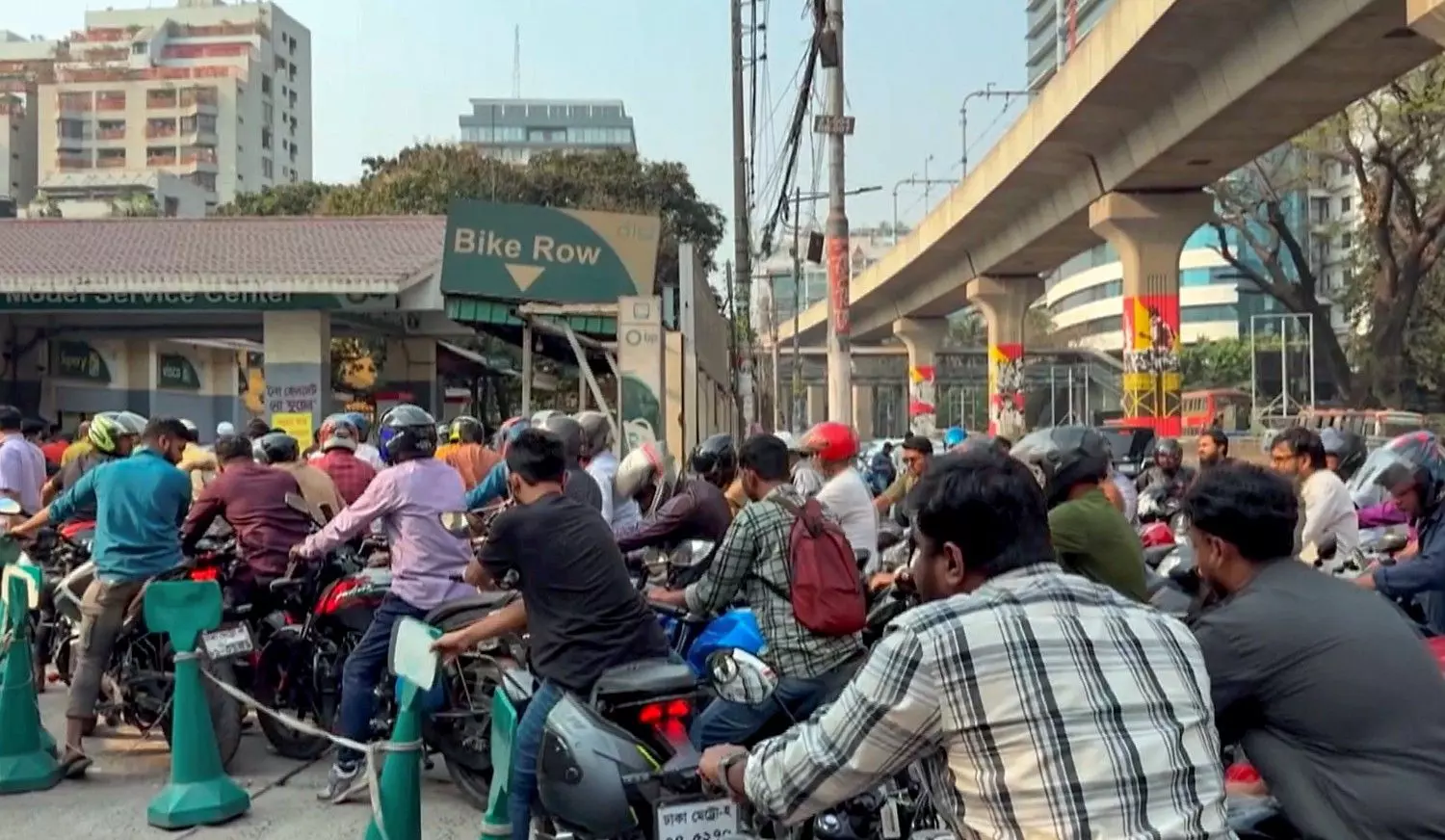
People wait in a long queue at a petrol pump in Dhaka, Bangladesh, on March 6, 2026, amid concerns over fuel supply shortage due to the ongoing war in West Asia. Photo: PTI
How Asian economies are coping with energy crisis amid Iran war
With 20pc of the world's energy passing through a single chokepoint, nations from India to Japan face a grim reality of skyrocketing prices, panic-buying, and the threat of a global war

While the joint war being waged by Israel and the US against Iran has raised serious questions over the vulnerability of world peace and whether the globe is already witnessing the much-dreaded Third Great War, a far more sinister threat is emerging in terms of the economy.
Follow Live updates on Iran war here
The reason: Iran’s decision to close down the narrow but immensely significant Strait of Hormuz, through which passes around 20 per cent of the world’s oil and liquefied natural gas (LNG). A large share of the liquefied petroleum gas (LPG) also goes through the waterway.
Since Asia is home to several major economies of the world and most or all of them are heavily dependent on the supply of energy from West Asia, shutting down the shipping route could spell disaster in no time.
Here we take a look at how various Asian states are coping with the crisis, particularly that related to oil:
India
While India is yet to see the worst of days, the ongoing war exposes the significance of the narrow stretch for its energy security. India imports 90 per cent of its oil, and nearly half of its crude oil imports or about 2.5 to 2.7 million barrels daily, pass through the strait, mostly from nations such as Iraq, Saudi Arabia, the United Arab Emirates and Kuwait. If the crisis snowballs, India has the option to fall back on Russian crude, for which the US also ‘authorised’ it till April 4.
Also read: This is the real Gulf War, and the world is paying the price
But while India still has a cushion when it comes to oil, by holding roughly 100 million barrels in refinery and commercial inventories (people were not convinced much, as large queues were seen outside petrol stations across the country out of fear for a price hike), the bigger worry is in LPG and LNG. India today is the second-largest LPG importer, and all of it comes from the Gulf producers, via Hormuz. In LNG, too, India is heavily dependent on imports and that also through Hormuz.
Iran war effect on Asian economies
♦ India has around 100 million barrels in reserves and may rely on Russian crude temporarily, the bigger concern is LPG and LNG supplies.
♦ Pakistan sharply increased fuel prices and is considering work-from-home policies and online classes to conserve fuel.
♦ Bangladesh imposed daily fuel sales restrictions and is struggling with rising LNG import costs after Qatar halted deliveries.
♦ In Sri Lanka, memories of the recent economic crisis triggered panic buying, although authorities say fuel stocks can last over a month.
♦ Nepal, which relies on fuel imports via India, faces rising production costs and inflation as global oil prices surge.
♦ China halted fuel exports to secure domestic supply and may depend on Russian oil if the crisis persists.
♦ Japan and South Korea hold large strategic reserves (over 200 days), but prolonged disruption could raise energy prices
Prices for both LPG (between Rs 60 and Rs 115) and LNG (almost by Rs 80) have already been increased (for domestic, commercial and industrial use). The government also invoked the Essential Services Maintenance Act (ESMA), asking the oil refineries to maximise domestic LPG production and prioritise supply for domestic cooking gas.
Pakistan
Pakistan, which has a perennial energy problem, decided to increase the price of fuel steeply, putting the common man under a lot of pressure. Prime Minister Shehbaz Sharif asked the provinces to penalise those hoarding petroleum products amid the crisis. His government was also considering implementing mandatory work-from-home policies and online classes in order to preserve fuel.
Pakistani Finance Minister Muhammad Aurangzeb said there was no fuel shortage, but things could worsen if the war dragged on, said Pakistan’s Dawn news website. Islamabad has also sent a formal request to its West Asian ally Saudi Arabia to provide an alternative route for oil supply through the Red Sea region.
Also read: US warning on India trade and Russian oil imports sparks debate | AI With Sanket
From Sunday (March 8), Pakistan was set to launch a weekly petroleum pricing mechanism to burden the consumer with extra costs and revive COVID-19-time measures barring the health-related prohibitions.
Bangladesh
Bangladesh, which recently saw a new government taking charge, imposed daily restrictions on sales of fuel after panic buying and stockpiling heightened concerns about supply.
According to a Reuters report, Bangladesh Petroleum Corporation, the country’s government-run importer and distributor, said the restrictions were aimed at reining in excessive demand, stabilising nationwide availability of stocks and assuring the public that there was no reason to worry.
Rumours about shortages have seen people and dealers hoarding fuel, it said, according to the report. Bangladesh imports 95 per cent of its fuel oil. It is also facing a high LNG import bill after Qatar decided to halt deliveries amid the crisis. The government also urged the citizens to minimise "unnecessary travels", news agency PTI reported.
Sri Lanka
Sri Lanka is not new to an economic crisis. The island-nation saw one of its worst times a few years ago when its political guard underwent a change. As the current war unfolded in West Asia, common Sri Lankans were seen rushing to fuel stations across the country, apprehending another terrible spell of energy shortage.
Panic-buying continued even as the authorities assured the public that Sri Lanka had adequate stocks of diesel and petrol to last more than a month, which is the general practice in the country, which doesn’t have enough storage facilities.
Also read: Did India provide intelligence inputs on Iranian warship to US?
The state-run Ceylon Petroleum Corporation stepped up distribution, releasing more than five million litres of fuel on March 2, which was a public holiday. The government has also warned hoarders of legal action. Meanwhile, President Anura Kumara Dissanayake assured that the Sri Lankan economy has the resilience to withstand the potential repercussions of the crisis, said news reports from the island-nation.
Nepal
For Nepal, which is also highly dependent on oil, a rise in fuel prices directly hit production costs, ultimately affecting the consumers. Rising inflation and slower economic growth are the last things the landlocked country, which just had an election, would want.
While Nepal’s immediate fuel supply is secure with the Nepal Oil Corporation, which imports fuel from its southern neighbour India, expressing hope that the supply will not be disrupted immediately, but panic-buying was rampant at several fuel stations. Supply of cooking gas, which has already been under pressure for the past month, has yet to return to normalcy, said a local report.
China
The challenges are a bit different for China. Beijing ordered its largest oil refineries to stop exporting diesel and petrol as the crisis snowballed. While it has supplies for several months (that would delay a straightaway rise in costs for transport, industry and households), after which it could take the help of Russia, the West Asian crisis could hurt it in other ways — its investments in the region and its ambitions.
Also read: US faces mounting discontent from Gulf allies on lack of warning about Iran strikes
China recently reduced its annual economic growth target to the lowest since the early 1990s and while it hoped to chart out a way out of the economic trouble at home, an intense trade war with the US and now the flare-up in West Asia, which would affect its energy supplies, might disrupt its plans.
“A prolonged period of turmoil and insecurity in the Middle East will disrupt other regions of importance for China,” Philip Shetler-Jones from the Royal United Services Institute was quoted as saying by the BBC.
Japan and South Korea
Other major Asian economies such as Japan and South Korea have considerable oil stockpiles that can serve them for more than 200 days, Sung Jinseok, a researcher at Energy Studies Institute, the National University of Singapore, told Fortune. A prolonged closure of Hormuz could lead to adverse impacts, such rise in prices in countries across Asia that import energy.
Japan imported over 2.3 million barrels of crude oil per day in January — nearly 95 per cent of its total imports that month, according to the country’s economy, trade and industry ministry. It is also one of the world’s largest importers of LNG.
Also read: Between fear and hope: Living through the Gulf crisis as tensions reshape daily life
The Japanese government is mulling partial use of its national oil reserves as the West Asian war continues, Kyodo News reported on Friday citing sources. It may do so either on its own or in coordination with other nations.
The Asian nation’s oil refiners have asked the government to release crude from its strategic petroleum reserves, a Bloomberg report added. However, as a diverse economy, Japan’s stock market faces a bigger threat if the war drags on, said one expert.
For Korea, a major hub in the global chip-making industry, disruption in oil import from West Asia could lead to inflation, which in turn affects electric costs at home, which again, could adversely impact the price competitiveness of semiconductors, a top politician from the country’s ruling Democratic Party told The Wall Street Journal recently.
On March 3, the Korean government said it would seek to secure oil supplies from regions other than West Asia, while assuring that the country had sufficient oil reserves, The Korea Times reported.
However, the nation’s KOPSI index saw a major crash this week as the oil prices surged, erasing more than $500 billion worth of market value, as a result of the war in the region from where Seoul sources 70 per cent of its crude.