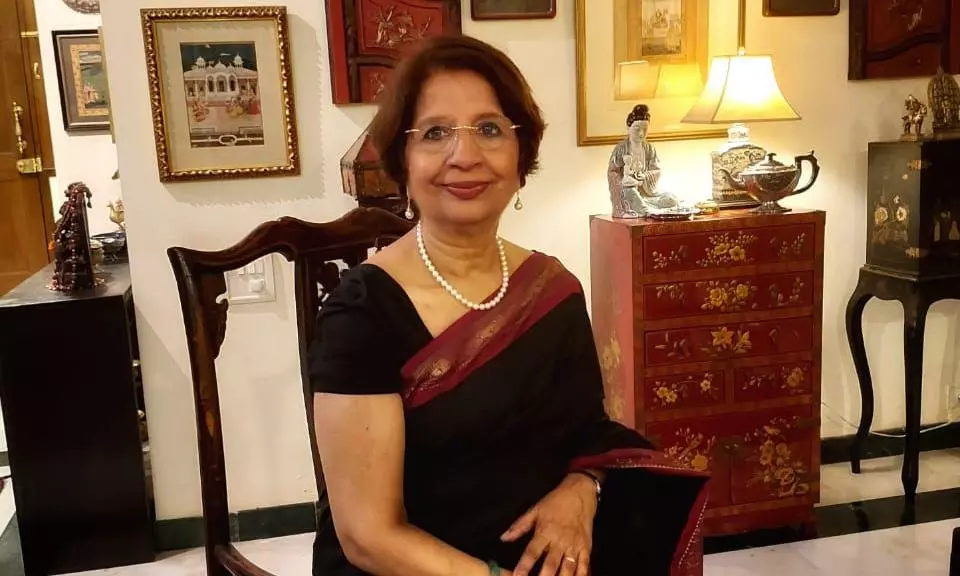
India's former foreign secretary Nirupama Rao: In her four-decade diplomacy career, what remains with her even today, she says, is the “sense of representing India’s voice in complex moments of history”
Former foreign secretary Nirupama Rao on Iran war, diplomacy, fighting patriarchy
In an interview with The Federal, the former foreign secretary warns the US-Israel-Iran conflict could incinerate lives and civilisational heritage, urging India to maintain strategic autonomy

When Iranian soldiers aboard a ship on the Indian Ocean met a sombre watery grave, far from the shores of their home, ex-Indian diplomat Nirupama Menon Rao, wrote a poignant note on social media. Expressing her grief over how sailors were suddenly consigned to the “deep, dark silence of the sea”, she described how the Indian Ocean, known for “trade, music and human exchange”, had turned into a “graveyard of sailors”.
Active on social media, which this career diplomat considers an effective “advocacy platform for policy”, ambassador Rao has been bringing out the sheer futility of war in her recent posts, after Israel-US began pounding the ancient cities of Iran. In a recent post, she quoted an old Persian proverb that warned: “When the fire spreads, the dry wood and the green wood burn together”.
Bats for dialogue
Reflecting on the West Asia conflict and her long journey as a diplomat while speaking to The Federal on International Women’s Day, ambassador Rao explained the meaning behind the quote: “What it means is that war does not distinguish between the guilty and the innocent, and that old Persian proverb captures the tragedy with painful clarity. Flames do not distinguish between soldiers and children…when the fire spreads, the dry and the wet burn together.”
The Bengaluru-based diplomat, who is deeply involved in literature and western classical music, finds the bombing historic cities in Iran (such as Shiraz where Tagore lingered and wrote, she writes) particularly distressing. These places carry the cultural memory of an entire civilization, she stresses, adding on a sad note that when ancient cities burn, we are reminded that "war destroys not only lives but also the archives of human history".
It’s not surprising that the 75-year-old ambassador Rao, (as she prefers to be called since she has fought hard to earn that title, she shares), who was India’s second woman foreign secretary from 2009 to 2011, is so passionately eloquent about the turbulence unfolding on the global stage. After all, as she says in her four-decade diplomacy career, what stays with her even today, is the “sense of representing India’s voice in complex moments of history”.
Also read: Iranian warships in Indian Ocean: How India responded as US-Iran conflict escalated
So, she airs her views on what India should have said, for example, after the sinking of the Iranian ship in its backyard. How India should have called out this action as a “matter of concern”, and urged all parties not to expand the “theatre of conflict and risk the stability of vital sea lanes.” She does not mince her words when she writes that "nations cannot bomb their way to peace" and pushes for "renewed dialogue” and “descalation” in the ongoing Israel-US vs Iran war.
Strategic autonomy
In her view, this conflict has shaken an already fragile international order. "The scale of military escalation between the United States, Israel, and Iran has injected enormous uncertainty into global politics and energy markets. The most worrying aspect is how quickly regional tensions can spiral into a wider confrontation involving multiple actors," she emphasises, adding that solution lies in diplomacy taking centrestage.
Wars of this scale rarely produce stable outcomes, she stresses. On how India should act in this volatile landscape balancing its strategic interests between Iran and its Western partners, she suggests, “India should maintain open diplomatic channels with all sides while avoiding alignment with any military bloc in this conflict. Our interests with Iran are rooted in connectivity, energy security, and regional access, especially through projects like Chabahar. At the same time, India’s strategic partnerships with the United States and other Western countries are central to its technological and economic growth,” she stresses, advising India to adopt the path of “strategic autonomy”.
“Engage all partners pragmatically while resisting pressure to choose sides in conflicts that do not serve our national interest,” she adds.
The America of her youth
As India’s foreign secretary, ambassador Rao, who entered the foreign service in the 1970s, has experienced enough turbulent periods on the global stage. She navigated the diplomatic fallout from the horrific 26/11 Mumbai attacks, where she pushed for action against perpetrators in Pakistan; managed security challenges in Afghanistan (where she identified the resurgence of the Taliban and Al-Qaeda amid terrorist suicide attacks on the Indian embassy in Kabul in 2008-9), and worked hard to strengthen the US-India strategic partnership, which she then emphasised as a “natural alliance”.
In fact, ambassador Rao has played a key role in deepening ties across defence, security, and trade with the United States, specifically managing the relationship between the two countries, during President Obama’s 2010 visit to India. Later, due to her skillful handling of the US-India relations, she was sent to the US as ambassador from 2011 to 2013.
Also read: When your 'best friends' start a war, silence is not diplomacy
In a recent social media post, however, this literature student laments where that the America of her youth has disappeared. It was a country that had captured her imagination as it gave the world “Huck Finn’s river”, the tragic vulnerability of Tennessee Williams’ Blanche DuBois (The Streetcar named Desire), and Holden Caulfield’s aching search for truth (in the remarkable Catcher in the Rye)." She hopes that a large country like America questions itself and the America she knows from her youth "lives beneath the noise of this moment".
Urges diplomacy to ease tensions
Hence, ambassador Rao makes a passionate plea for a renewed international effort to restore dialogue and de-escalation. Diplomacy and deterrence have weakened, she insists and drives home the fact that “military action may produce tactical victories, but it rarely resolves the political disputes that lie beneath them”.
“Without sustained diplomatic engagement, the region risks entering a prolonged cycle of retaliation,” she warns.
She continues, “During the Cold War, India operated within a relatively rigid global structure dominated by two superpowers. Today’s world is far more fluid and multipolar, offering both opportunities and risks.” In this scenario, ambassador Rao admits Indian diplomacy has adapted by building diverse partnerships across regions and sectors.
"Maintaining stable relations with neighbours, however, remains essential for India because regional peace is the foundation of India’s broader global ambitions," she points out.
On how long this West Asia war will continue, she says, it is difficult to predict the duration of this war because escalation and retaliation are now driving the conflict.
“If neither side finds an exit ramp, the fighting could continue for months with intermittent surges of violence. And that is troubling since the wider West Asian region is extremely vulnerable because many countries are tied into the conflict through alliances, geography, or energy infrastructure. Prolonged instability would disrupt trade routes, energy supplies, and political balances across the region,” she warns.
Defining moments
Serving as India’s Ambassador to China and the United States were “defining experiences” in her diplomatic career, shares ambassador Rao.
"It placed her at the centre of two of India’s most consequential relationships. Becoming India’s Foreign Secretary was another deeply meaningful responsibility. These roles demanded both strategic judgment and a deep understanding of India’s evolving global role,” she admits.
Former foreign secretary Nirupama Rao has played a key role in deepening ties with the United States across defense, security, and trade, specifically managing the relationship between the two countries, during President Obama’s 2010 visit to India. She became the ambassador to the USA subsequently
It offered her a rare vantage point on how major powers think and operate. "The two capitals differ greatly in political culture, yet both demonstrate the complexity of managing global influence," she says. However, it was the experiences in these two powerful nations that reinforced her belief that “diplomacy requires constant engagement and careful calibration”.
She recognised even back then that great-power relations are rarely static and demand both realism as patience.
Also read: By striking Iran, Trump and Netanyahu make a mockery of global order
This expert on India-China relations, went on to write a book, The Fractured Himalaya: India Tibet China 1949-62, focused on the complex saga of the early years of the India-China relationship. As a diplomat-practitioner, Rao's telling is based not only on archival material from India, China, Britain and the United States, but also on a deep personal knowledge of China, when she served as India's Ambassador.
Battling patriarchy
The Kerala-born ambassador Rao joined the Indian Foreign Service at the age of 22 in 1973. At that time, the profession was overwhelmingly male, and women had to constantly prove their competence, she recalls.
“The battles were often subtle rather than dramatic, involving the need to earn credibility in rooms where women were rarely present,” she says in the interview. On her website, she writes how she would define her life as a struggle to build an identity for herself as an independent, professional woman who wanted to break free of the stereotypes that define feminine lives, especially in societies like ours. "The very thought that statecraft, the conduct of relations between sovereign countries, could involve women was anathema, even up to a few decades ago," she had written.
The question posed back then was: how can women deal with drunken sailors seeking consular assistance? Ambassador Rao tells The Federal, “It was assumed that women might not be suited for dynamic diplomatic assignments. Those perceptions could be discouraging, but they also strengthened my determination to succeed. I learned to rely on professional excellence and disciplined work rather than confrontation. Over time, competence and consistency speak louder than stereotypes.”
She was persistent, and preparation was key. These qualities helped her to navigate this challenging environment.
It was Jawarharlal Nehru who played a role in paving the way for women to make a mark in diplomacy, she says, adding that he believed strongly that independent India must reflect the principle of equality between men and women. “Under his leadership, women were encouraged to enter the civil services and represent India abroad. Figures such as Vijayalakshmi Pandit demonstrated that women could excel in diplomacy at the highest levels,” she says. It was this early encouragement that helped open doors for later generations of women diplomats.
It was a "deeply encouraging sight" to see women from the armed forces take visible leadership roles in national security presentations during Operation Sindoor, she says. “It reflects how India is gradually expanding opportunities for women in fields once closed to them,” she says.
Inspirational world leaders included Nelson Mandela, who stood out for her because of his extraordinary capacity for reconciliation after immense personal suffering. Among women leaders, she admired figures like Indira Gandhi and Angela Merkel who demonstrated that women could exercise authority in global politics with intelligence and resilience. “Their leadership showed that strength and empathy are not contradictory qualities,” she says.
On a basic philosophy in life that helped her serve well in diplomacy, she replies that diplomacy requires patience, humility, and the ability to listen carefully before speaking. “I have always believed that understanding another country’s perspective is the starting point of any meaningful negotiation. At the same time, one must remain firmly anchored in one’s national interest. Balance between empathy and conviction is the essence of good diplomacy," she shares.
Also read: Future will be much more multipolar, says Jaishankar
“Future diplomats will need intellectual curiosity, cultural sensitivity, and the ability to navigate rapidly changing global technologies and ideas. Strategic thinking must be combined with emotional intelligence and ethical judgment. Diplomacy taught me that patience and perseverance often achieve more than dramatic gestures. It also reminded me that the world is interconnected and that wise leadership seeks cooperation rather than confrontation,” says ambassador Rao.
Social media for policy
A staunch believer in the power of social media as an advocacy platform for policy, she says, "Social media has transformed how ideas circulate in public life. It allows policymakers, scholars, and citizens to engage directly with global debates in real time. If it is used responsibly, it can amplify thoughtful analysis and encourage dialogue across borders. At the same time, it must be approached with care because speed and emotion can sometimes overwhelm nuance."
After her retirement, ambassador Rao has actively pursued her diverse interests, publishing a book of poems and her love for music. A western classical singer, her 2017 debut album, Peace is my dream, features 14 tracks, including the stirring Vaishnava Janato. This former envoy has created the South Asian Symphony Orchestra, which she explains, seeks to "build bridges across countries through the universal language of music".
While diplomacy deals with power and politics, human life, to her is so much richer. “Poetry, music, and cultural projects allow us to explore the emotional and civilisational layers of our shared humanity,” she says, stressing that these pursuits actually complement diplomacy, reminding us that culture often succeeds where politics struggles.