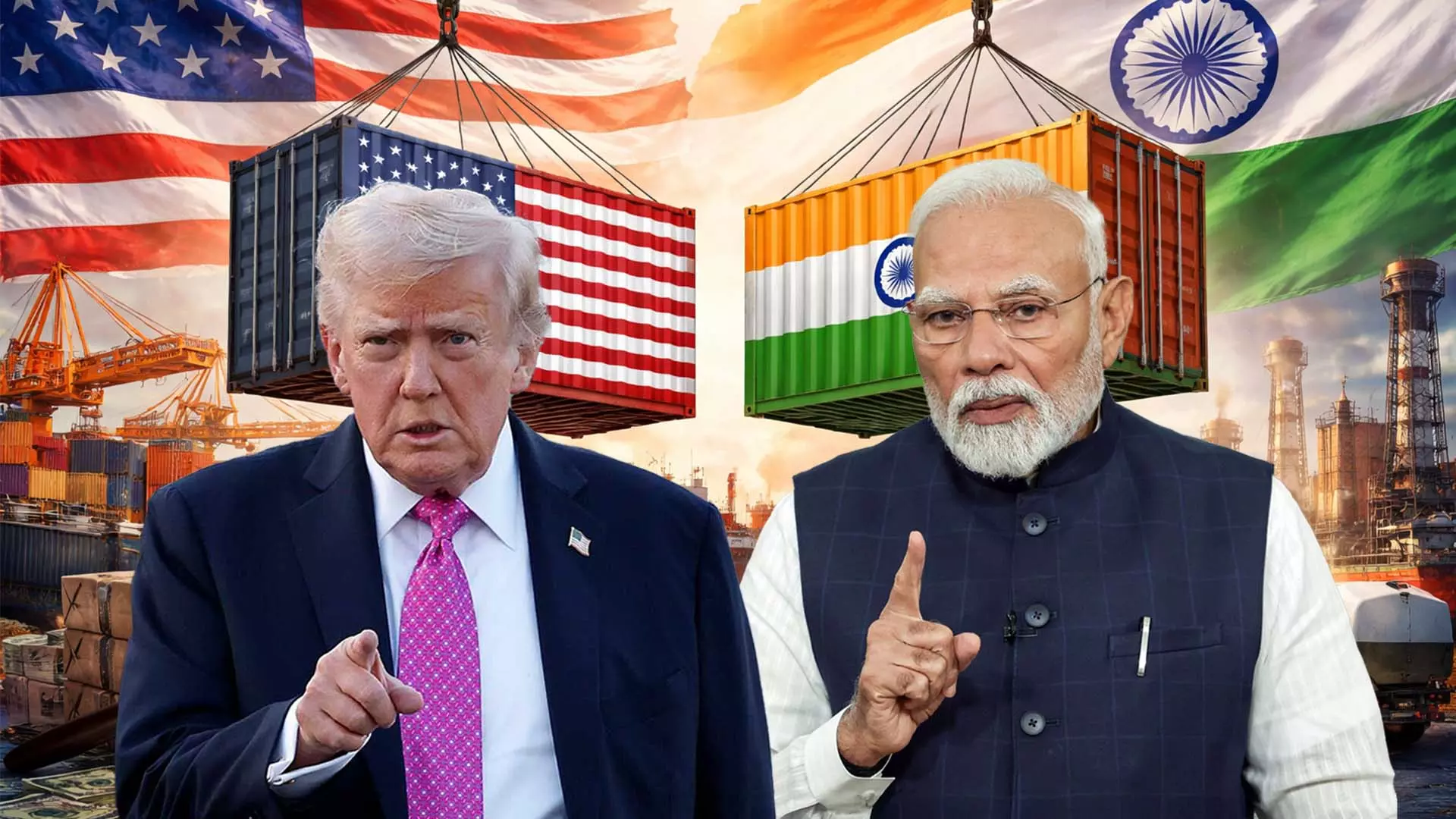
Is India moving to US bloc? New Delhi's strategic autonomy comes under scrutiny
Tariffs, oil imports, and trade deals signal a deep policy shift for the Indian foreign policy establishment

India’s long-claimed policy of non-alignment is facing renewed scrutiny as recent developments point to a clear tilt towards the United States. From trade concessions to oil imports, New Delhi’s moves suggest a recalibration that could redefine its foreign policy trajectory.
For decades, India stressed non-alignment. During the Cold War, New Delhi was officially non-aligned, though widely viewed as closer to the erstwhile Soviet Union. After its disintegration in the early 1990s, India had an opportunity to truly chart an independent path.
Also read: Iran slams 'selective' action amid Geneva talks breakthrough with US
On paper, India continues to describe its policy as “strategic autonomy” — the modern buzzword for non-alignment. But in practice, its foreign policy axis appears to have shifted steadily in favour of Washington.
Economic vulnerability
India’s economic structure plays a central role in this shift. As a developing economy, India’s capacity to resist external pressure remains constrained.
The US is India’s largest export market, accounting for around 17 per cent of its exports. This dependence makes New Delhi vulnerable to American policy decisions.
When US President Donald Trump imposed reciprocal and punitive tariffs of up to 50 per cent last August, it sent shockwaves through India’s export sector. The move underlined how exposed India is to America's economic leverage.
Trade deal terms
Despite domestic criticism, the Narendra Modi government has moved towards a reconstituted trade deal with the US. The agreement is scheduled to be signed in March.
The framework indicates that US goods may enter India at zero tariffs, while Indian goods going to the US could face at least an 18 per cent tariff. Analysts have described the arrangement as unequal.
Also read: India-US interim trade pact: ‘Reciprocal’ deal or a surrender treaty?
India’s traditionally protected agricultural sector is also being opened to American access. For many observers, this signals a significant departure from past trade postures.
Oil decisions
Energy policy has added another dimension to the debate. Reports suggest that India has promised the US it will stop purchasing oil from Russia and Iran, including covert supplies.
Recently, the Indian Coast Guard seized two US-sanctioned oil tankers allegedly linked to Iran. Though Tehran denied any connection, the move was interpreted as New Delhi signalling compliance with Washington's expectations.
Since the Ukraine war began four years ago, India has been a major buyer of discounted Russian crude. Any reduction in these imports could alter long-standing ties with Moscow.
Russia factor
Russia has been central to India’s strategic calculus, particularly in balancing Pakistan and countering China in the Asian region. President Vladimir Putin has publicly indicated that he understands India’s constraints. However, Moscow’s long-term response remains uncertain.
Also read: Why US trade deal won’t flip India’s crude oil slate overnight
In the past, Russia has expanded outreach to Pakistan, including offering military assistance, when India moved closer to Washington. A similar recalibration could resurface if Moscow perceives strategic drift.
China dimension
China’s reaction is more nuanced. While India’s proximity to the US may not immediately hurt Beijing’s interests, tensions could rise through multilateral groupings.
The Quad — comprising the US, India, Australia, and Japan — has been viewed by China as a strategic counterweight in the Indo-Pacific. Beijing has openly criticised the grouping.
If Washington were to press India into more assertive positions in the Pacific or South China Sea, New Delhi could face a difficult balancing act between US expectations and regional stability.
Temporary or lasting?
The critical question remains: Is this shift enduring or tactical?
One possibility is that India’s pro-US stance may soften once Trump leaves office in three years. Strategic autonomy remains a stated cornerstone of Indian diplomacy.
Another possibility is that structural economic dependence and geopolitical alignments have pushed India into a more permanent Western orbit.
Also read: Why Iran's ballistic missiles could shift power balance in West Asia
For now, it is India’s relationships with Russia and Iran that appear most strained as New Delhi navigates closer ties with Washington.
Whether this represents a temporary accommodation or a historic realignment is a question that will shape India’s global posture in the years ahead.
The content above has been transcribed from video using a fine-tuned AI model. To ensure accuracy, quality, and editorial integrity, we employ a Human-In-The-Loop (HITL) process. While AI assists in creating the initial draft, our experienced editorial team carefully reviews, edits, and refines the content before publication. At The Federal, we combine the efficiency of AI with the expertise of human editors to deliver reliable and insightful journalism.