



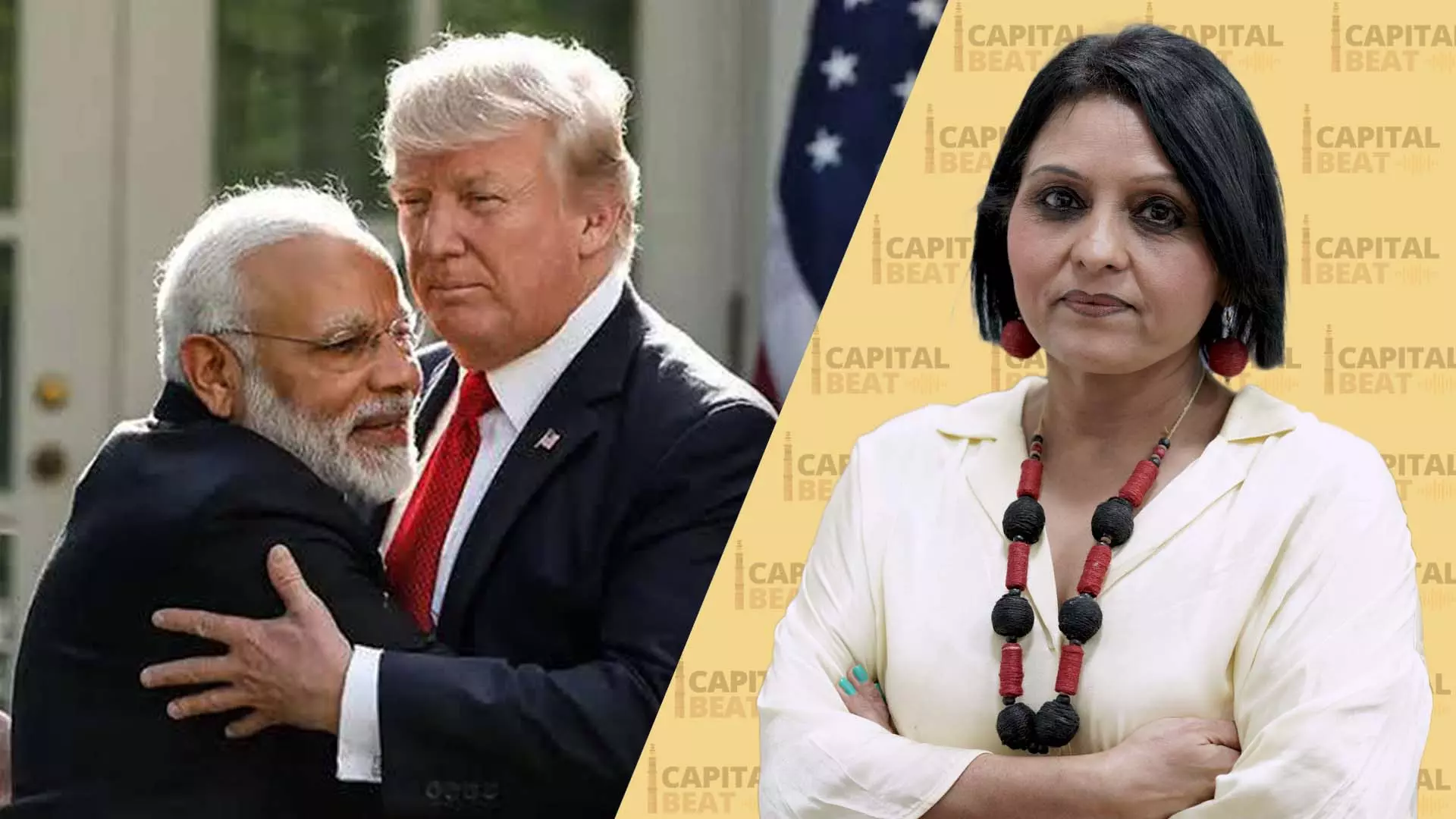
India-US interim trade pact: ‘Reciprocal’ deal or a surrender treaty?
The interim pact includes tariff cuts, reciprocal duties, and promises of market access, but the Opposition calls it a “surrender deal”. Is it so?

In this episode of Capital Beat, senior journalist Kallol Bhattacherjee (The Hindu), JNU’s Professor Gulshan Sachdeva, policy expert Pushparaj Deshpande, and international affairs expert Sanjay Kapoor examined the India-US interim trade framework, focusing on tariff terms, market-access commitments, and the US-linked condition tied to India’s purchase of Russian oil.
The discussion followed a joint statement issued early Saturday (February 7) on an “interim agreement” on reciprocal and mutually beneficial trade, framed as a step toward a fuller bilateral trade agreement expected in the coming months, alongside an executive order referenced from the US side.
A key focus was the divergence between what was described from the White House statement—especially the monitoring clause on Russian oil imports—and the absence of that element in public messaging attributed to India’s side during the episode.
What the joint statement lists
The episode laid out the stated elements of the interim framework: tariff cuts by India on select US goods (including agricultural and food categories and alcoholic beverages), and a reciprocal tariff structure by the US applying an 18 per cent tariff on Indian-origin goods in categories including apparel, leather, footwear, plastics, rubber, organic chemicals, décor, artisanal items, and machinery.
Also read: Trade boost or strategic retreat? India-US deal beyond the rhetoric
The discussion also referenced a potential tariff removal clause contingent on finalisation, including a US indication that reciprocal tariffs could be lifted on Indian exports such as gems, diamonds, aircraft parts, and generic pharmaceuticals.
Other elements listed in the episode included market-access commitments in “strategically important” sectors, rules-of-origin safeguards to limit third-country pass-through, commitments to address non-tariff barriers affecting US medical devices and ICT import licensing, and plans to align technical standards and conformity assessments.
The Russian oil monitoring clause becomes the flashpoint
A central point of dispute in the episode was a clause read out from the White House statement describing monitoring of whether India “resumes directly or indirectly importing Russian Federation oil,” and a mechanism to recommend “additional action” including reimposition of an “additional ad valorem” duty of 25 per cent on Indian imports.
The episode highlighted that this linkage—trade tariff relief tied to energy sourcing—was not presented as part of the Indian public articulation cited in the discussion, and was used to explain the political controversy that followed.
Also read: Details of India-US interim trade deal: Which sectors benefit, what’s protected
The panel discussion repeatedly returned to two questions raised by the framework as presented: whether the interim arrangement is being treated publicly as a concluded “deal” despite limited detail, and whether the oil-linked clause introduces a sovereignty and policy constraint beyond trade terms.
Bhattacherjee flags missing text and conditionality
Bhattacherjee’s remarks emphasised the distinction between a joint statement and a legally binding trade agreement, and the absence of the negotiated text in the public domain. Bhattacherjee: “A joint statement is just a joint statement.”
He also drew attention to the tariffs element being paired with a separate US executive order, described in the episode as containing the conditionality around Russian oil monitoring and future tariff reimposition. Bhattacherjee: “The details about the tariff reduction and the conditionalities behind this reduction appears in another executive order issued by the White House.”
The episode also referred to public messaging by Commerce Minister Piyush Goyal that did not mention the Russian oil condition, while reporting uncertainty over which ministry would address the issue in public briefing.
Sachdeva frames talks as “not normal” trade negotiations
Professor Gulshan Sachdeva described the negotiations as distinct from conventional trade talks, arguing that the process as described blends tariff terms with non-trade conditions. Sachdeva: “These are not normal negotiation, normal trade negotiations.”
Also read: How India-US trade deal map sends a diplomatic signal to Pakistan
He noted that the interim framework could provide partial relief to Indian exporters that faced higher tariffs in recent months, while underlining the lack of detail beyond stated intent on non-tariff barriers and standards. Sachdeva: “There is intention, there is intent of doing these things.”
The discussion also treated the Russian oil linkage as the “worrying part,” with the episode presenting it as an unusual coupling of trade and energy policy conditions within the same overall trade trajectory.
Kapoor calls the arrangement “horribly one sided”
Sanjay Kapoor assessed the arrangement as unevenly articulated, particularly as described from the US side, while also recognising the possibility of reduced strain for Indian companies that faced tariff escalation. Kapoor: “I think it’s horribly one sided at the moment the way it has been articulated by the US.”
He objected to an external monitoring posture tied to India’s oil purchasing decisions. Kapoor: “I don’t like the idea of the US putting a gun on our head and make keeping a watch on us how much of oil we are buying or not buying.”
The episode positioned this as a broader question of how far trade concessions and market access can be negotiated without diluting autonomy on third-country commercial relationships, as framed in the Russia-related clause.
Deshpande challenges the “father of all deals” narrative
Pushparaj Deshpande argued the interim framework is being over-celebrated relative to its scope, describing it as a broad framework rather than a finalised agreement. Deshpande: “It’s not a deal or an agreement… this just establishes a broad framework and principles.”
Also read: India-US trade deal: Zero tariffs on gems, pharma, farm produce, says Goyal
He also questioned why the framework was being publicly portrayed as a major success while still imposing higher tariffs on Indian goods and raising sectoral uncertainties described in the episode. Deshpande: “I really don’t understand why the Modi government is raucously feting a deal that is heavily tilted in favour of the US.”
The episode included Deshpande’s sharp criticism of the absence of detailed disclosure and the mismatch between statements issued by the two sides, presented as a transparency and accountability issue within the episode’s framing.
Parliament, disclosure, and the next phase
The episode raised whether parliamentary scrutiny and formal briefing should follow, while also noting that the agreement text was not available and negotiations were described as ongoing.
Sachdeva pointed to limits of clarity until the final contours are known, while acknowledging that limited clarifications were attempted through a press conference. The discussion also referenced a structural point: trade agreements often proceed through executive action, with debate and questioning dependent on parliamentary dynamics.
Also read: Hugs haven’t helped: Congress slams Centre over India-US trade pact
The panel treated March—cited in the episode as the expected timeframe for signing—as the next critical milestone, with multiple panellists emphasising that significant detail remains unresolved and that public understanding depends on the eventual release of the text.
(The content above has been transcribed from video using a fine-tuned AI model. To ensure accuracy, quality, and editorial integrity, we employ a Human-In-The-Loop (HITL) process. While AI assists in creating the initial draft, our experienced editorial team carefully reviews, edits, and refines the content before publication. At The Federal, we combine the efficiency of AI with the expertise of human editors to deliver reliable and insightful journalism.)
