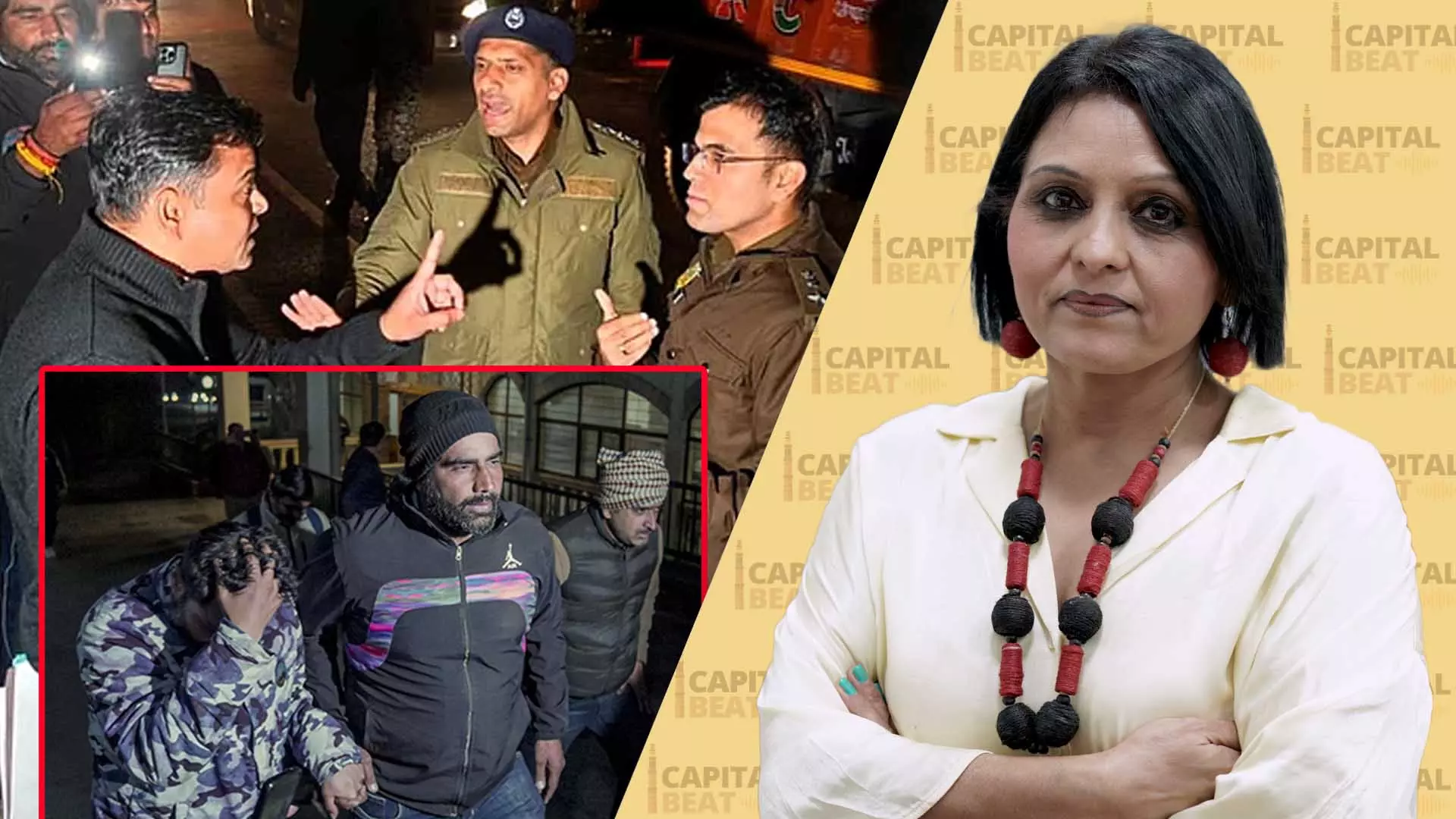
Did the Delhi-Himachal police standoff expose flaws in inter-state policing?
On Capital Beat, a panel of experts discussed the legality, procedural lapses, and political implications of the 24-hour Delhi-Himachal police standoff over Youth Congress arrests

A dramatic inter-state confrontation between the Delhi Police and the Himachal Pradesh Police over the arrest of three Indian Youth Congress activists dominated this episode of Capital Beat. The discussion featuring former IPS officer Yashovardhan Jha Azad, senior journalist TK Rajalakshmi and senior advocate Sanjoy Ghose, focused on the legality of inter-state arrests, alleged procedural violations, and the wider implications for India’s federal structure.
The episode examined how a 24-hour standoff on a Shimla highway unfolded after Delhi Police attempted to arrest three Youth Congress workers without prior intimation to the Himachal Pradesh Police. The confrontation involved barricades, counter FIRs, and a midnight court appearance, culminating in transit remand being granted and the accused being taken to Delhi after a seizure memo was shared.
The panel debated whether the episode reflected a collapse of federal norms, politicisation of the police system, and jurisdictional overreach, as both states are governed by rival political parties.
Inter-state arrest protocol
Sanjoy Ghose stated that established norms require police from one state to inform and coordinate with local authorities before exercising powers of arrest outside their jurisdiction.
“Police is a state subject… If you now want to exercise your police power outside your state, you have to take that state's police into confidence,” he said.
Also Read: ‘This is India, not North Korea’: Rahul attacks PM Modi over crackdown on Youth Cong
He outlined the standard procedure, explaining that officers must approach the jurisdictional station house officer (SHO) before executing an arrest. “If you want to exercise your power of investigation or arrest… you have to take that state's police into confidence,” he reiterated.
Ghose described the absence of such coordination as a violation of protocol, and added that such inter-police confrontations had precedent. He cited past instances of police forces clashing during arrest attempts across state lines.
Political control over police
The discussion expanded to the issue of police reforms and political control. Ghose said, “For the last 30–40 years, the civil society has been fighting for police reforms, and one of the police reforms is to insulate the police from the political executive.” He stated that all political parties share responsibility for resisting reforms.
Also Read: AI Summit protest: Dramatic standoff between Delhi, Shimla police ends after 24 hours
“There is a consensus amongst all political parties that there will be no police reform. They want the police to be subservient to them,” he said.
Referring to comparative international examples, he noted that countries such as Canada, the United Kingdom, Sweden, Switzerland, and Australia provide institutional independence to police and prosecution systems. He contrasted this with the Indian context, stating that political control over appointments, promotions, and transfers affects operational independence.
'Conspiracy angle a farce'
The core of the case involved a protest by a handful of Youth Congress workers, described as a “shirtless protest.” Ghose questioned whether the act was even criminal.
“Public printing a T-shirt is not a crime, wearing a T-shirt is not a crime. As long as there is no intent to cause harm in the form of violence… this whole conspiracy angle is absolutely a farce,” he said. He also questioned the basis for remand.
Also Read: Arrest of IYC chief Uday Bhanu Chib: Implications for dissent and free speech
“At the remand hearing also they were saying, ‘We have to make arrests from Uttar Pradesh, Madhya Pradesh, Chhattisgarh, Jammu and Himachal,’” he said, describing the case as exaggerated.
Azad echoed this assessment, stating, “It didn’t even attract any kind of a bailable offence. It was just a violation of prohibitory order. They didn’t have AK-47. They didn’t fire in the air. There was no violence.”
'Remand for what?'
Azad questioned the necessity of taking remand in such circumstances. “The funniest thing is that a remand was taken. For what? What had to be discovered?” he asked. He described the deployment of a 20-member Delhi Police team led by an ACP to Himachal Pradesh as "excessive".
Also Read: ‘Deep conspiracy’ found in IYC 'shirtless protest' at AI Summit: Delhi Police
“Why did they take 20 men? For the simple reason they realised that that is another police loyal to the HP government,” he said.
Azad characterised the episode as “the biggest joke of our system", adding that such incidents had occurred before and would likely recur. He stated that operational autonomy for police officers was lacking, asserting that no chief minister supported meaningful police reforms.
Broader questions about federal structure
The panel linked the incident to broader questions about India’s federal structure. Ghose stated, “This is extremely, extremely sad,” referring to what he described as the politicisation of institutions.
He referred to issues involving governors, delays in appointments, and fund releases, describing them as part of a pattern of friction between the Centre and Opposition-ruled states.
Also Read: Congress slams ‘witch hunt’ against IYC over shirtless protest
Azad also called for bipartisan respect for law. “There should be respect for the law from both sides,” he said, adding that restraint was required from both the ruling and opposition parties.
'Harmless, peaceful protest'
Rajalakshmi framed the issue as an overreach. She stated that deploying “scarce resources” of the Delhi Police to arrest individuals in other states amounted to “a waste of taxpayers’ money".
Describing the protest as peaceful, she said, “It was a harmless, peaceful protest by a handful of people. Whether they had their shirts on or their shirts off was totally immaterial.”
She also raised concerns about shrinking protest spaces. “If every act of protest, every act of democratic protest is seen as an anti-national act, that is something which I don’t think the people of this country will accept,” she said.
'Glorious history of peaceful protests'
Azad stressed that accountability must begin with those in power. “It must come from the ruling party… they should show a little bit more maturity, generosity,” he said.
He added that operational freedom for the police was essential. “If you don’t have any operational freedom for the police, don’t post the right people,” he said.
Rajalakshmi described the episode as “making too much out of nothing", reiterating that India has a “glorious history of peaceful protests and satyagraha".
The standoff concluded without resolution, as the transit remand allowed Delhi Police to take the accused back to the national capital. The legal proceedings are expected to continue.
(The content above has been transcribed from video using a fine-tuned AI model. To ensure accuracy, quality, and editorial integrity, we employ a Human-In-The-Loop (HITL) process. While AI assists in creating the initial draft, our experienced editorial team carefully reviews, edits, and refines the content before publication. At The Federal, we combine the efficiency of AI with the expertise of human editors to deliver reliable and insightful journalism.)