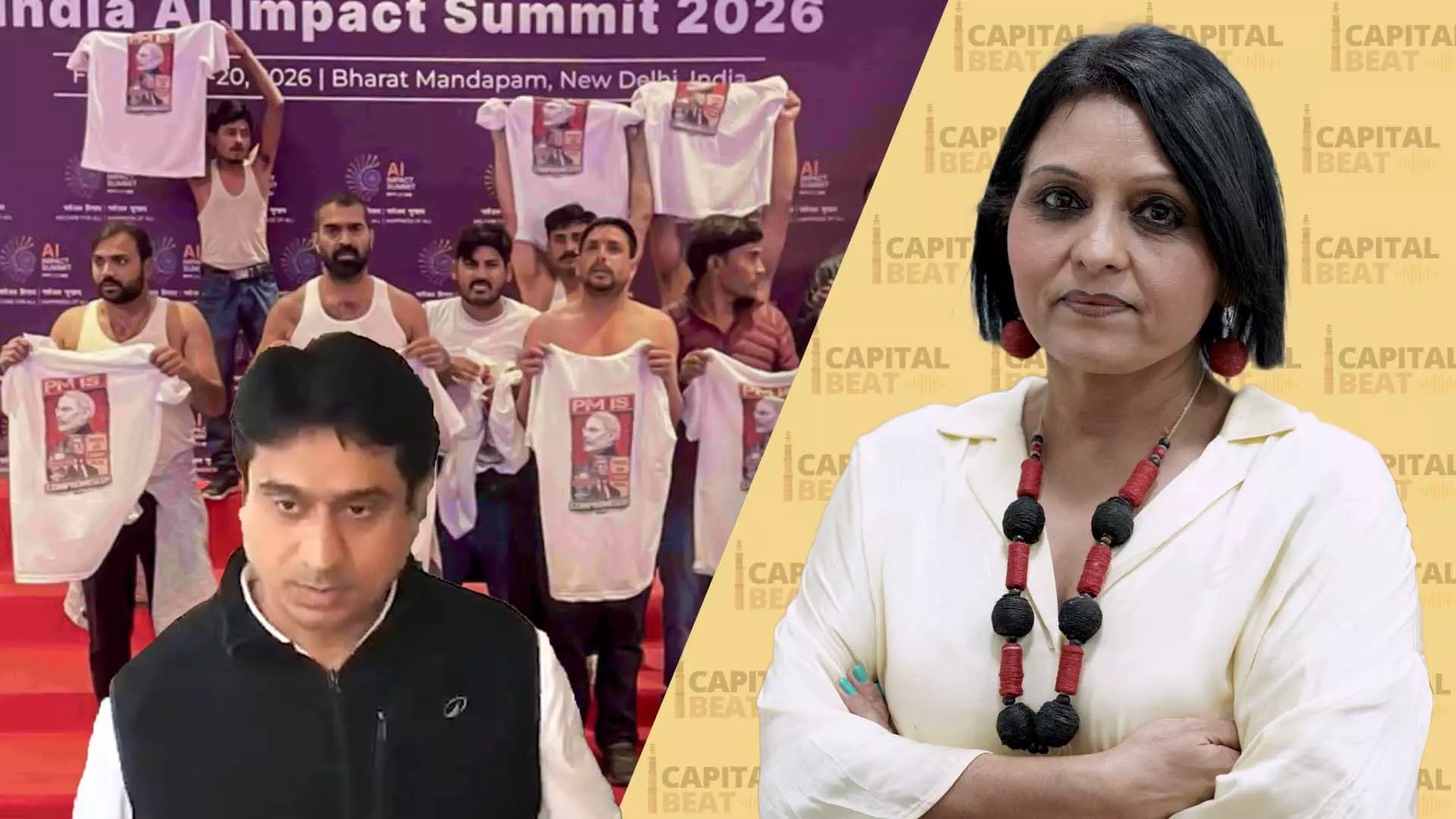
Arrest of IYC chief Uday Bhanu Chib: Implications for dissent and free speech
Is it a crime to print T-shirts? Capital Beat panellists discuss criminal conspiracy and other charges against Chib

In this episode of Capital Beat, Senior Advocate Sanjoy Ghose and senior journalist TK Rajalakshmi discussed the arrest of Indian Youth Congress chief Uday Bhanu Chib in connection with a shirtless protest at the India AI Impact Summit 2026. The discussion examined the legal grounds cited by the Delhi Police and the broader implications for dissent and free speech.
The panellists addressed the FIR, the grounds of arrest, and the charges of criminal conspiracy, obstruction of a public servant, and wilful disobedience invoked against Chib.
FIR not shared with defence lawyers
Ghose stated that the defence had demanded a copy of the FIR before the magistrate but the Delhi Police opposed sharing it. He clarified that what was circulating publicly was only the “grounds of arrest” under Section 35 of the Bharatiya Nagarik Suraksha Sanhita, not the FIR.
He said the FIR, which records the entire incident, details of offences, and the role of each accused, had not been shared with the lawyers of the accused or placed in the public domain.
Also Read: Youth Congress president arrested over 'shirtless' protest; Congress slams Centre
On the issue of printed T-shirts, Ghose argued that sending people to jail to “recover T-shirts” would make the judicial system “a laughing stock". He questioned when the printing of T-shirts became an offence in a democracy.
'Attempt to create a larger narrative'
Ghose said the individuals who went to the venue had already been apprehended and that the T-shirts were in police possession. He questioned how the number of T-shirts printed would alter the nature of the protest if only a handful of individuals were present at the venue.
He posed a hypothetical scenario: If an opposition party printed thousands of T-shirts criticising the Prime Minister as part of a protest campaign, where would the offence lie, he asked.
Also Read: Congress slams ‘witch hunt’ against IYC over shirtless protest
He described the arrest as an attempt to create a larger narrative beyond what he termed a “simple incident", and referred to past cases where multiple individuals were arrested under broader conspiracy allegations.
Allegations of overreach
Ghose stated that Chib was not physically present at the venue and had not telephonically spoken to those who protested, and that he had been implicated through the principle of conspiracy.
He said that invoking provisions related to sovereignty, territorial integrity, and national security created what he described as a “bogie of national interest", and argued that dissent is integral to liberal democracies.
Also Read: Delhi court calls shirtless protest assault on public order
He argued that protests by activists worldwide — including climate, feminist, caste, and race activists — are part of democratic expression. He maintained that the protest did not imperil India’s sovereignty or integrity.
Propriety versus criminality
Addressing the argument that the protest was improper at an international summit, Ghose said criminal law requires breach of a specific statute. He stated that while certain forms of speech — such as hate speech, caste-based slurs, or gender-based offences — are criminalised, “propriety” by itself does not constitute a crime.
He said that discomfort, embarrassment, or perceived shame does not meet the legal threshold of a criminal offence unless a law has been breached.
Also Read: BJP accuses Rahul of being the mastermind behind Youth Congress AI Sumit protest
When asked whether obscenity could justify arrests and detention, he said that such questions should be directed to the Home Minister and the Police Commissioner, reiterating that the defence had yet to receive the FIR outlining the precise allegations.
Custody and legal process
Ghose explained that after the four-day police remand, the prosecution must produce Chib before the court. He outlined three legal options available to the police: release, seek further remand, or request judicial custody.
He stated that, subject to confirmation of the written order, the court had directed that any interrogation of Chib must take place in the presence of his lawyers.
He described the police deployment at the Patiala House Court as resembling arrangements made for “a dreaded terrorist", and questioned the allocation of state resources over the incident.
Political implications
Rajalakshmi termed the arrest an “overreach", questioning when protest became an offence in India. She said that the government appeared “extra sensitive” to protests, and that dissent was increasingly framed under criminal provisions.
She noted that several individuals remain in jail for extended periods without trial, and questioned the use of clauses related to national shame and propriety in this context.
On whether the case could widen politically, including potential implications for the Congress leadership, Rajalakshmi said that state assembly elections were approaching and that such actions could be politically motivated.
She stated that prolonged detention could galvanise the Congress politically and mobilise support, adding that invoking stringent clauses over such a protest risked appearing disproportionate.
Dissent and democracy
Ghose said that the matter could have been handled by detaining the protesters briefly and releasing them the same day. Instead, he said, the case was being expanded by arresting individuals from multiple states and interrogating those involved in printing T-shirts.
He stated that the case had put institutions — including the judiciary, prosecution, and media — “on trial", and that its future trajectory would depend on how far the authorities chose to pursue it.
Also Read: Youth Congress chief defends protest at AI summit: 'Won't damage India's image'
Rajalakshmi concluded that India has a long history of protests, including during the freedom movement, and that detention and release have been part of democratic processes. She questioned the necessity of invoking multiple criminal clauses over what she described as a small group staging a protest.
(The content above has been transcribed from video using a fine-tuned AI model. To ensure accuracy, quality, and editorial integrity, we employ a Human-In-The-Loop (HITL) process. While AI assists in creating the initial draft, our experienced editorial team carefully reviews, edits, and refines the content before publication. At The Federal, we combine the efficiency of AI with the expertise of human editors to deliver reliable and insightful journalism.)