



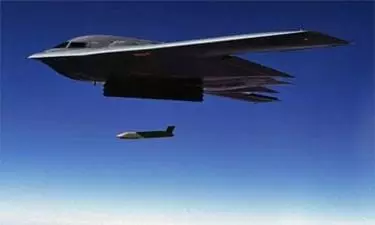
The JASSM-ER (Joint Air-to-Surface Missile–Extended Range) is a stealthy cruise missile capable of striking targets over 600 miles (965 km) away. Photo: US Air Force website
US readies to deploy its most lethal long-range missiles as Iran holds its ground: Report
Pentagon drains global stealth missile stockpiles for Iran strikes after Trump’s "Stone Age" vow and the downing of two US aircraft

The Iran war appears to be entering a dangerous new phase as the United States is preparing to deploy some of its most lethal long-range weapons, the JASSM-ER missiles, to strike Iranian targets. Recent reports indicate a significant escalation in US military posturing toward Iran, after two US military aircraft was brought down by Iran on Saturday (April 4).
According to Bloomberg, the Pentagon is planning a massive campaign that would utilise nearly the entire global inventory of JASSM-ER (Joint Air-to-Surface Standoff Missile-Extended Range) cruise missiles. This strategy involves consolidating stockpiles from strategic positions worldwide to focus a concentrated, stealth-driven strike capability on Iranian targets.
The JASSM-ER (Joint Air-to-Surface Missile–Extended Range) is a stealthy cruise missile capable of striking targets over 600 miles (965 km) away. It is designed to hit high-value, well-defended targets from a safe distance, reducing risk to the launching aircraft.
Also read: How Iran brought down two US military aircraft and why it is significant
The move comes amid US President Donald Trump’s threat last week that he would bomb Iran “back to the Stone Age”.
America's missile stockpiles
Bloomberg, citing sources, reported that an order to draw the roughly $1.5 million missiles from stockpiles in the Pacific was issued at the end of March. Missiles from multiple locations, including US facilities, are being moved to US Central Command bases and to Fairford in the UK.
The report alleged that Trump administration pressured British leadership to grant permission for its bases to serve as a staging ground for Iranian operations.
A significant share of the US arsenal committed to the Iran conflict includes both extended-range JASSM-ER missiles and a large portion of the standard JASSM variant, which has a strike range of roughly 250 miles (402 km).
These long-range systems have allowed US forces to operate from safer distances, limiting risk to personnel. However, the heavy reliance on such weapons is steadily eroding stockpiles that were originally reserved for potential high-intensity conflicts with more capable adversaries, including China.
Also read: US burns $10,300 a second in Iran war, says SIPRI study
Meanwhile, The Washington Post also reported that the Pentagon has begun relocating components of the THAAD (Terminal High Altitude Area Defense) missile system from South Korea to the Middle East. This strategic shift follows reports that Iran successfully destroyed a $300 million interceptor at a US-allied airbase in Jordan, exposing vulnerabilities in regional air defenses.
Mounting pressure
The scale of the campaign is putting US reserves under strain. Since the beginning of Operation Epic Fury, US forces have targeted more than 12,000 sites across Iran, including naval platforms, missile infrastructure and defence units. This has led to rapid depletion of key munitions.
In the first month alone, over 1,000 JASSM-ER missiles were reportedly used, said the report.
From a pre-war stock of around 2,300, only about 425 missiles remains available for global deployment. Around 75 missiles were deemed "unserviceable" due to damage or technical faults.
Also read: If US plans Iran ground war, where does it launch it from?
US aircraft also fired 47 missiles during the raid linked to the capture of Venezuelan President Nicolas Maduro, according to the reports.
The US has now reached a tipping point where "playing it safe" is no longer viewed as a viable strategic option. The recent loss of two military aircraft within Iranian airspace has served as a profound embarrassment for the Pentagon, leaving the administration both humiliated and determined to retaliate.
Scale of operation
US claims of air superiority was punctured after Iranian forces downed advanced American aircraft, F-15E Strike Eagle and an A-10 Warthog. Iran also targeted helicopters during rescue missions.
Also read: What’s behind Trump’s flip-flops on Iran war?
Several MQ-9 drones have also been destroyed. Despite claims that its air defences are weakened, Iran has shown incidents as proof of resilience, retaining enough capability to pose a threat and is pushing the US towards greater reliance on long-range strikes.
JASSM-ER missiles have been launched from multiple platforms, including bombers and fighter jets, underscoring the scale of the operation. As the conflict continues, the key challenge is keeping operations going with limited resources that are hard to replace.