



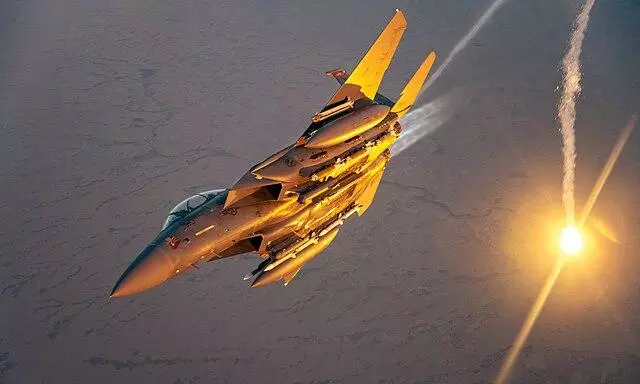
The F-15E Strike Eagle that went down within Iranian territory during combat operations carries a pilot and a weapons systems officer. Representative image: Wikimedia commos
How Iran brought down two US military aircraft and why it is significant
Iran claims to have downed two US military aircraft and hit helicopters, raising questions over air defence gaps and the conflict’s next phase

The ongoing war between the United States, Israel, and Iran has taken a sharper turn after the Iranian forces claimed to have shot down two US military aircraft and damaged two helicopters.
With one pilot still missing and recovery operations underway, the incident could shape the next phase of the war. The attacks came in rapid succession of hits, targeting multiple US aircraft within a short span.
A rapid string of strikes
The most serious incident involved an F-15E Strike Eagle that is reported to have gone down within Iranian territory during combat operations. The $31.1 million aircraft (about Rs 289 crore), carries a pilot and weapons systems officer. While one crew member has been retrieved, the second member is still missing, prompting an urgent search operation.
Also read: Karaj attack: Iran issues 'hit list' of 8 key bridges in West Asia
Around the same time, an A-10 Warthog was struck during operations over Kuwait. The pilot ejected safely and survived, but the loss still marks a rare blow to the system known for its resilience in combat.
Rescue efforts under threat
The risks were not confined to combat sorties. The situation escalated further when two Black Hawk helicopters involved in the rescue mission came under fire. According to officials, both aircraft were hit while operating near Iranian airspace but managed to exit safely without crashing.
In a separate development, Iran has claimed it damaged a CH-47 Chinook helicopter at a base in Kuwait in a drone strike. However, these claims remain unverified, with no official confirmation from the US so far.
Also read: Iran war: IRGC threatens 18 US tech, infra companies; fully prepared, says US
These attacks indicate Iran’s retaliation on support and rescue operations too.
How did Iran strike?
Media reports suggest the strikes were likely enabled by short-range air defence systems designed to engage aircraft at lower altitudes. Military analysts believe Iranian forces relied less on traditional radar and more on passive detection tools, such as infrared and electro-optical tracking, which identify heat signatures from engines without emitting signals that could expose their position.
This method allows defenders to remain concealed while increasing the likelihood of catching fast-moving aircraft off guard, particularly during low-level or high-speed manoeuvres.
Despite sustained bombardment, parts of Iran’s defensive grid appear to have remained functional, enough to exploit momentary vulnerabilities in US flight patterns.
Iran's reaction
The situation has been further complicated by the disappearance of one F-15E crew member. US forces have launched an intensive search-and-rescue effort, but reports suggest Iranian units are also scanning the crash site.
Iran has offered a reward of approximately $66,000 bounty to any citizen who helps capture the missing airman.
Also read: If US plans Iran ground war, where does it launch it from?
While Iranian leaders have framed the incidents as proof of resilience, using them to project strength domestically and internationally, Washington has taken a more restrained line.
Iran's parliament Speaker Mohammad Baqer Qalibaf mocked US efforts, saying, “After defeating Iran 37 times in a row, this brilliant no-strategy war they started has now been downgraded from ‘regime change’ to ‘Hey! Can anyone find our pilots? Please?’ Wow. What incredible progress. Absolute geniuses.”
US President Donald Trump dismissed the losses as an expected part of warfare, signalling that the administration does not view the episode as a strategic turning point.
Implications of the strikes
The downing of these aircraft is highly significant because it marks the first time in over 20 years that American fighter jets have been lost to enemy fire. The last such instance was during the 2003 invasion of Iraq.
Apart from the historic importance, the strikes also hold political implications in the ongoing war. The US and Israel had maintained that Iran’s air defences were largely destroyed and its airspace was under full control. However, the reported downing of the advanced F-15E deep inside Iranian territory suggests these claims may be overstated, indicating that Iran still retains functional detection and defence capabilities.
Despite weeks of heavy bombardment, Iran appears able to sustain the conflict through asymmetric tactics. Rather than seeking a conventional military win, it may be aiming to prolong the fight and gradually increase pressure on its adversaries.
Also read: US burns $10,300 a second in Iran war, says SIPRI study
The search for the missing pilot has turned into a tense and high-risk operation, with US rescue teams racing against Iranian forces. Reports suggest Iran has offered rewards for information, while rescue efforts have already faced complications, including damage to aircraft.
War strains domestic support
Such incidents can also have domestic political consequences in the US, as visible losses and missing personnel may weaken public support for the conflict, particularly as financial and strategic costs continue to mount.
Although US leadership has indicated that diplomatic efforts will continue, the incident comes at a sensitive moment following stalled ceasefire discussions. The developments could strengthen Iran’s position in negotiations if it believes it can still impose costs on US forces.
On Friday (April 3), Iran, in retaliation for the destruction of its key bridges in Karaj, had listed eight major bridges across the West Asia region, in an apparent warning of a possible attack.
As tensions ripple across the region, affecting energy routes, allied territories, and global markets, the message is clear: the conflict is deepening, and the risks are only growing.