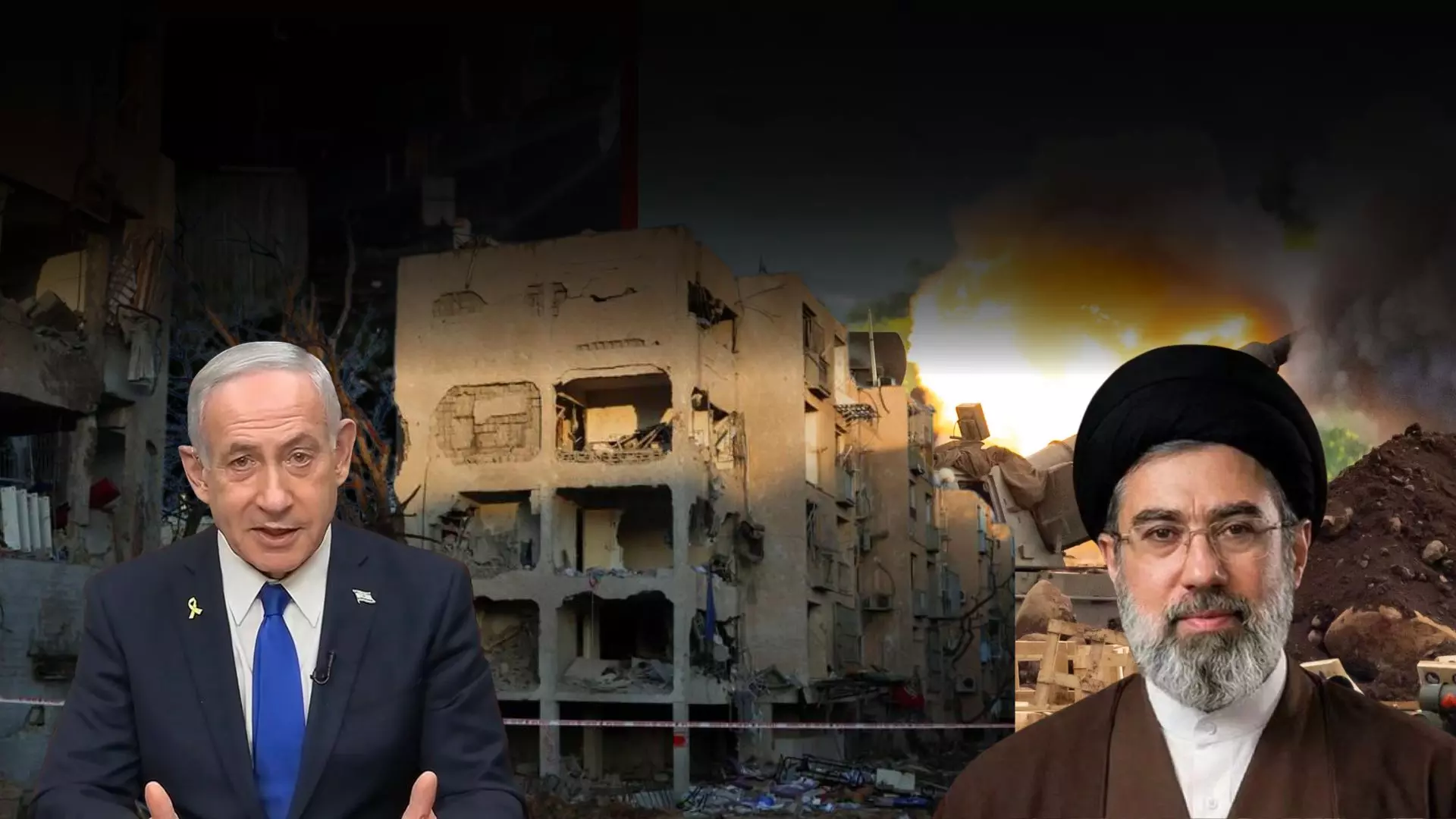
Israel, Iran's tit-for-tat war puts global security on the edge
Tehran’s strikes on Israeli cities of Dimona and Arad ignite global fears of a nuclear catastrophe, while its long-range targeting of Diego Garcia signals a dangerous expansion of the conflict

Iran and Israel have continued to breach each other's territory in the ongoing conflict in West Asia. A day after the Jewish state targeted Tehran on the occasion of 'Nowruz' (Persian New Year) on Friday (March 20), the Muslim state hit back, targeting cities located near the highly sensitive Shimon Peres Negev Nuclear Research Facility and also Jerusalem, where its missile attack fell just short of the Al-Aqsa Mosque even as devotees were preparing for their Eid prayers.
Also read: Iran war: 'Trump might end up helping China and boosting electric ecosystem globally'
However, it was the attack on the southern cities of Dimona and Arad, located close to the nuclear facility, which left the international community deeply worried. With more than 150 people injured in the attacks, some of whom seriously, and significant damage to civilian assets reported, the latest attacks by Tehran have intensified fears that the conflict might be far from ending. Iranian attacks continued on Sunday (March 22), too, with at least 15 people getting injured in seven different sites in Israel.
Iran's tit-for-tat strikes
Iran claimed that its key Natanz Nuclear Facility had been hit by Israel on Saturday, but ruled out any radioactive leakage. If true, it is the second time that it has been targeted in this conflict, which started on February 28. Israel also pounded Iran's giant South Pars gas facility earlier this week, which saw the latter retaliating by targeting energy assets in Qatar, Saudi Arabia, and the United Arab Emirates, putting the entire region on the brink.
The tit-for-tat strikes have ignited a vicious cycle that has defined the conflict in recent weeks. The geopolitical implications are enormous, as the war now threatens to spill over into even more volatile territory.
Iran targets Israeli nuclear facility
On March 21, Iranian ballistic missiles hit Dimona and Arad, located just 18 and 35 kilometres from the nuclear facility, respectively. Named after former Israeli prime minister and president Shimon Peres, the facility is considered a cornerstone of Israel’s undeclared nuclear weapons programme. The International Atomic Energy Agency, however, said that no damage had been indicated at the nuclear centre.
Attack details
However, the residential areas in Arad and Dimona witnessed significant devastation. Israeli emergency services have been scrambling to evacuate the injured, with at least 50 people moved to safety from the impact sites. In Arad, 88 people were injured, 10 of them critically, as missiles targeted the city centre, causing extensive damage to buildings and public property. In Dimona, at least 39 people were hurt, including a young boy in critical condition due to shrapnel wounds from a direct hit on residential buildings.
Israel adamant to continue war
The Israeli establishment, however, was unfazed and vowed to continue with the adventurism. “This is a war in which we must continue to crush, to achieve victory,” the country's National Security Minister Itamar Ben-Gvir said in Arad, where he went to meet the local people. He called the people of Israel "strong".
Also read: Is Trump serious about winding down Iran ops? Mixed signals raise concerns | Capital Beat
Israeli Southern District Police Commander Haim Bublil described the situation in Arad as highly complex, noting: "The scene is very complex. At this stage, more than 50 injured people have been evacuated from the site. The damage is significant, as you can see."
Meanwhile, the IAEA called for “maximum military restraint,” specifically urging that no attacks be carried out near nuclear sites, given the grave risks they could entail.
The growing risk of a broader conflict
The escalation between Iran and Israel has now reached a critical juncture. With both sides intensifying their military operations against the opponent's critical assets, be it energy or nuclear, the risk of broader regional conflict is now more tangible than ever.
The geopolitical ramifications could be felt far beyond West Asia, as other powers, both global and regional, could be drawn into the crisis. Iran has also launched two intermediate-range ballistic missiles toward the US-UK military base Diego Garcia in the Indian Ocean, which, observers feel, could be significant as it shows the range of Tehran's missile-hurling capacity.
Also read: Iran denies surplus oil supply after US eases sanctions on stranded crude
It was during this war that the US sank an Iranian war vessel, which was returning from a drill in India, raising questions over the possibilities of the conflict stretching into faraway zones. Iran's missile launch at the western base adds more to the concern.
What’s next for the region?
As Iran and Israel continue their military operations, the fear remains that this conflict could spiral into an all-out war with far-reaching consequences. Already, the global oil and energy security situation has taken a big hit. The underlying tensions are far from resolved, and the question looms large: How long will this cycle continue, and what will be its long-term effects on regional and global stability?
The content above has been transcribed from video using a fine-tuned AI model. To ensure accuracy, quality, and editorial integrity, we employ a Human-In-The-Loop (HITL) process. While AI assists in creating the initial draft, our experienced editorial team carefully reviews, edits, and refines the content before publication. At The Federal, we combine the efficiency of AI with the expertise of human editors to deliver reliable and insightful journalism.