







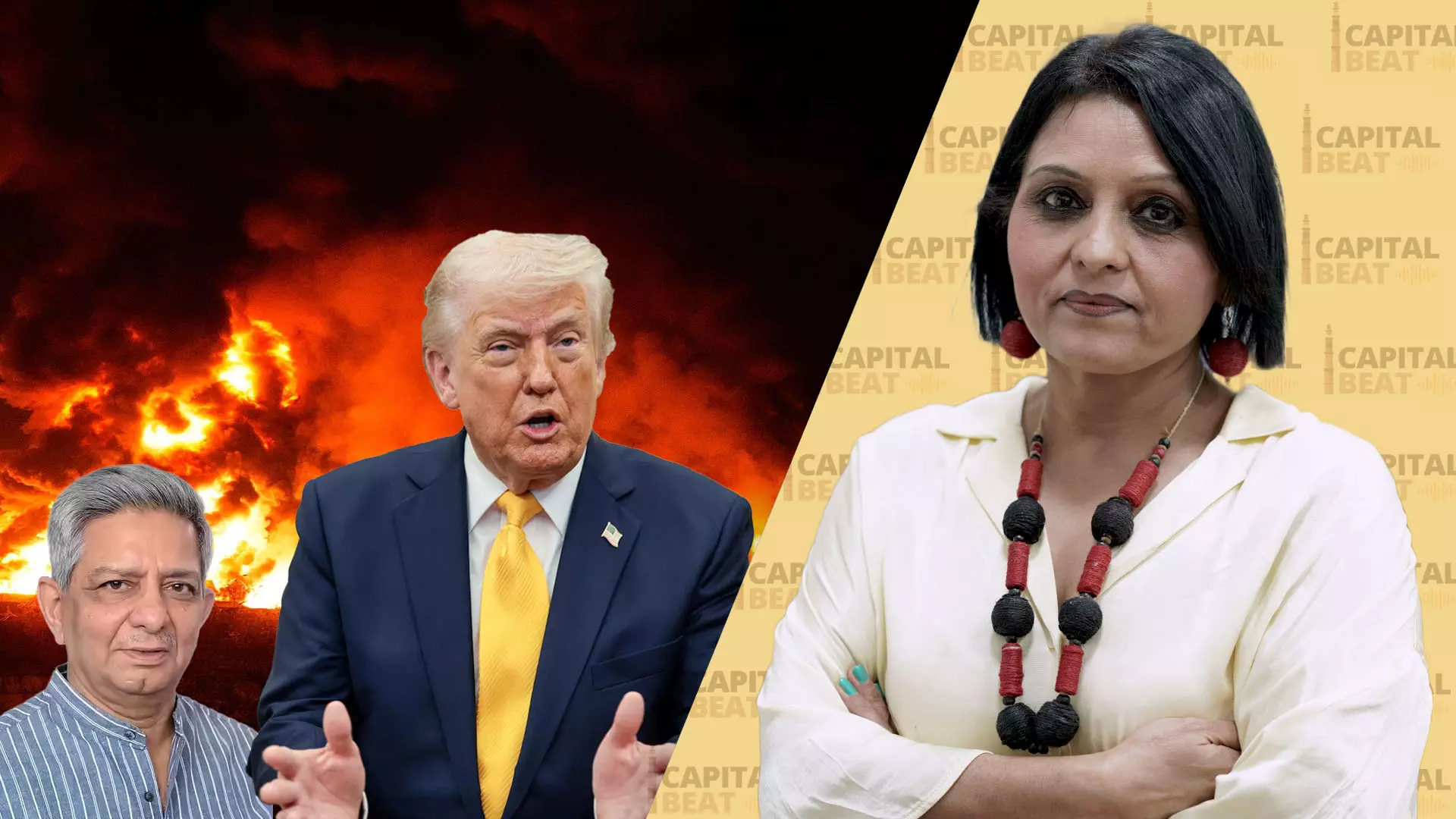
Is Trump serious about winding down Iran ops? Mixed signals raise concerns | Capital Beat
Former diplomat questions Washington’s intent as increased military presence and funding requests contradict Trump’s claim of intending to scale back Iran war

United States President Donald Trump may be talking about “winding down” the Iran war, but his actions suggest otherwise, with additional troop deployments and fresh funding requests, says former diplomat Rajiv Dogra.
In this episode of Capital Beat, The Federal spoke to the former Ambassador on whether Washington is truly stepping back or simply managing optics amid rising economic and military pressure. He argued that the mixed messaging reflects deeper troubles for the US in the conflict.
Mixed signals
Trump on Friday (March 20) said the US was “very close” to achieving its objectives in Iran and was considering winding down military operations. However, this came even as his administration deployed 2,500 additional Marines to the region and sought more funds from Congress.
The contradiction, Dogra said, has raised questions not just in India but globally. “Americans themselves are asking the same question — is he serious? The world says don’t take him seriously because he doesn’t mean what he says,” he noted.
Also read: Why India, China and the rest of the world are unable to stop Iran war
According to Dogra, Trump’s shifting positions have eroded credibility. “He has not yet become a laughing stock, but he is not taken seriously by anyone in the world because he flips from one position to another every single minute,” he said.
War reality
Dogra suggested that the US may actually be struggling in the conflict despite claims of success. “If a psychologist were to analyse his statements, they would probably say he is losing badly in this war against Iran,” he said.
He argued that Trump may have miscalculated and ignored military advice. “His own generals warned him that this would be a bad war. But for reasons that appear personal, he went ahead,” Dogra added.
He also pointed to speculation that Israel played a key role in pushing the US into the conflict, citing domestic pressures on Israeli Prime Minister Benjamin Netanyahu.
Victory claims
Trump has listed several achievements, including degrading Iran’s missile capabilities, destroying its defence base, and eliminating naval and air power. But Dogra dismissed these as premature or exaggerated.
Drawing a historical parallel, he said: “On December 16, 1971, when Pakistan surrendered, a newspaper headline still claimed ‘victory on all fronts’. Trump is using the same syndrome.”
Also read: Iran war: Trump lit the fire, now wants the world to help extinguish it
He added that Iran continues to maintain positions directly opposing US claims. “There is no meeting ground between the two if Trump sticks to his narrative,” he said.
Economic strain
Dogra highlighted the rising financial burden of the war on the US. “Even for America, USD 200 billion is a huge amount. It shows how expensive the war has become,” he said.
He noted that initial estimates of war costs may have been understated, and actual losses — including aircraft and military assets — could be much higher.
“The costs are humongous. Radar stations, naval bases, and military infrastructure have been badly damaged. It will take billions to rebuild,” he said.
Hormuz crisis
Trump’s statement that countries using the Strait of Hormuz should “guard and police” it has raised concerns, especially for energy-dependent nations like India.
Dogra described the stance as unfair but consistent with Trump’s approach. “He is saying, ‘I created this situation, now you handle it.’ In his world, this is not unusual,” he said.
He added that the US may be seeking an exit due to domestic pressure. “Questions are being asked in America, and once casualties rise, public opinion will turn sharply,” he said.
India’s dilemma
For India, the situation is particularly challenging given its dependence on energy imports from the region. Dogra stressed that Iran remains strategically important.
“Iran is indispensable for India — strategically, economically, and even civilisationally,” he said, noting its role as a gateway to Central Asia.
Also read: Iran claims first strike on US F-35 amid escalating conflict
He also questioned India’s decision to reduce oil imports from Iran under US pressure. “We were getting favourable terms. The loss to India has been in billions,” he said.
Energy risks
Dogra warned that alternatives to Gulf energy supplies would be costly and inefficient. “You can buy oil from anywhere, but transport costs will rise significantly,” he said.
He pointed out that India’s dependence extends beyond oil to gas, fertilisers, and even helium. “If the Strait of Hormuz is disrupted, India will face a tight situation in the months ahead,” he said.
The ongoing crisis, he added, could have long-term consequences even if the war ends soon.
NATO tensions
Trump’s criticism of NATO allies, calling them a “paper tiger,” also drew sharp remarks from Dogra.
“This is not language befitting a president. Calling allies cowards is street language,” he said.
He explained that NATO’s charter does not mandate involvement in conflicts outside Europe, and European nations are increasingly wary of following US leadership.
Also read: Iran denies surplus oil supply after US eases sanctions on stranded crude
“Europe has already suffered economically due to its alignment with the US, especially after the Ukraine war,” Dogra said.
Endgame doubts
Despite Trump’s claims of success, Dogra believes the reality will eventually surface. “He is wearing a mask — a mask of deception,” he said.
He argued that as facts emerge about US losses, the narrative of victory will collapse. “Once the truth comes out, the bravado will fall flat,” he said.
Even if the conflict ends soon, Dogra warned of lasting global impact. “The effects will remain for a long time, and countries like India will feel the pain,” he concluded.
(The content above has been transcribed from video using a fine-tuned AI model. To ensure accuracy, quality, and editorial integrity, we employ a Human-In-The-Loop (HITL) process. While AI assists in creating the initial draft, our experienced editorial team carefully reviews, edits, and refines the content before publication. At The Federal, we combine the efficiency of AI with the expertise of human editors to deliver reliable and insightful journalism.)
