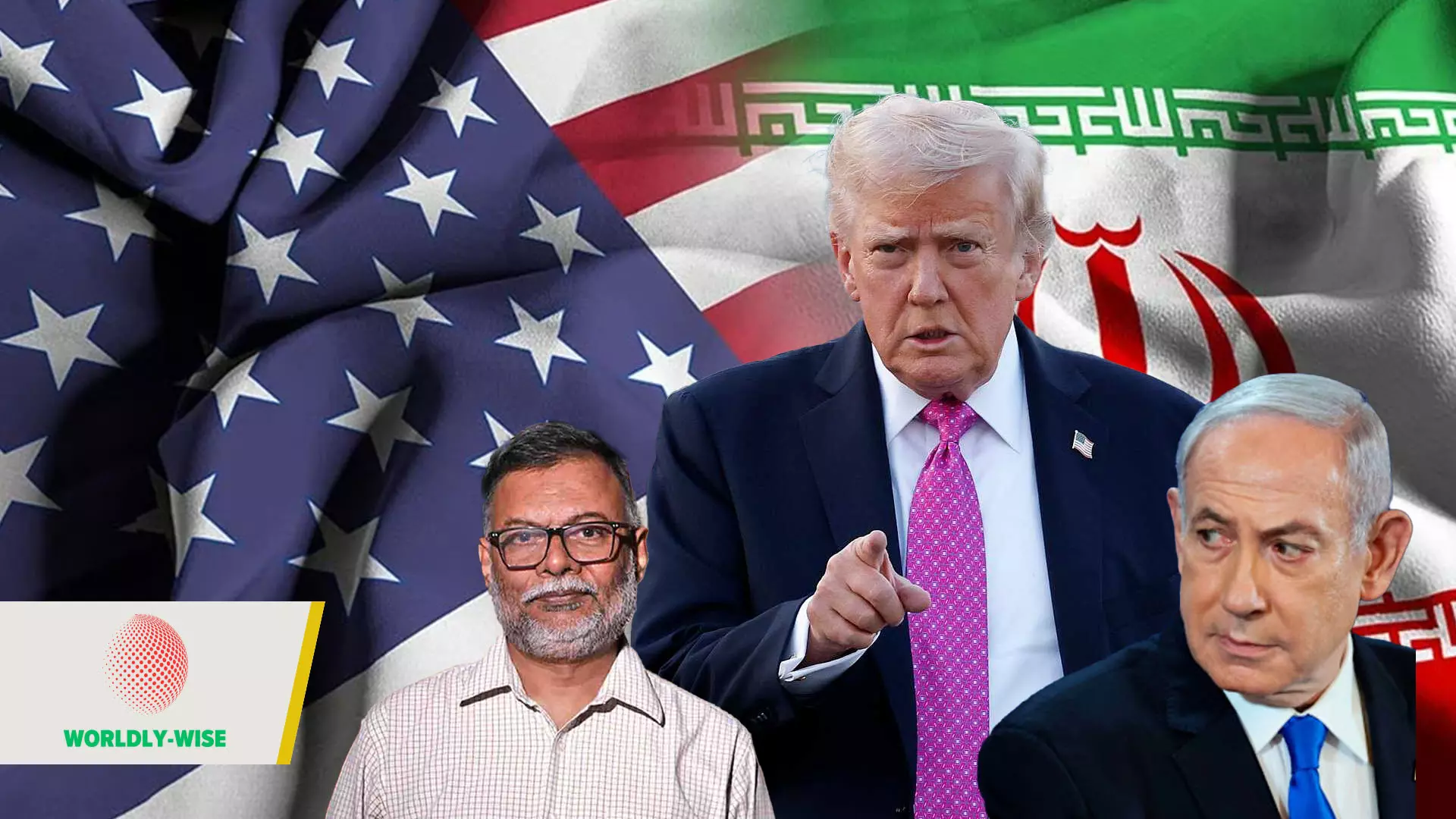
Why India, China and the rest of the world are unable to stop Iran war
US struck Iran mid-negotiation, leaving all sides rigid and every potential mediator either unwilling or unable to step in, says KS Dakshina Murthy

As the war between the US, Israel, and Iran drags on with global consequences, the chances of a negotiated settlement appear increasingly slim.
The collapse of negotiations in the middle of ongoing talks has “confounded a lot of people,” raising serious questions about whether the military strike on Iran was pre-planned rather than a failure of diplomacy.
In an interview with The Federal, in the YouTube show Worldly Wise, Consulting Editor and international affairs expert KS Dakshina Murthy explained why diplomacy broke down and whether any mediation is still possible.
Edited excerpts:
Before the war, there were multiple rounds of talks between the US and Iran. What went wrong, and why did diplomacy collapse so suddenly?
This is confounding a lot of people, because the talks were going on, and it looked like it was going to end in some kind of a settlement. But the attempt to militarily strike Iran has been a long-standing agenda of Israel. And the US, under Donald Trump, has always moved in step with Israeli Prime Minister Benjamin Netanyahu.
There is a controversy over what triggered this. In fact, the whole world, especially Iran, was very surprised when, in the middle of the talks — which were still ongoing and even being shifted to Geneva for a final settlement — the US attacked Iran, followed closely by Israel.
Trump is trying to explain it by saying that Israel was anyway preparing to bomb Iran, and that is why the US joined in. But it all looks inconsistent, suggesting that the original agenda was always to strike Iran. Now the US is saying Iran was too rigid and unwilling to stop its nuclear program. That is being used as the justification. But the fact that the attack happened while negotiations were ongoing is what is causing the problem now.
Also read | Europe’s snub to Trump is a moral victory for Iran
Nearly 20 days into the US-Israel missile attacks, the conflict has taken on global ramifications — gas fields have been attacked, the airline industry in the region has come to a halt, and ripple effects are spreading everywhere.
So it is crucial for the world that there is some kind of settlement, but that is not happening because of the very nature of how this war began — with a sudden attack during negotiations. That is why today we see no real headway in mediation, with all sides sticking rigidly to their positions.
Iran has listed conditions like reparations, security guarantees, and recognition of its rights. Are these genuine demands or a sign that Tehran is not ready to negotiate?
Iran was shocked by the suddenness of the attack, especially because it happened during negotiations. So naturally, it is now looking for guarantees. If Iran agrees to a ceasefire or to restart negotiations, what is the guarantee that the US and Israel will not attack again? That is the first concern.
Who can stop the Iran war, and why they won't
China: Close to Iran, but staying mysteriously silent
Russia: Well-placed, but tied down in Ukraine war
Gulf states: Most affected, but too close to the US
India: Good ties with both sides, but Israel tilt hurts
Europe: Rejects US Hormuz plan, but backs Iran nuclear stance
UN: Willing, but paralysed by US veto in Security Council
Iran also feels slighted because it sees this as an illegal war. The UN Security Council has not cleared this war, and there was no direct threat from Iran to either the US or Israel. The US says it acted on intelligence that Iran was preparing to attack, presenting it as a preemptive strike. But there is no evidence to support this. And as we know, Trump has been known to make false claims in the past.
So Iran is saying: you started this war without provocation, so you must pay for the damages. That is the demand for reparations.
Also read | A crumbling Iran could turn out more dangerous
Secondly, Iran wants guarantees that the US and Israel will not attack again. Thirdly, Iran insists that it is a sovereign nation — a member of the UN — and has the right to develop its nuclear programme and decide its own path. Nobody else can dictate terms to it.
These are the three key conditions Iran has put forward. But the US and Israel have not even indicated that they have engaged with these demands, let alone responded to them. Instead, they continue to insist that they will weaken Iran’s military capabilities. There is even talk now of the US deploying 2,000 to 5,000 Marines near the Strait of Hormuz to secure international shipping routes.
So rather than moving toward negotiations, the conflict may actually expand. At this point, it is unclear whether talks will resume or whether the war will escalate further.
Is there any neutral party left that has the credibility to mediate and bring both sides to the table?
This is another big surprise about the conflict. The most logical country to step in would be China.
China has close ties with Iran and is also a major rival to the US. It has the economic, political, and military strength to take on the US at multiple levels. So it is well-positioned to act as a mediator. But surprisingly, China has not made any serious attempt to project itself in that role.
Russia could also have been a key player, possibly in coordination with China. But Russia is tied up in its war with Ukraine, and while Russian President Vladimir Putin has made statements, he has not been able to do much.
The most affected stakeholders are actually the West Asian countries — Qatar, the UAE, Saudi Arabia, and Oman. These countries are directly impacted because Iran is targeting US economic and military interests in their territories. Their economies are suffering — airlines have shut down, tourism has been hit, and energy infrastructure is under threat.
They are in a difficult position. They have no direct conflict with Iran, but they are closely aligned with the US. While they have called for de-escalation, they have not been able to pressure the US effectively. These Gulf Cooperation Council countries are holding meetings to figure out how to respond. But instead of leading mediation, they are absorbing the impact of the war.
Also read | Trump lit the fire, now wants the world to help extinguish it
India was also in a position to mediate, given its good relations with both Iran and the US. But India does not have a track record of mediating international conflicts. Moreover, its recent diplomatic positioning in favour of Israel has diluted its credibility in the region.
European countries have also not taken a strong initiative. While they rejected US proposals regarding the Strait of Hormuz, they broadly align with the US and Israel on the issue of Iran’s nuclear programme.
So globally, what we are seeing is a kind of paralysis in mediation. The world is watching but unable to act.
Ultimately, the responsibility falls back on the West Asian nations. If they do not act, the consequences will not just affect them, but the entire world.
The content above has been transcribed from video using a fine-tuned AI model. To ensure accuracy, quality, and editorial integrity, we employ a Human-In-The-Loop (HITL) process. While AI assists in creating the initial draft, our experienced editorial team carefully reviews, edits, and refines the content before publication. At The Federal, we combine the efficiency of AI with the expertise of human editors to deliver reliable and insightful journalism.