



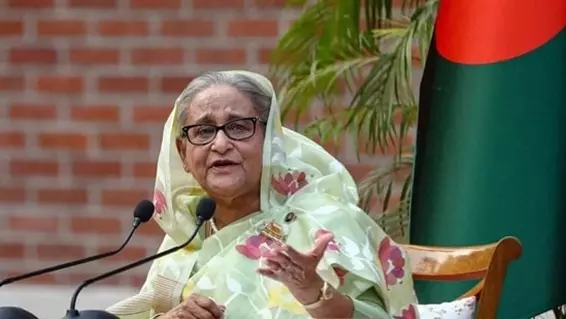
Sheikh Hasina indicted by Bangladesh ICT in enforced disappearances case
Bangladesh tribunal indicts Sheikh Hasina, former RAB officers over enforced disappearances during the Awami League regime

Former Bangladesh Prime Minister Sheikh Hasina, along with 16 other accused, were indicted by the International Crimes Tribunal in a crime against humanity case over allegations of enforced disappearances during the Awami League regime on Tuesday (December 22).
10 of the accused from RAB
According to a report in the Daily Star, out of the 17 accused, 10 are former Rapid Action Battalion (Rab) officers from the army. The accused also includes Hasina's former defence and security adviser, Major General (retd) Tarique Ahmed Siddique.
Also Read: Hindu man's killing: Protest erupts outside Bangladesh mission in Delhi
The report further stated that before the charges were framed, the tribunal asked the accused who were present whether they pleaded guilty, following which all 10 ten stood up and pleaded not guilty.
According to Daily Star, the officers are Brig Gen Md Qamrul Hasan, Brig Gen Tofayel Mostafa Sarwar, Brig Gen Md Mahbub Alam, Brig Gen Md Jahangir Alam, Col AKM Azad, Col Abdullah Al Momen, Col Md Sarwar Bin Kashem, Col Anowar Latif Khan, Lt Col Md Moshiur Rahman Jewel, and Lt Col Md Saiful Islam Sumon.
Hasina’s ‘witch hunt’ jibe
The International Crimes Tribunal (ICT) of Bangladesh had last month convicted Sheikh Hasina and sentenced her to death, finding her guilty of "crimes against humanity" for her efforts to suppress the July 2024 anti-government protests.
Also Read: Bangladesh media under attack, editors say ‘right to stay alive’ at risk
Sheikh Hasina has said that the verdict of the International Crimes Tribunal (ICT) was not a judicial exercise but a political one, describing it as a "political assassination in judicial robes."
In an interview with ANI, she said she was denied the right to defend herself and to appoint lawyers of her choice, alleging that the tribunal had been used to conduct a "witch hunt of the Awami League."
Slams Yunus govt
Despite the allegations, Hasina said her trust in Bangladesh's constitutional framework remains intact.
"Our constitutional tradition is strong, and when legitimate governance is restored and our judiciary regains its independence, justice will prevail," she said.
Also Read: Bangladesh suspends visa services for Indians due to 'unavoidable circumstances'
Against this backdrop of legal action and recent violence, Hasina accused the interim administration headed by Chief Adviser Muhammad Yunus of lacking democratic legitimacy and driving the country toward instability by weakening institutions and empowering extremist elements.
Criticizes ban on Awami League
She also questioned the credibility of elections scheduled for February, citing the continued ban on the Awami League.
"An election without the Awami League is not an election, but a coronation," she said, alleging that Yunus is governing "without a single vote from the Bangladeshi people" while attempting to bar a party that has won nine national mandates.
Also Read: Osman Hadi murder: Inqilab Moncho threatens Yunus interim govt with ouster
Hasina warned that voter participation historically collapses when people are denied the option to vote for their preferred party, leading to widespread disenfranchisement.
Any administration formed under such circumstances, she said, would lack moral authority and squander an opportunity for genuine national reconciliation.
The ICT verdict, she said, has also triggered demands for her extradition, which she dismissed as coming from "an increasingly desperate and adrift Yunus administration," while others recognise the proceedings as a politically driven "kangaroo tribunal."
Thanks India
She expressed gratitude for India's continued hospitality and the support extended by political parties across India. Explaining her exit from Bangladesh, Hasina said she left to prevent further bloodshed and not because she feared accountability.
Also Read: Bangladesh unrest: Student leader shot in Khulna ahead of elections
Placing developments within a regional context, Hasina addressed the worsening of India-Bangladesh relations, including Dhaka's decision to summon the Indian envoy.
She blamed the interim administration for issuing hostile statements against India, failing to protect religious minorities and allowing extremists to influence foreign policy.