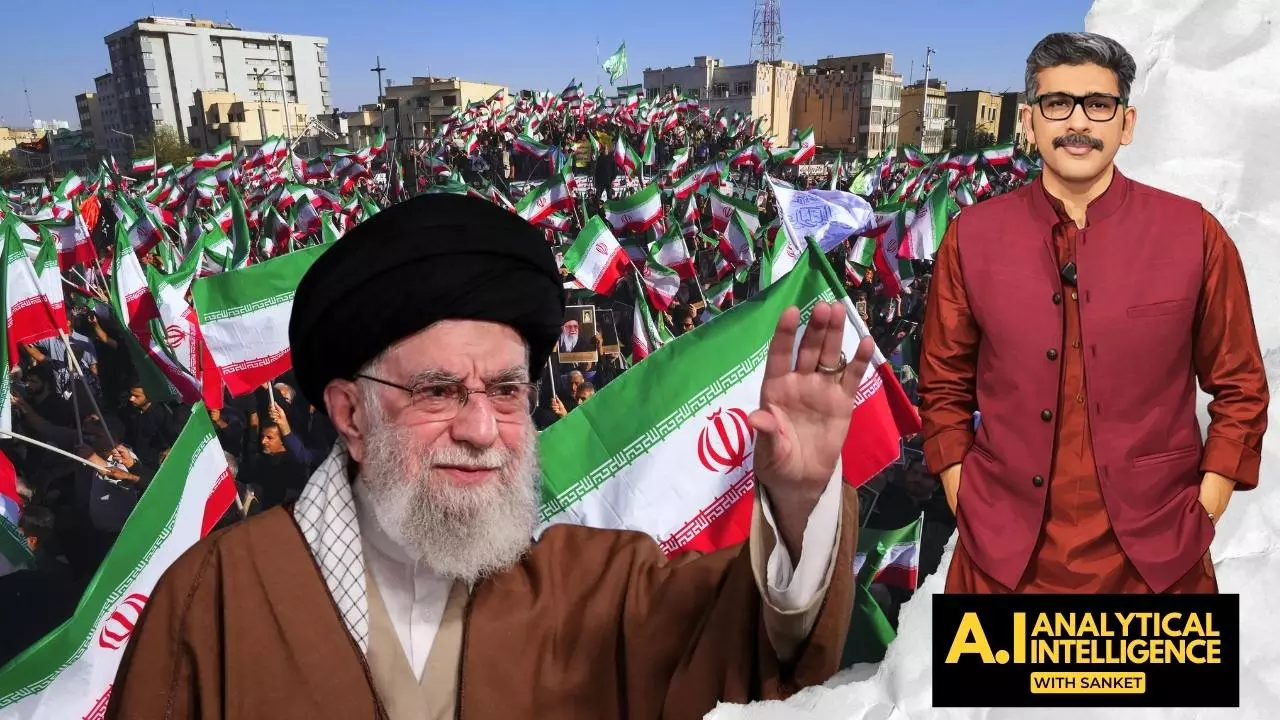
Iran after Khamenei and its possible impact on the world | AI With Sanket
As tensions surge in West Asia after the killing of Khamenei, we debate whether this signals a regime change in Iran or the start of a wider regional conflict

As tensions soar in West Asia following US and Israel's join military attacks on Iran and the assassination of Iran's Supreme Leader Ayatollah Ali Khamenei, the question of regime change has come sharply into focus.
In this episode of AI With Sanket, The Federal spoke to Dr Khinevirad Jahangir, director and professor at the Centre for Israel Studies at OP Jindal Global University, and award-winning investigative journalist Dr Wael Awad on whether this moment marks the beginning of the end for Iran’s post-1979 Islamic system — or the start of a broader regional war.
Roots of hostility
Dr Jahangir described the conflict as “an old war and a new battle”, tracing tensions between Iran, the United States, and Israel back to the 1979 Islamic Revolution. Until then, Iran under the Shah had maintained diplomatic relations with both Washington and Tel Aviv.
Follow our Live coverage of the West Asia crisis Day 3 here
According to him, the revolution fundamentally altered Iran’s ideological orientation. “Iran rejected the idea of the state of Israel after the Shia revolution,” he said, adding that anti-Americanism became embedded in Tehran’s regional posture.
He argued that the US saw the 1979 revolution as a strategic loss, having lost the Shah, a key ally. From that point on, Iran perceived America as a “counter-revolutionary external actor,” cementing decades of animosity.
October 2023 trigger
The more immediate trigger, Dr Jahangir suggested, lies in the fallout from October 7, 2023. He noted that Iran’s support for Hamas and its backing of anti-Israel resistance movements heightened direct confrontation.
“Iran not only extended its full support to Hamas but also showed its support to what happened on October 7,” he said. For Israel, that marked a “moment of no backing off.”
Also read: Is the US-Israel strike on Iran reshaping West Asia, and how should India respond?
He added that with Hezbollah weakened and domestic unrest simmering inside Iran over the past three years, Israel saw a strategic opportunity. “This is the weakest point Iranian Revolutionary Guards have come to since 1979,” he said.
Khamenei question
Would the death of Khamenei end the Islamic regime? Dr Jahangir was cautious. “It may not,” he said, stressing that two factors would determine the outcome — the strength of domestic protest movements and the sustainability of American pressure.
He argued that the US would be constrained by domestic politics, particularly if Donald Trump seeks to preserve his “America First” image. “America doesn’t have much liberty of continuing this war beyond four to six weeks,” he said.
Ultimately, he suggested that the decisive factor would be internal. “It will depend on the domestic actors in Iran to take it from there,” he said, warning that a civil war scenario could not be ruled out.
Reform or radicalism?
On whether Khamenei’s death might empower moderates, Dr Jahangir was sceptical. He contended that so-called reformists within Iran operate within the framework of the Shia revolutionary ideology.
Also read: Why did Iran bomb its neighbours? Do Dubai, Abu Dhabi have US military bases?
“Nothing is moderate within the Iranian system that has been in place since 1979,” he said, arguing that genuine reform would require a fundamental rethinking of the role of Sharia law in governance.
He contrasted post-1979 Iran with the pre-revolutionary era, recalling that before 1979, the state was not driven by clerical authority. “There was a separation of church and state kind of arrangement,” he said, adding that many Iranians remember that period fondly.
Return to monarchy?
The possibility of restoring the monarchy under Reza Pahlavi was also debated. Dr Jahangir acknowledged that Iran’s 1950s history included democratic elements such as the Majlis, a parliamentary system.
He revisited the 1953 coup against Prime Minister Mohammad Musaddiq, who had nationalised Iran’s oil industry. While Western intervention played a role, he argued that Iran’s post-1979 misfortunes could not be attributed solely to foreign interference.
“The revolution of 1979 was a mass revolution against corruption and nepotism,” he said, asserting that the clergy “hijacked” a movement that initially focused on economic grievances rather than establishing a Shia theocratic state.
Regime change policy
Dr Awad offered a sharply different perspective. He framed the current offensive as part of a longstanding American “regime change by force” doctrine.
Also read: Iran is not Libya, Iraq, or Syria; regime change won't happen the West's way'
He cited examples including Afghanistan, Iraq, Libya, and Syria, arguing that Iran has long been a target since the 1979 revolution. “The regime change policy is a saga which continues with American foreign policy,” he said.
In his view, Israel’s regional security doctrine following October 7 aims to dismantle adversarial states across the region. “Iran is the only castle left in the region defending against Israeli expansion,” he claimed.
Legitimacy debate
Dr Awad described the attacks as illegal and illegitimate under international law. He insisted that Iran’s retaliation was defensive and warned of a widening regional conflict.
“This is no more a limited war against Iran,” he said, arguing that US bases in the Gulf could become targets and that escalation would draw in multiple actors.
He rejected the characterisation of Iran as weak, noting that despite economic sanctions and protests over the years, the government has endured. “When it comes to an attack by a foreign power, nobody wanted foreign intervention in their affairs,” he said.
Public support
Pointing to mass gatherings marking the revolution’s anniversary, Dr Awad argued that the regime retains substantial public backing. “You cannot mobilise millions without ground support,” he said.
Also read: Saudi’s Ras Tanura refinery shut down after Iran drone attack; oil prices surge
He warned that regime change efforts could destabilise not only Iran but global energy markets. With Iran central to oil corridors and trade routes, escalation could impact India, China, Japan, and South Korea.
“It’s a global war America is fighting to control the passage and oil resources,” he said, suggesting broader geopolitical motives, including countering BRICS and de-dollarisation trends.
Can Iran endure?
Asked directly whether Iran would “fold like Venezuela”, Dr Awad was emphatic. “Iran is not a small cakewalk,” he said, asserting that Tehran is prepared for a prolonged confrontation.
He maintained that Iran would “fight till the end,” cautioning that American casualties could shift US domestic opinion.
Also read: West Asia conflict: India’s edible oil imports, agri exports under threat
The panel ultimately revealed two sharply contrasting visions: one viewing Iran’s internal fragility as a potential tipping point for regime transformation, the other seeing external aggression as likely to consolidate national unity and trigger a broader regional confrontation.
As the situation unfolds, the durability of Iran’s post-1979 system — and the stability of West Asia — hangs in the balance.
(The content above has been transcribed from video using a fine-tuned AI model. To ensure accuracy, quality, and editorial integrity, we employ a Human-In-The-Loop (HITL) process. While AI assists in creating the initial draft, our experienced editorial team carefully reviews, edits, and refines the content before publication. At The Federal, we combine the efficiency of AI with the expertise of human editors to deliver reliable and insightful journalism.)