







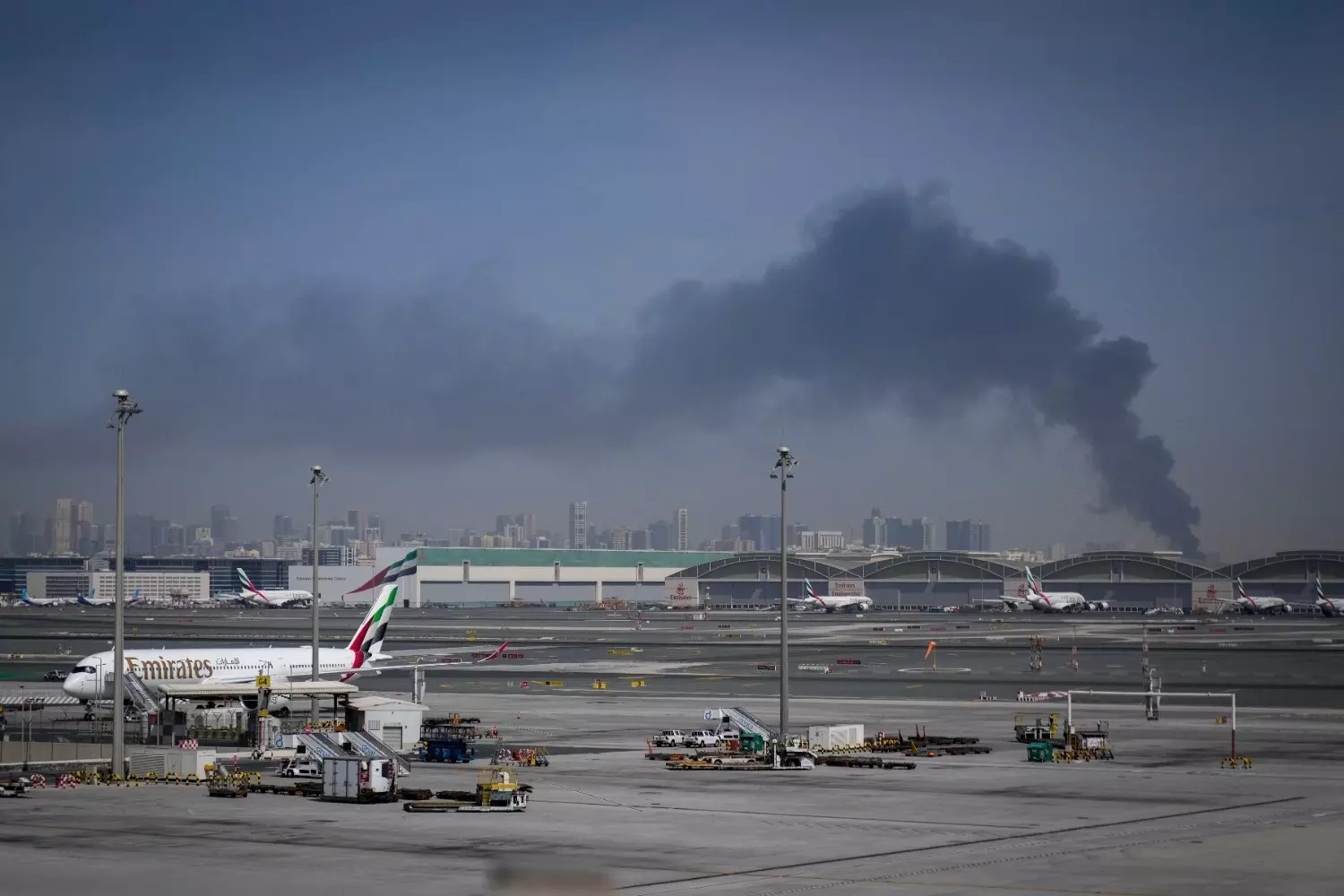
Emirates aeroplanes are parked at the Dubai International Airport after its closure in Dubai, United Arab Emirates, on March 1, 2026, amid heavy retaliatory strikes by Iran against attacks by Israel and the US. Photo: AP/PTI
Why did Iran bomb its neighbours? Do Dubai, Abu Dhabi have US military bases?
Fulfilling its warning, Tehran launches massive retaliatory attacks on US military bases in the Gulf region, giving Washington a clear signal

A month before Israel and the US launched a fierce military attack on Iran, which saw the death of its supreme leader, Ali Khamenei, Iranian Foreign Minister Abbas Araghchi had warned that if Washington chose to hit Tehran, it would go after America’s myriad military bases in the Middle East.
Follow Live updates on Middle East conflict
That the warning was no hollow threat became evident after the joint strikes began on Saturday (February 28), with Iran launching retaliatory strikes across several Gulf states, including, among others, Bahrain, Jordan, Kuwait, Qatar and Iraq, all of which are home to US military sites.
The attacks and counterattacks were not restricted to the first day either, as Tehran resumed targeting the US bases on Sunday (March 1). Explosions were heard for the second day in major cities such as Dubai, Doha and Manama, with even Oman, traditionally neutral, complaining of drone attacks on its port and an oil tanker. Even Dubai, a major commercial hub in the Middle East, did not escape Iran’s wrath, with some of its landmarks getting hit, although it doesn’t have a formal American military base.
'Your war not with your neighbours'
Following the missile strikes, a top diplomat of the UAE asked Tehran to return to its senses and warned that its act was only isolating itself. “Your war is not with your neighbours,” Anwar Gargash, diplomatic adviser to the president of the Gulf nation, said.
Also read: Billions of dollars at risk as Dubai airport shuts down amid Iran missile threats
It was not surprising to see Iran using the option of targeting American bases in the region close to its borders, as it not only gives a message back to a powerful enemy but also shocks the regional allies that allow it to have a foothold. Among the US bases that Iran attacked are the Al Udeid Air Base in Qatar, Al Salem Air Base in Kuwait, Al Dhafra Air Base in the UAE, and the US Fifth Fleet base in Bahrain, according to the Iranian media.
Here are the United States' major military bases in the Gulf region, many of which have been targeted by Iran in retaliation against the attacks by Israeli and American forces on February 28, 2026.
The US’s military presence in the Gulf is a cornerstone of global geopolitics, built over decades of shifting alliances and economic necessity. While it often looks like a permanent fixture, it actually evolved through three distinct phases — energy security, regional containment, and counterterrorism.
Here we take a brief look at the various military bases that the US has in the Gulf:
Qatar:
The Al Udeid Air Base, covering an area of 24 hectares and located in the desert near the national capital of Doha, serves as the forward headquarters for US Central Command. It oversees American military operations across a region that extends from Egypt to Kazakhstan. It is the largest US base in the Middle East, accommodating approximately 10,000 troops.
Bahrain:
The tiny island nation serves as the headquarters for the US Navy's Fifth Fleet, which is responsible for the Gulf, Red Sea, Arabian Sea, and certain regions of the Indian Ocean.
Also read: War on Iran delivers a body blow to already battered Indian airlines
Kuwait:
Multiple military facilities encompass Camp Arifjan, which is the forward headquarters for US Army Central, and the Ali Al Salem Air Base, located approximately 40 kilometres from the border of Iraq and referred to as "The Rock" due to its remote and rugged terrain. Camp Buehring was founded during the Iraq War in 2003 and functions as a staging area for US Army units preparing to deploy to Iraq and Syria, as stated on the US Army website.
UAE:
The Al Dhafra Air Base, located to the south of Abu Dhabi, the capital of the UAE, and utilised in conjunction with the UAE Air Force, serves as a vital hub for American air power. It has played a significant role in missions targeting the Islamic State and has facilitated reconnaissance operations throughout the region, as stated by the US Air Force Central Command.
Dubai's Jebel Ali Port, on the other hand, is officially not designated as a military base, but is still recognised as the largest port of call for the US Navy in the Middle East, frequently accommodating American aircraft carriers and various other naval vessels.
Jordan:
Situated in Azraq, 100 kilometres northeast of the capital city of Amman, the Muwaffaq al Salti Air Base accommodates the US Air Forces Central's 332nd Air Expeditionary Wing, which conducts operations throughout the Levant, as stated in a 2024 report by the Library of Congress.
Saudi Arabia:
US military personnel in Saudi Arabia, totalling 2,321 in 2024 as stated in a White House letter, collaborate with the Saudi Arabian government to deliver air and missile defence capabilities while also assisting in the operation of American military aircraft.
Also read: A beginner's guide to the US-Israel war with Iran
Some troops are positioned approximately 60 kilometres south of Riyadh, at Prince Sultan Air Base, which facilitates US Army resources, including Patriot missile systems and Terminal High Altitude Area Defense systems.
Iraq:
The US has a presence at Ain Al Asad Air Base located in western Iraq’s Anbar province, where it supports Iraqi security forces and contributes to the NATO mission, as stated by the White House.
Located in the semi-autonomous Kurdistan Region of northern Iraq, Erbil Air Base functions as a central hub for US and coalition forces engaged in training and battle drills. This base bolsters U.S. military operations by offering a secure environment for training, intelligence sharing, and logistical coordination in northern Iraq, as per a congressional report.