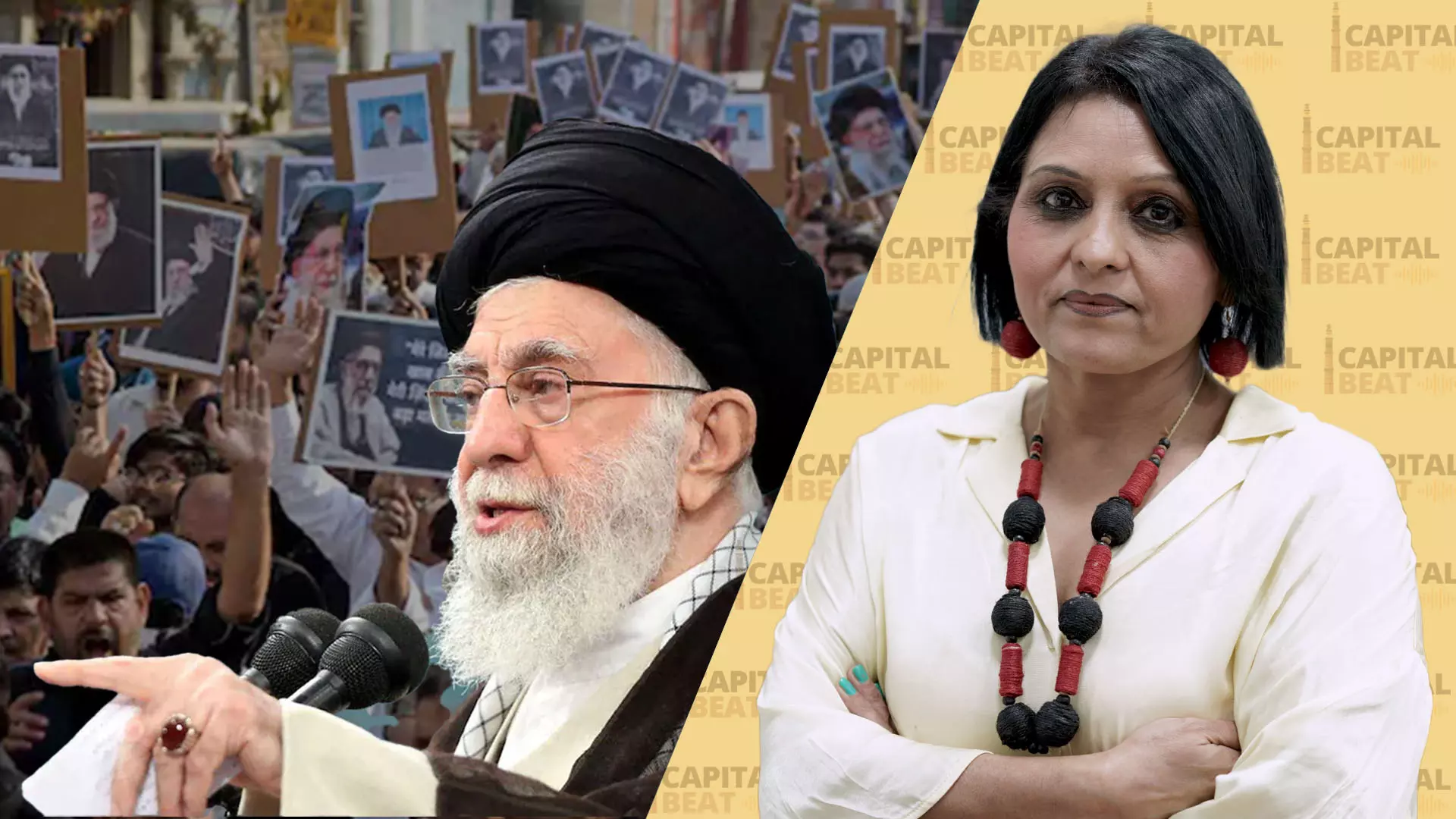
top iranian leader died
Is the US-Israel strike on Iran reshaping West Asia, and how should India respond?
Experts on Capital Beat debate regime change politics, oil shock risks, diaspora safety and India’s diplomatic balancing act after Khamenei’s killing triggers regional escalation

“This is perhaps the 67th or 68th regime change that the Americans have undertaken,” said former ambassador Anil Trigunayat, calling the killing of Iran’s Supreme Leader Ayatollah Ali Khamenei part of a long-standing US foreign policy pattern.
As tensions explode across West Asia following coordinated US-Israel strikes and Iran’s retaliatory attacks, India finds itself balancing moral positioning, strategic interests, and the safety of nearly 10 million Indians in the Gulf. In this episode of Capital Beat, The Federal spoke to former ambassador Anil Trigunayat, international affairs expert and veteran journalist Sanjay Kapoor, and policy expert Pushparaj Deshpande to unpack the escalating crisis and India’s calibrated response.
Regime change playbook
Ambassador Trigunayat said it was “too soon” to expect any mitigation of tensions. “The Americans from the very beginning have been planning for this kind of a regime change, and that is their common foreign policy agenda everywhere,” he said, adding that those who follow the region “knew that this was going to happen.”
He pointed to the earlier 12-day war in June, which followed six rounds of negotiations. “While negotiations were ongoing, we saw the Israelis striking. They always work in tandem. It was a matter of when, not if,” he said.
According to him, Israel’s “decapitation strategy” — earlier used against Hezbollah and Hamas — has proven effective. “Last time also, they wanted to take out Khamenei, but President Donald Trump told them not to. This time, they were able to convince him,” he said.
Trump’s gamble
Asked whether Trump was “biting more than he can chew,” especially with US midterm elections due, Trigunayat said technically the war is illegal without Congressional approval.
“He will have to go back to Congress, especially if body bags go back to the United States,” he said. However, he added that Trump “has proven that no country at this stage has the capacity to contain him.”
“He knows he has nothing much to lose. He has two years more. Whatever happens in the next Congressional elections might put a brake on him, but that is something to be seen,” he said.
For India, however, the bigger question lies elsewhere. “What happens in the Middle East is existential for us. We are heavily dependent on the region,” he said, referring to energy supplies and diaspora concerns.
India’s balancing act
India’s Ministry of External Affairs issued a statement expressing deep concern and urging restraint, dialogue, and respect for sovereignty and territorial integrity.
Trigunayat defended the calibrated wording. “Instead of naming everyone, the statement reiterates our consistent position. Sovereignty must be respected. That applies to Iran, and also when Iran attacks Gulf countries,” he said.
India, he stressed, must prioritise national interest. “We have about 10 million people in the region. Their welfare is of utmost importance. If the Strait of Hormuz is closed, navigation will be disrupted, energy security will be impacted, and prices will skyrocket.”
He added that diplomacy is ongoing. “External Affairs Minister S Jaishankar has spoken to all counterparts — Iranian, Israeli and others. That is what diplomacy is about.”
Oil shock fears
Kapoor warned that markets could react sharply as trading resumes. “There will be a crisis undoubtedly,” he said, pointing to contingency planning around alternative crude supplies.
He said India may rely more on Venezuela, Angola and Nigeria, especially as purchases from Russia have declined. “Oil purchases from Russia dropped from 36.3% in the last quarter of 2025 to 9% in January 2026,” Deshpande later added.
Kapoor cautioned that Venezuelan crude is “sticky” and requires refinery adjustments. “It will be a very expensive energy regime in the coming days,” he said.
Moral position debate
Kapoor disagreed with the government’s muted tone. “India could have taken a moral stand. Sovereignty has been violated most wantonly by the United States and Israel. India should have been strong enough to say that,” he argued.
He warned that India would not like “a situation where the entire control of the Middle East is taken over by Israel.”
Deshpande went further, arguing that India’s global credibility is at stake. “It was critical for India to reaffirm its commitment to the rules-based world order, mandated by Article 51 of our Constitution and the UN Charter,” he said.
He described the targeted killing of leadership in a sovereign country as “a disturbing revival of coercive unilateralism and regime change doctrines.”
“If external powers claim authority to engineer regime change, what stops them from doing so in our neighbourhood?” he asked.
Modi visit controversy
Deshpande criticised Prime Minister Narendra Modi’s recent visit to Israel, calling it “ill-timed.”
“This risks conveying alignment and endorsement of an incumbent government in Israel on the eve of national elections,” he said, referring to Prime Minister Benjamin Netanyahu’s political situation.
He argued that diplomacy should not blur into perceived partisan endorsement, drawing parallels with Modi’s 2019 Houston rally in the US. “If you are going to say we want peace and dialogue, you should not have gone there at this juncture,” he said.
United Nations' limits
On the United Nations’ apparent ineffectiveness, Trigunayat said the problem lies with the permanent five members’ veto power.
“You blame the tool rather than those holding the tool,” he said. “When anything goes to the Security Council, the US, UK or France will veto it. Russia and China will make noises. That’s it.”
He emphasised realism. “We are living in unusual times with one hyperpower acting and getting away with it. You may have laws, but who enforces them?”
Regional ripple effects
Protests have erupted in Karachi outside the US Consulate, with casualties reported. Trigunayat noted that Pakistan has a significant Shia population that reveres Khamenei.
However, he suggested Gulf states may not see similar unrest. “In Gulf countries, regimes are stronger. Also, Iran has attacked some of them. That alienates them and brings them closer to the US and Israel,” he said.
Kapoor added that within Iran, the picture is complex. “There is growing support for intervention because people were sick of the clergy. But they are not happy about external intervention either. They are nationalist,” he said.
He also noted reports of Iran declaring a 40-day mourning period, significant in Shia tradition, potentially mobilising public sentiment.
Diaspora safety
On the safety of Indians in the Gulf, Kapoor said, “I don’t think their safety is imperilled immediately. Many are in bomb shelters.”
Still, all three agreed that contingency planning is crucial. “The immediate priority is how we provide assistance if escalation intensifies,” Trigunayat said.
Grim outlook
As missile exchanges continue and US President Trump warns of unprecedented retaliation, the crisis appears far from resolution.
“There are more question marks than answers,” Kapoor said. “There is a great amount of death of morality taking place in the world, and that is worrisome.”
With oil markets poised to react, geopolitical alignments shifting, and domestic political debates intensifying, India’s tightrope walk between moral voice and strategic realism will be tested in the days ahead.
The content above has been transcribed from video using a fine-tuned AI model. To ensure accuracy, quality, and editorial integrity, we employ a Human-In-The-Loop (HITL) process. While AI assists in creating the initial draft, our experienced editorial team carefully reviews, edits, and refines the content before publication. At The Federal, we combine the efficiency of AI with the expertise of human editors to deliver reliable and insightful journalism.