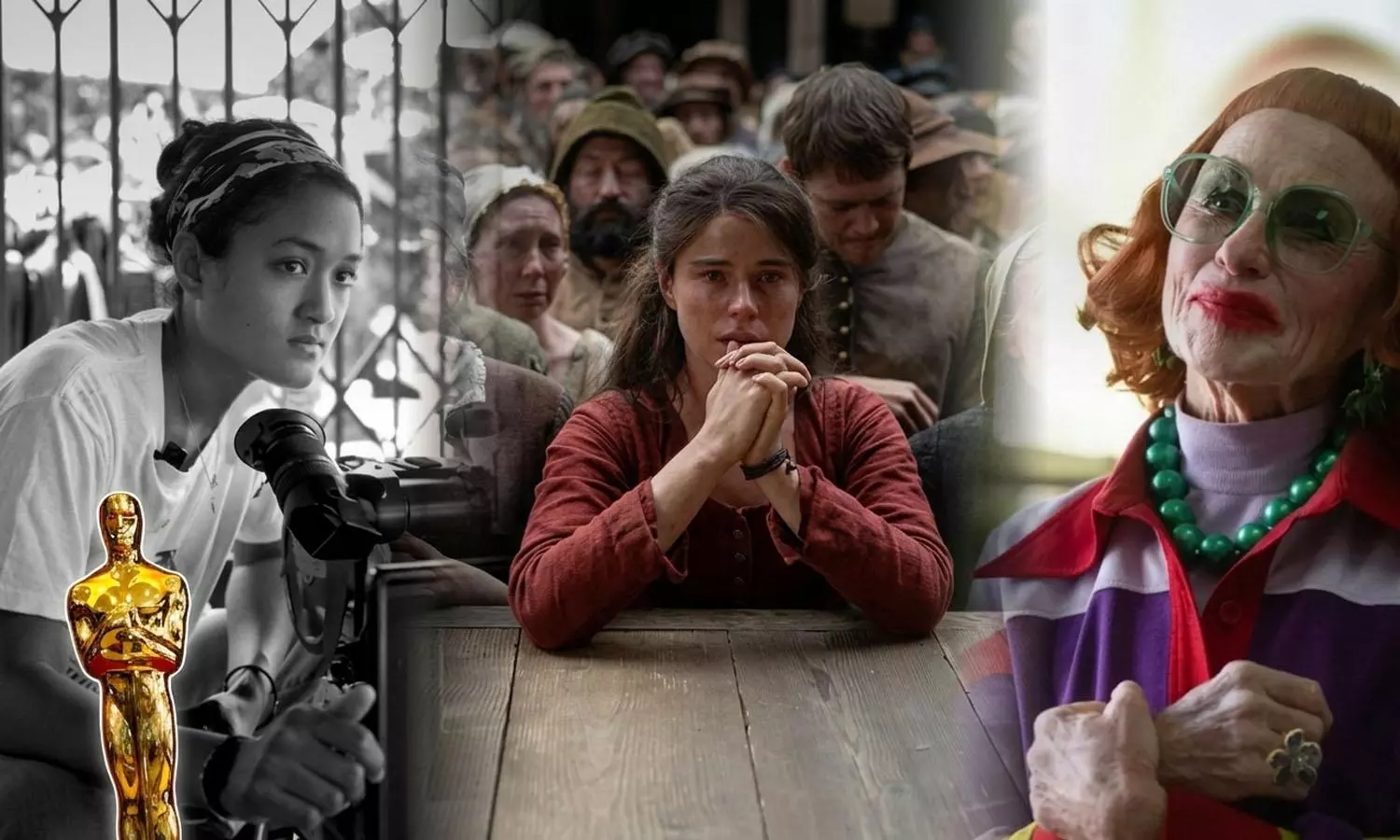
Are women’s stories finally taking centre stage in cinema?
Film critic Aseem Chhabra discusses complex female characters, historic wins by women at the Oscars, and why Hollywood remains largely male-dominated

As the 98th Academy Awards (Oscars) highlighted powerful female characters and historic achievements by women in filmmaking, The Federal spoke to Chhabra about evolving portrayals of women in cinema, the significance of women working behind the camera, and whether Hollywood is truly changing. Excerpts:
Do films like Hamnet, which centre on women’s inner lives, signal a broader shift in cinema storytelling?
I would not read too much into it and say this is a trend that will happen every year. What I find fascinating is that this film was directed by a woman, Chloé Zhao. This is probably her fourth or fifth film and she has already won an Oscar for Best Director.
Also read: Oscars 2026: Big wins, surprises and historic moments explained
The film is based on a novel written by a woman, and Jesse Buckley’s performance is brilliant. What makes it interesting is that the studios also recognised that the main character in the film is Agnes, Buckley’s character. She was promoted for Best Actress.
Paul Mescal, who played William Shakespeare and was also brilliant, was promoted as a supporting actor. If he had been nominated, it would have been in the Best Supporting Actor category.
So clearly it was a very woman-centric film. The story is focused on Agnes because she carries the emotional burden of the child’s death while her husband is away. She is the one who handles everything. It is a very woman-focused story.
Even though I would not call it a trend, it is fascinating that sometimes stories are told where the woman is completely at the centre and the man becomes a secondary character.
Over the past few years, films like Poor Things, Anatomy of a Fall, and now Hamnet have centred on complex female protagonists. Do you see a deeper shift in how women are written today?
Yes, I think there are clearly more well-defined, three-dimensional characters of women today. These characters have flaws, warmth, goodness and contradictions. That makes them much more real.
Earlier, especially in many Hindi films, you would see weeping mothers or stereotypical portrayals. There was not much complexity.
Also read: How Oscar-winner Jessie Buckley draws Shakespeare’s wife out of the shadows in Hamnet
Anatomy of a Fall is a great example. In that film we are never completely sure whether the protagonist may have pushed her husband. She has also had relationships outside her marriage and she is very open about it, including a lesbian relationship.
Similarly, in Poor Things, Yorgos Lanthimos created a character that is entirely centred on a woman. Emma Stone’s character goes through many situations where you cannot easily judge whether her actions are good or bad.
She is not a pure white character. There are shades of grey and even black in her personality. That kind of writing is very good and much more interesting.
Amy Madigan’s performance in Weapons stood out this year. Do you think the industry is opening up to stronger roles for older actresses?
You have to remember that Amy Madigan has been acting since around 1981. That is about 45 years in the industry. She has delivered very consistent performances and had one Oscar nomination earlier in the 1980s but had never won.
I am very glad this role was given to her. It is an extremely negative role.
I heard a commentator say that the last time a negative character won an Oscar was in Rosemary’s Baby. Ruth Gordon, who played the creepy neighbour, won the Best Supporting Actress Oscar.
Also read: Bugonia won no Oscars, but expertly examines the fragile boundary between reason and paranoia
I loved Weapons. It was terrifying and hilarious. Madigan’s character is extremely creepy and very unsettling. The power she has in the story and the way the children ultimately rip her apart is one of the most satisfying moments in the film.
What I also appreciate is that an actress of her stature was willing to take that risk. Many actresses might say they do not want to appear with a bald look or play such a creepy, horrible character. But she did it and performed brilliantly.
It also shows that roles for older actresses are being written and that actors are willing to embrace them.
Horror films like Weapons and Sinners also received recognition this year. Does that signal a shift in the Academy’s preferences?
Yes, because traditionally the Academy has not taken horror films very seriously. They often consider them entertainment but not on par with serious dramas.
Projects like Hamnet are usually what the Academy prefers.
Also read: From PTA's first win to K-pop glory, Oscars 2026 rewrites the record books
But this year, films like Sinners and Weapons were very popular and made a lot of money as well. Seeing entertaining films and horror films getting recognition is a very good sign.
The Oscar win for cinematographer Autumn Durald Arkapaw was historic. What does it mean for women behind the camera?
Cinematography has always been a very male-dominated field. When you hear the names of great cinematographers, they are almost always men.
Autumn Durald Arkapaw has been working in the industry for some time. She is also a woman of colour with Filipino roots. That makes her achievement even more significant.
Also read: Why the 2026 Academy Awards look set to be a two-film race for the ‘Big Five’
When she went up to accept the award, she asked all the women in the audience to stand up. That reminded me of the moment when Frances McDormand won for Three Billboards Outside Ebbing, Missouri.
At that time, McDormand asked all the nominated women in the audience to stand. She even called out Meryl Streep to stand up first. Then she told people in the industry to remember these women and hire them in the future.
It was a powerful moment, and Arkapaw’s gesture felt similar.
When a woman shapes the visual language of a film as cinematographer, does it change how stories are told?
I am not sure I can answer that fully because cinematography is such a technical job.
But I can say that Sinners is beautifully shot. There is a remarkable musical and dance sequence in the middle of the film where the camera moves fluidly between characters and captures the history of Black Africans, Chinese Americans and other immigrant communities.
It is one of the most impressive sequences I have seen. I would love to watch it again just to study how it was shot.
Also read: Oscars 2026: ‘One Battle After Another’ wins the Oscar race
Can I say that only a woman could have shot it that way? I am not sure. Cinematography is technical craft.
If a woman writes the story or directs it, then I can clearly say there is a woman’s perspective. But cinematography is slightly different.
So does gender influence technical roles in filmmaking?
Take editing for example. Thelma Schoonmaker has edited almost all of Martin Scorsese’s films. She won an Oscar for Raging Bull and several others.
Raging Bull is an extremely brutal and violent film. If you look at the storyboard and the editing style, it is intense and bloody.
Yet Schoonmaker executed it brilliantly. She works very closely with Scorsese, and they have known each other since their days at New York University.
So is it because she is a woman, or because they have a creative connection? I think it is the latter.
Similarly, in the case of Sinners, the director and cinematographer probably developed a strong creative understanding.
But the fact that a woman can walk into a field dominated by men and perform at the same level or even better is fantastic.
Looking at the Oscars this year, do you see meaningful change or just isolated moments for women in cinema?
I still think these are exceptions.
If you look at the history of the Oscars, how many women have won Best Director?
Kathryn Bigelow was the first woman to win for The Hurt Locker. Interestingly, her ex-husband James Cameron was nominated the same year for Avatar.
Avatar was a massive project, but Bigelow won with a much smaller film.
Also read: How Ryan Coogler’s Sinners, with 16 Oscar nods, marks a turning point for Black-led cinema
Chloé Zhao also won for Nomadland. The director of Barbie was nominated but did not win.
Women are more often nominated in categories like writing, costume design and production design. Music score, for example, is still largely dominated by men.
There are many areas of filmmaking where women rarely receive recognition.
The fact that among five Best Director nominees this year only one was a woman tells you a lot.
The industry is slowly changing. There are brilliant women directors making outstanding films.
Kathryn Bigelow, for instance, has made very powerful films such as Zero Dark Thirty, which is about the hunt for Osama bin Laden. Many might assume that such a story requires a male director, but she proved otherwise.
She can make very strong, masculine films, yet also bring a certain gentleness and nuance to the storytelling.
(The content above has been transcribed from video using a fine-tuned AI model. To ensure accuracy, quality, and editorial integrity, we employ a Human-In-The-Loop (HITL) process. While AI assists in creating the initial draft, our experienced editorial team carefully reviews, edits, and refines the content before publication. At The Federal, we combine the efficiency of AI with the expertise of human editors to deliver reliable and insightful journalism.)