



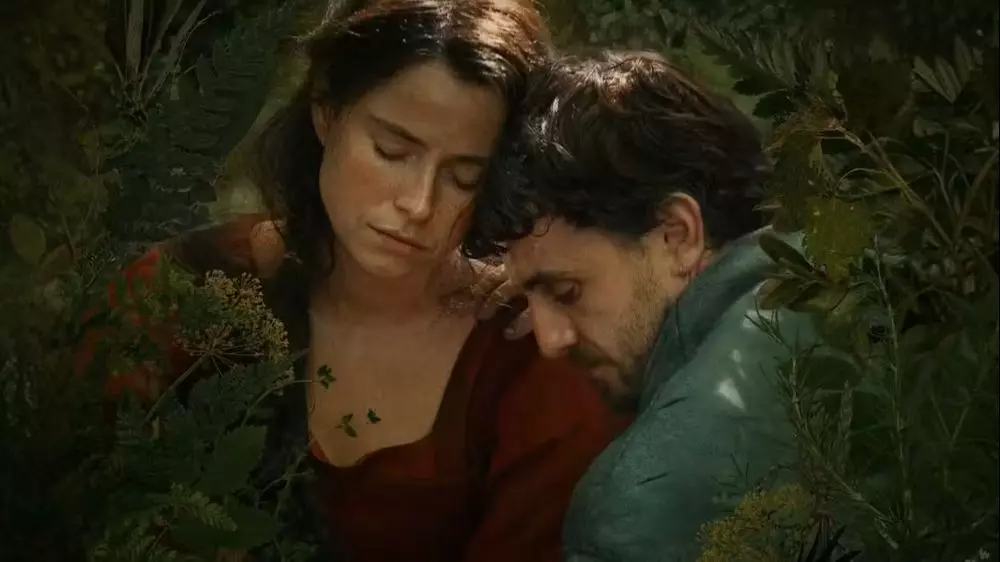
Jessie Buckley and Paul Mescal in Hamnet.
How Oscar-winner Jessie Buckley draws Shakespeare’s wife out of the shadows in Hamnet
The first Irish actress to win Best Actress Oscar, Buckley has been praised for the uncompromising energy she brings to the role of the 16th century woman often alleged to be someone who held the bard back. Hamnet portrayal counters this narrative.

When Jessie Buckley won the 2026 Oscar for Best Actress, she made history, becoming the first Irish actress to win the award.
The recognition, however, seems inevitable. Buckey, who won the Academy Award for her intense, immersive portrayal of Agnes Shakespeare in Hamnet, nudges this historical figure from the shadows into the spotlight. Touted as the definitive talent of her generation, the 35-year-old has received repeated praise for the uncompromising energy she brings to the role of the 16th century woman — a strong, gifted healer and a falconer, inextricably tied to the forest she often inhabits.
Hamnet tracks Shakespeare’s (played by Paul Mescal) courtship of Agnes, their marriage and the sudden death of their 11-year-old son, to the birth of Shakespeare’s powerful play, Hamlet. Critics have praised Buckley for her raw visceral energy, for her ability to portray a quiet strength, raw emotionality, profound vulnerability, and her "unarmed" acting style.
Also read: Bugonia won no Oscars, but expertly examines the fragile boundary between reason and paranoia
What makes Buckley’s win laudable is that rather than playing a passive wife to the bard, she, along with the film’s woman director Chloé Zhao and author Maggie O’ Farrell (the film is an adaptation of her 2020 historical fiction Hamnet), turns Agnes into this free-spirited, intuitive, and complex individual, who exists as a "full story" unto herself. She serves as the anchor of the film, countering the traditional narrative that alleged she held Shakespeare back — a woman eight years older than him, who “trapped” him in a “shotgun marriage” by her pregnancy.
Though the credit goes to Maggie O’ Farrel for writing the character, Buckley rises to the task of portraying her with a deeply personal, instinctual act that captures both the quiet grief of losing a child and a fierce, unconventional strength.
Remembering Shakespeare’s wife
Historically known as Anne, but referred to as Agnes in her father's will and in O'Farrell's telling, Shakespeare’s wife has long been portrayed negatively by biographers — often as a burden or an obstacle in Shakespeare's life. But in Hamnet, she is reimagined as an introspective and almost mystical character, who has deep insights and is often found sleeping curled up upon tree roots. Instead of a woman who "trapped" Shakespeare into marriage, she is portrayed as a creative and resilient force in his life.
For centuries, it was believed that Shakespeare abandoned his wife in Stratford-upon-Avon while he sought fame in London. That Agnes was a woman he escaped from. In the film, however, Agnes is the one to insist that he move to London to pursue his ambitions.
Also read: How Joachim Trier’s Sentimental Value weaves poetry through small moments and fragile conversations
O'Farrell's presentation of the character echoes more recent findings about Shakespeare’s wife. In 2025, the discovery of a letter fragment suggests that Anne may have actually supported her husband and was involved in his financial life. Some scholars, like Germaine Greer, argue that she would have been quite a "catch" for the bard owing to her family's financially secure position. In fact, the couple stayed together until Shakespeare's death in 1616.
O’Farrell’s book also claims that Hamlet was born from the sorrow that envelops the couple after the death of their son. Both parents are unable to come to terms with the death of their son and in “Hamnet”, we see William intoning the famous “To be, or not to be” of Hamlet, while he hovers near the Thames at night, contemplating whether to fling himself in.
The writer gives Agnes a significant role in her husband's creative legacy. And Buckley’s portrayal has contributed in no small measure to pull up the character from the footnotes of history, turning a "literary ghost" into a "living pulse”.
Buckley reportedly build a deep, personal by keeping a diary and compiled a "scrapbook" of her own "dreams and inner self" while filming, allowing her to embody Agnes's inner life and feelings rather than just acting them. Her performance is marked by intense, quiet moments, with her facial expressions in the film's final act described as a masterclass.