Will AI summit deliver outcomes benefiting Global South? Why critics are sceptical
Meet spotlights AI’s potential for inclusion and innovation, but critics warn that centralised decision-making and corporate dominance may dilute real impact

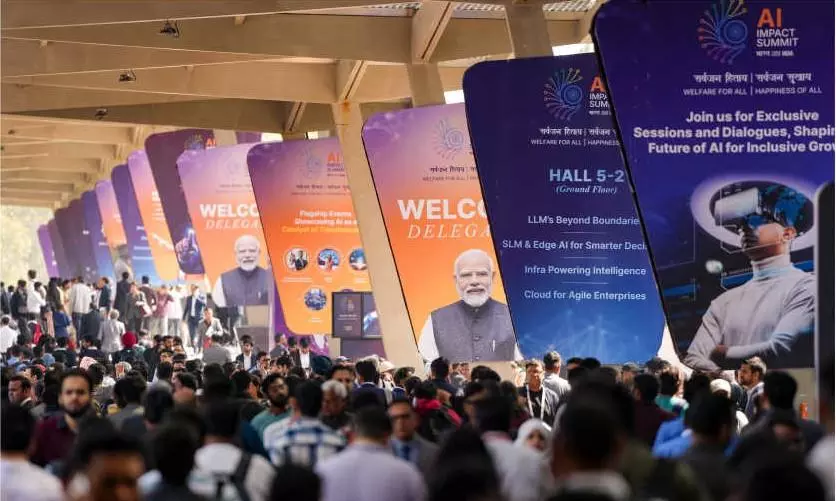
As the India AI Impact Summit began in Delhi on Monday (February 16), its very name signalled a shift, suggesting that artificial intelligence was moving beyond ambition and into tangible outcomes. Yet, as policymakers, founders, and researchers gather for the “historic” summit, the meaning of “impact” itself is under debate.
‘Summit’s primary value’
For MK Dutta, Director of the Amity Centre for Artificial Intelligence, the summit’s primary value lies in widening awareness and participation across society.
“The most important thing this will achieve is sensitisation of AI to all stakeholders across society, age groups, professions, and genders. When the government creates so much visibility around an event like this, acceptance and awareness naturally increase,” he told The Federal.
Also Read: AI Impact summit LIVE! India stands at the forefront of AI transformation, says PM Modi
He argued that the act of convening diverse actors is itself significant.
“In this way, different sectors, age groups, and genders have been given a chance to solve their problems through innovation. That is why I believe the word ‘impact’ is appropriate here. Bringing all stakeholders together is in itself a major impact,” he said.
‘India needs to build guardrails’
Urvashi Aneja, founder and executive editor of Digital Futures Lab – which works on the ethics and governance of technology – agrees that centring impact is timely, but cautions against equating visibility with results.
“I think the focus on impact is important, especially at a time when there is a lot of speculation about whether the AI hype cycle we’re in is going to deliver on its promise. This is particularly relevant for governments in the Global South who are already investing heavily in AI to help leapfrog development and address pressing socioeconomic issues. But there’s a risk that the word ‘impact’ gets used synonymously with diffusion or adoption,” she said.
Also Read: India AI Impact Summit 2026 begins in New Delhi from today: All you need to know
“Diffusion or adoption won’t necessarily mean that the impact has been positive… If India wants to follow through on the impact question, it needs to invest in evaluations of AI systems and build guardrails to ensure they are safe. It also needs to align incentives and take a hard look at where AI is actually needed, rather than assuming it is the solution to everything. There’s a long journey from the language of impact to actual impact on the ground,” she told The Federal.
‘Affordability, access are central concerns’
Beyond the language of impact, affordability and access remain central concerns. Dutta notes that without deliberate intervention, AI risks becoming the preserve of large corporations.
“Our country’s needs are diverse, and unless AI becomes affordable, it will remain limited to those at the higher end. Right now, AI is a costly business, without access to infrastructure like supercomputers, smaller players cannot participate. If you are not a big company, you will not be able to use AI at scale. So there must be an ecosystem where MSMEs and startups that do not have large funds can enter AI. This summit will facilitate that by creating opportunities and connections,” he said.
Also Read: A hollow obsession with data-centre proliferation
He also sees the summit as a space where capital and ideas intersect.
“What will happen in such a summit is matchmaking. There are thousands of panels and events, and innovators with ideas but no money can connect with venture capitalists and investors. It creates a pipeline where ideas can find funding,” he said.
‘Need for sustained investment’
From an academic standpoint, Khalid Raza of Jamia Millia Islamia’s Computer Science department, who works with and on AI, stresses that ambition must be backed by sustained investment.
“From a research and academic perspective, my primary consideration is centered on execution and sustainability. India has articulated a compelling vision for shaping the global AI agenda, and the opportunities are indeed immense. However, realizing this vision will require sustained and coordinated investment in critical areas such as high-performance computational (HPC) infrastructure, large-scale and high-quality dataset creation, and long-term strengthening of research capacity within academic and scientific institutions,” he said.
“Additionally, ensuring equitable access to AI infrastructure and research opportunities for academic institutions, startups, and researchers across diverse regions will be crucial in building a truly inclusive and innovation-driven ecosystem,” he said.
Wishlist of Summit outcomes
Raza expects concrete announcements in areas that strengthen both infrastructure and collaboration.
“I expect the summit to lead to meaningful announcements and initiatives in several key areas. These include expansion of national AI compute infrastructure, strengthening of research collaborations between academia, industry, and government, and enhanced international partnerships that promote responsible and inclusive AI development,” he said.
Also Read: AI Impact Summit: AI will create more jobs than it replaces, says MeitY secretary
“In particular, initiatives supporting public-sector AI deployment, open datasets, and accessible research infrastructure will be highly valuable in empowering researchers and institutions to contribute more actively to global AI innovation,” he added.
Raza said that if India could “successfully integrate its strong talent ecosystem, academic excellence, startup innovation, and digital public infrastructure into coordinated national AI programmes”, it had “the potential to establish a distinctive global model for applied and inclusive AI development”.
IFF criticises centralised decision-making
Yet the summit has also drawn sharp criticism from some quarters. Apar Gupta, founder director of the Internet Freedom Foundation (IFF), argued that decision-making power within the summit remains concentrated.
In a post on the IFF website, he wrote, “Official programming at the earlier summits in the series (Bletchley Park, Seoul, Paris) was compact by comparison to the India AI Summit, which is closer to a festival or large-scale exposition. While the summit intends to ‘democratise AI,’ an analysis of its 793 public events reveals the agenda-setting power rests with the government (including aligned technical and academic institutions) and large technology companies.”
Also Read: Feb 14 News Live: Nvidia CEO cancels visit to India AI Impact Summit
“Government bodies dominate programming with central (eg. MeitY, IndiaAI Mission, STPI) and state IT departments (Goa, Odisha, Telangana) involved in organising approximately 40 per cent of the sessions. Multinational corporations and industry associations command another 35 per cent. This list includes Big Tech and AI startups along with chambers of commerce that serve both as sponsors and the intellectual architects for this event,” he added.
‘No platform for civil society reps’
Gupta also pointed to what he sees as the absence of equivalent platforms for labour and civil society representatives.
“The corporate concentration is most visible in the ‘CEO Roundtable’ and ‘Leaders' Plenary,’ forums that, by their prominence, only throw into sharper relief the absence of any equivalent high-level platform for labour leaders, human rights defenders, or marginalised communities. There is no ‘Civil Society Plenary’ with comparable prestige or access to heads of state. Viewed critically, the summit's structure grants multinational corporations parity with sovereign governments, normalising a form of ‘multi-stakeholderism’ where AI companies negotiate any potential governance rules directly with states,” he said.
'Will Summit translate into meaningful change?'
He also questioned whether outcome documents would translate into meaningful change, describing the event as more of a spectacle.
“With Delhi hotel rooms touching USD 6,000 dollars a night, it is a reasonable forecast that the summit will prioritise the interests of power and profit, not only across the hundreds of panels and talks, but also in the deal making that will be done behind closed doors. This will be matched with a flurry of boastful digital content and news reporting on Modi, with leader and CEO-centric reels and photo moments,” wrote Gupta.
Also Read: Crossing Rs 4-5L a night: AI Impact Summit sends Delhi luxury-hotel fares soaring
“Recognising this reality does not discount the efforts of public officials, civil society, researchers, and academic experts who are participating earnestly to advocate for rights-respecting frameworks in AI. However, the very design of this summit and the overall context in which it is taking place may not value their intent or labour. Any claims of AI solving for population-scale problems must be matched against the reality of the Global South…” he wrote.