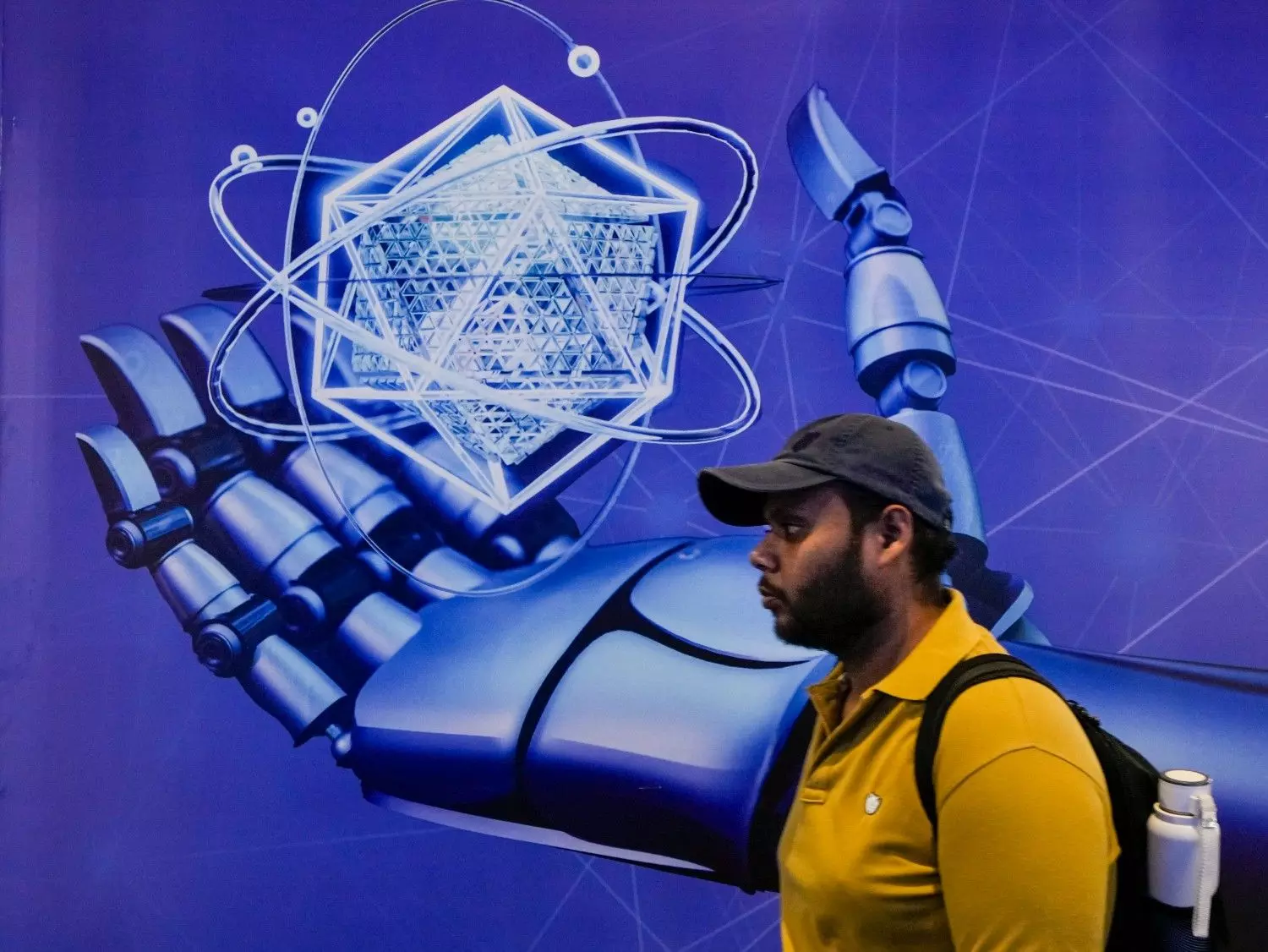
A visitor walks past a display panel featuring a robotic hand at the India AI Impact Summit 2026 at Bharat Mandapam in New Delhi on February 16, 2026. Photo: PTI
Storing foreign data in India is neither necessary nor sufficient to develop Indian AI, and is guaranteed to create power shortages and spread Delhi-like air pollution across the country
Ahead of the AI impact summit that India is hosting at present, Prime Minister Narendra Modi threw out an open invitation to the rest of the world to store their data in India.
As grand gestures go, this is pretty impressive. But as a means of developing Indian AI capability or generating sufficient power to fuel India’s economic growth without making Delhi’s winter-time pollution the generalised air quality standard for the country as a whole, that invitation is grossly misplaced.
Also read: Claude AI maker Anthropic launches Bengaluru office, bets big on India market
Will having a lot of data stored in India necessarily help India develop AI capability? This is like asking, does having the world’s largest population ensure that Indians have the highest standard of living in the world? After all, people produce wealth and income, so having lots of people should ensure a lot of wealth and income generation. But we know that India has 4.4 times the population of the United States, and yet, the US GDP is 7.5 times as large as India’s.
Storing world's data in India
Having the world’s data stored in India is neither necessary nor sufficient for India to develop AI capabilities. Let us look at the ‘sufficient’ part first.
Suppose some European countries realise that storing their data at home is a big bother, calling for largescale investment in electricity generation, making its availability stable in terms of supply and frequency, in the physical security of the data centres, and in constantly upgrading security software to keep the data hacker-proof, and decide to let India store the data in a data centre in India. Can India use that data to train its AI model under development?
Also read: Why Bengaluru could emerge as a major semiconductor hub
Absolutely not. The European Union (EU) allows data to be transferred to a country outside the bloc only if the country has a legal framework on data protection at least as strong as the EU’s own General Data Protection Regulation, and has a reputation for compliance with the regulation. Data would come to India, if it does, with ironclad guarantees against breach of data privacy and integrity.
Clearly, having foreign data stored locally is not sufficient, even from the limited perspective of data availability, to help Indian developers create a foundation model.
But data is necessary to build AI models. How do we ensure the availability of mass-scale data? India is one of the world’s largest generators of data, whether personal, engineering, financial, sporting, agricultural, wildlife or whatever other kind, and if that data can be accessed, that would be more than sufficient to meet any data requirement of AI model building.
Indian AI developers do not need access to foreign data to succeed in building a foundation model that can be used for a large language model.
Just because data is generated, it does not mean that the data will be available for model building. Millions of Indians wear a tracking/monitoring device that captures data on their exercise, pulse rate and so on. We have not devised a way to capture, store and process this data to proactively detect any impending adverse health event. Having lots of data centres housing foreigners’ data will do little to change this.
Also read: 'Excited about data centre capacity coming up in India': Microsoft CEO Satya Nadella
Do Indians need to develop a foundation model of their own? Why not simply use the proprietary or open-source models already in circulation, made available by companies from the US and China?
India doesn't need own AI models
India does need its own AI models. This is because AI is used not just in assorted businesses, but also for fortifying national security, including in deploying and controlling new military weapons systems. Consider swarms of drones numerous enough to get past enemy missiles and anti-aircraft batteries, controlled by AI.
AI is not located just in the cloud. Small chunks of extremely useful AI can be housed in embedded systems or other edge computing structures.
Consider a tank-hunting drone, which could well lose navigational and targeting assistance once the target’s jamming devices scramble the signals guiding the drone. Only edge computing on the drone can help it estimate the target’s location and make contact.
AI for strategic purposes cannot be built on foreign models, whether proprietary or open source. So-called open-source models can have backdoors baked into them or have safeguards against total customisation, especially for national security uses.
While Indian companies could well develop commercial AI applications built on open-source models borrowed from foreign countries, AI for national security would have to be developed at home. This would call for Indian data on which the AI can be trained, and Indian AI developers making use of the data.
However, even if data and development talent are available, the overriding constraint might well be the availability of high-end chips in large enough numbers.
Also read: Explained: What is Google’s new Project Suncatcher to build AI data centres in space?
This year’s Economic Survey has a chapter on AI, which examines various scenarios for India’s development of AI, and the availability of high-speed processing semiconductors comes across as a stumbling block in every one of them. High bandwidth memory chips would pose a similar problem.
China is close to overcoming such problems by developing its own chipmaking industries, with massive investment by private companies, the government and universities. But isn’t India already tackling this challenge by promising foreign chipmakers enormous subsidies, at least $10 billion, to set up chip-fabrication facilities in India?
The simple reality is that just because an advanced chip is manufactured in India, it does not mean that it will be available for local deployment. The national government that commands the allegiance of the company owning the intellectual property in the chips and chipmaking equipment could, for whatever reason, decide to weaponise access to that technology, and bar the company manufacturing the chips in India from supplying their output to Indian entities.
There is no substitute for India funding and developing advanced silicon using Indian talent and Indian resources. Having huge acreage under data centres will be of no help when it comes to overcoming this challenge.
Also read: AI Impact Summit: AI will create more jobs than it replaces, says MeitY secretary
Data centres are capital-intensive, not labour-intensive. Only during the construction of the buildings and their heat removal infrastructure would jobs be created. Sure, jobs would be generated in setting up the power plants needed to generate the gigawatts of power needed to run the data centres, and in mining the coal needed to fuel those power plants.
The requirement for power
India has no surplus power capacity. India does not even produce enough power to make electricity a clean fuel for cooking at home, ending dependence on imported hydrocarbons. And if India is serious about meeting its manufacturing aspirations, that would call for massive additions to electricity generation capacity to power that aspiration.
Also read: Govt tightens IT rules on AI, mandates 3-hour takedown deadline
If India depends on coal-burning power plants to power data centres — despite half the generation capacity being renewable, 70 per cent of the power generated comes from thermal plants — the air around the power plants would be suffused with incompletely burnt coal, carbon monoxide and carbon dioxide (thankfully, Indian coal has little sulphur). Winds would carry that pollution far and wide.
There is no rational basis for Indian policymakers’ current infatuation with data centres.
(The Federal seeks to present views and opinions from all sides of the spectrum. The information, ideas or opinions in the articles are of the author and do not necessarily reflect the views of The Federal.)